
 Worksheets
Physics 2 Review
Total questions: 84
Worksheet time: 1hrs 21mins
Name
Class
Date
1.
A device that increases or decreases the voltage of alternating current
a)
A. magnet
b)
B. magnetic pole
c)
C. transformer
d)
D. magnetic force
2.
The attraction or repulsion created by spinning electric charges
a)
A. electric generator
b)
B. magnetic force
c)
C. solenoid
d)
D. electromagnet
3.
One of two points, such as the ends of a magnet, that have opposing magnetic qualities
a)
A. magnetic pole
b)
B. magnetic force
c)
C. transformer
d)
D. electric generator
4.
A device that converts electrical energy into mechanical energy
a)
A. electromagnet
b)
B. electromagnetic induction
c)
C. electric motor
d)
D. electromagnetism
5.
The process of creating a current in a circuit by changing a magnetic field
a)
A. electric generator
b)
B. electric motor
c)
C. electromagnetic induction
d)
D. magnet
6.
The interaction between electricity and magnetism
a)
A. magnetic force
b)
B. electromagnetism
c)
C. electromagnet
d)
D. magnetic pole
7.
A device that converts mechanical energy into electrical energy
a)
A. electric generator
b)
B. electric motor
c)
C. electromagnetic induction
d)
D. electric generator
8.
A coil of wire with an electric current in it is called a(n)
a)
A. transformer.
b)
B. electric generator.
c)
C. electric motor.
d)
D. solenoid.
9.
As electrons move, they make
a)
A. electromagnetism.
b)
B. auroras.
c)
C. ferromagnetism.
d)
D. magnetic
fields.
10.
What is created when a wire moves between the poles of a magnet?
a)
A. a ferromagnet
b)
B. a solenoid
c)
C. an electromagnet
d)
D. an electric current
11.
A compass needle responds to a magnetic field, because the compass needle is a
a)
A. generator.
b)
B. motor.
c)
C. magnet.
d)
D. transformer.
12.
What is created when a magnet moves through a coil of wire?
a)
A. an
electromagnet
b)
B. a ferromagnet
c)
C. a
solenoid
d)
D. an
electric current
13.
What uses an electromagnet to measure electric current?
a)
A. armature
b)
B. commutator
c)
C. galvanometer
d)
D. solenoid
14.
A coil of wire that has a soft iron core and that acts as a magnet when an electric current is in the coil is called a(n)
a)
A. temporary
magnet.
b)
B. permanent
magnet.
c)
C. electromagnet
d)
D. ferromagnet.
15.
Increasing the electric current in the wire is one way to
a)
A. strengthen
a solenoid’s magnetic field.
b)
B. make
an electromagnet become a solenoid.
c)
C. make
a solenoid become an electromagnet.
d)
D. weaken
a solenoid’s magnetic field.
16.
Which of the following are two effects of Earth’s magnetic field?
a)
A. compass
points to geographic north, auroras seen at both poles
b)
B. compass
points to magnetic north, auroras seen at both poles
c)
C. compass
points to geographic south, auroras seen at the equator
d)
D. compass points to geographic north, auroras seen
at the equator
17.
Increasing the number of loops per meter in the coils of a solenoid is one way to
a)
A. increase the wire’s electric current
b)
B. strengthen the solenoid’s magnetic field.
c)
C. decrease the wire’s
electric current.
d)
D. weaken the solenoid’s magnetic field.
18.
What can you make visible by sprinkling iron filings around a magnet?
a)
A. the areas called domains
b)
B. the magnetic forces
c)
C. the north and south poles
d)
D. the magnetic field lines
19.
What do we call the the amount of force exerted on a certain area?
a)
fluid
b)
pressure
c)
buoyant
20.
When pressure is applied to a confined fluid, the increase in pressure is transmitted equally to all parts of the fluid. This fact is called________.
a)
Pascal's Principle
b)
Newton's Principle
c)
Archimedes' Principle
d)
Bernoulli's Principle
21.

Water pressure increases as depth increases.
a)
True
b)
False
22.

Hydraulic pressure in machines takes advantage of what principal?
a)
Pascal's Principal
b)
Newton's Principal
c)
Water Principal
23.
Liquids take the same ________ and _________ as their container.
a)
shape and size
b)
shape and volume
c)
size and color
d)
size and temperature
24.
This is a measurement of the amount of matter, or 'stuff', in an object or substance.
a)
volume
b)
density
c)
mass
d)
length
25.
What was the principle Archimedes discovered?
a)
Volume
b)
Density
c)
Buoyancy
d)
Gravity
26.

The upward force exerted by a fluid is called the...
a)
buoyancy force
b)
air force
c)
fluidity principal
d)
Harry Potter's law
27.

Buoyancy is the tendency for objects to float in a fluid. Buoyancy pushes the opposite direction of...
a)
waves push.
b)
magnetic pull.
c)
the wind.
d)
gravity's pull
28.
Thermodynamics is the study of what?
a)
The transfer of energy
b)
The creation of energy
c)
The speed of reactions
d)
The affect of heat on the speed of a reaction
29.
Temperature is a measure of the...
a)
total energy in a substance
b)
total kinetic energy in a substance
c)
average potential energy in a substance
d)
average kinetic energy of molecules in a substance
30.

A substance with a high specific heat:
a)
Is always extremely hot.
b)
Requires a lot of energy to become hot.
c)
Is not heavy.
d)
Does not requires a lot of energy to become hot.
31.
The transfer of thermal energy between objects of different temperatures is called...
a)
temperature
b)
heat
c)
internal energy
d)
none of these
32.
What quantity of heat is required to raise the temperature of 450 grams of water from 15°C to 85°C? The specific heat capacity of water is 4.18 J/g/°C.
a)
131670 J
b)
159885 J
c)
-131670
d)
none of the above
33.
The amount of heat required to raise the temperature of 1g of something by 1 C, is called what?
a)
Latent Heat
b)
Specific Heat
c)
Heat of Formation
d)
Heat of Fusion
34.
The amount of heat needed to melt one mole of a substance is called:
a)
Specific Heat
b)
Latent Heat
c)
Heat of vaporization
d)
Heat of fusion
35.
What is enthalpy?
a)
A measurement of chaos
b)
The heat content of a system
36.
What is entropy?
a)
A measurement of chaos
b)
The heat content of a system
37.
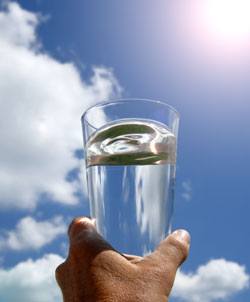
The temperature of a glass of cold water will eventually...
a)
Match the temperature of the surrounding environment.
b)
Always be colder than the surrounding environment.
c)
Become warmer than the surrounding environment.
d)
Never change temperature.
38.

Total entropy increases over time.
a)
True
b)
False
39.
Heat is measured in
a)
joules
b)
grams
c)
degrees celcius
40.
The Law of _______________ states that energy cannot be created nor destroyed only transferred
a)
Specific Heat
b)
Conservation of Energy
c)
Exothermic Reaction
d)
Potential Energy
41.
Energy in exothermic reactions are
a)
released
b)
absorbed
42.
The __________ law of thermodynamics states that entropy is always increasing.
a)
first
b)
second
c)
third
d)
zeroth
43.
Heat transfer [blank] occurs from hot to cold.
a)
always
b)
never
c)
sometimes
d)
rarely
44.
Which phase of matter has the greatest motion and least orderly arrangement?
a)
solid
b)
liquid
c)
gas
45.
Which of the following is not a primary color of light?
a)
Blue
b)
Red
c)
Yellow
d)
Green
46.
We see objects because light is refracted from them?
a)
True
b)
False
47.
The color of light is determined by _______ of the light waves?
a)
the medium
b)
the frequency
c)
the amplitude
d)
the speed
48.
If the angle between the incident ray and reflected is 30 degrees, what is the angle of incidence?
a)
60 degrees
b)
25 degrees
c)
15 degrees
d)
30 degrees
49.
What is the period of a 45 Hz electromagnetic wave?
a)
1.35 x 10¹⁰ seconds
b)
2.2 x 10⁻² seconds
c)
3.7 x 10⁻³ seconds
d)
8.7 x 10⁻⁶ seconds
50.
An object is located 30 cm from a convex lens. The lens forms a real image at a distance of 20 cm. What is the focal length of this lens?
a)
13.5 cm
b)
0.0833 cm
c)
12.0 cm
d)
8.7 cm
51.
A concave lens converges light rays to form real images?
a)
True
b)
False
52.
Radio rays with a 1800 m wavelength are sent out from a transmitter. What is their frequency?
a)
5.4 x 10¹¹
b)
2.3 x 10⁻⁸
c)
6.0 x 10⁻⁶
d)
1.7 x 10⁵ Hz
53.
During a physics lab, a plastic strip was rubbed with cotton and became positively charged. The correct explanation for why the plastic strip becomes positively charged is that ...
a)
the plastic strip acquired extra protons from the cotton.
b)
the plastic strip acquired extra protons from the charging process
c)
protons were created as the result of the charging process
d)
the plastic strip lost electrons to the cotton during the charging process
54.
Insulators are different than conductors in that insulators ____.
a)
do not contain electrons or protons
b)
do not contain any charge
c)
have a weaker affinity for electrons
d)
do not allow charge to freely move
55.

Consider the conduction charging shown.
a)
Electrons move from the insulating stand into the sphere.
b)
Protons move from the bar into the sphere.
c)
Electrons move from the charged metal bar into the sphere.
d)
Protons move from the sphere into the negatively charged bar.
56.
A glass rod becomes positively charged when it is rubbed with silk. This net positive charge accumulates because the glass rod
a)
gains electrons
b)
loses electrons
c)
gains protons
d)
loses protons
57.
A balloon is rubbed against a student's hair and then touched to a wall. The balloon sticks to the wall due to
a)
magnetic forces between the particles of the balloon and the particles of the wall
b)
electrostatic forces between the particles of the balloon and the particles of the wall
c)
magnetic forces between the particles of the wall
d)
electrostatic forces between the particles of the balloon
58.
A negatively charged plastic comb is brought close to, but does not touch, a small piece of paper. If the comb and the paper are attracted to each other, the charge on the paper
a)
must be positive
b)
must be negative
c)
may be neutral or negative
d)
may be neutral or positive
59.
Two electrically charged identical-sized metal spheres, A (charge of -4) and B (charge of +8). If the spheres are brought into contact, which sphere will have a net gain of electrons?
a)
both A and B
b)
neither
c)
only A
d)
only B
60.
When a plastic rod is rubbed with wool, the wool acquires a positive charge because
a)
protons are transferred from the wool to the rod
b)
protons are transferred from the rod to the wool
c)
electrons are transferred from the rod to the wool
d)
electrons are transferred from the wool to the rod
61.

Two electrically neutral metal spheres, A and B, on insulating stands are placed in contact with each other. A negatively charged rod is brought near, but does not touch the spheres, as shown in the diagram below. How are the spheres now charged?
a)
A is positive and B is positive.
b)
A is negative and B is positive.
c)
A is positive and B is negative.
d)
A is negative and B is negative.
62.
Mass and energy are interrelated and this is shown with Einstein's equation, E=mc2.
a)
True
b)
False
63.

The diagram shows a circuit involving a photoelectric cell. When UV light is shone onto the metal cathode, electrons are emitted establishing a photocurrent.
Which of the following changes could cause the photocurrent to stop?
Which of the following changes could cause the photocurrent to stop?
a)
Increasing the potential difference of the power supply.
b)
Increasing the frequency of the UV light.
c)
Increasing the intensity of the UV light.
d)
Changing the metal surface to one with a smaller work function.
64.
Light of a single wavelength is incident on a metal. Electrons are released. The intensity of the light is then increased.
Which of the following changes occur?
Which of the following changes occur?
a)
Rate of electron emission: increase.
Energy of electrons: increase.
Energy of electrons: increase.
b)
Rate of electron emission: decrease.
Energy of electrons: no change.
Energy of electrons: no change.
c)
Rate of electron emission: decrease.
Energy of electrons: increase.
Energy of electrons: increase.
d)
Rate of electron emission: increase.
Energy of electrons: no change.
Energy of electrons: no change.
65.
The photoelectric effect only occurs if the light shining on the metal is:
a)
coherent.
b)
above a minimum intensity.
c)
above a minimum frequency.
d)
above a minimum wavelength.
66.

The graph shows maximum kinetic energy of emitted electrons against frequency of incident light for a number of different metals.
The work function is determined by:
The work function is determined by:
a)
the x-intercept.
b)
the y-intercept.
c)
the gradient.
d)
the area under the graph.
67.
The graph shows maximum kinetic energy of emitted electrons against frequency of incident light for a number of different metals.
The threshold frequency is determined by:
The threshold frequency is determined by:
a)
the x-intercept.
b)
the y-intercept.
c)
the gradient.
d)
the area under the graph.
68.
The following observations are made about the photoelectric effect:
1. No electrons are emitted below the threshold frequency.
2. Above the threshold frequency the energy of electrons depends on the frequency of the light.
3. Increasing intensity increases the number of emitted electrons.
Which (if any) of these observations can be explained by a wave theory of light?
1. No electrons are emitted below the threshold frequency.
2. Above the threshold frequency the energy of electrons depends on the frequency of the light.
3. Increasing intensity increases the number of emitted electrons.
Which (if any) of these observations can be explained by a wave theory of light?
a)
All of them.
b)
1 and 2 only.
c)
3 only.
d)
None of them.
69.
The photoelectric effect is when:
a)
Electrons collide inside a metal to release photons.
b)
One incident metal electron releases one photon.
c)
One incident photon releases one electron from a metal.
d)
Photons are absorbed in to metal ions releasing electrons.
70.
A region of influence surrounding an object is best defined as:
a)
An electric field
b)
A field
c)
A force
d)
A gravitational field
71.
The electric field surrounding a positively charged object is
a)
Away from the charge
b)
Toward the charge
72.
What quantity remains the same everywhere between two parallel plates?
a)
Electric Field
b)
Electric Potential
c)
Electric Potential Energy
d)
Speed
73.
In a parallel circuit, if one connection is broken, all of the connections stop working.
a)
True
b)
False
74.
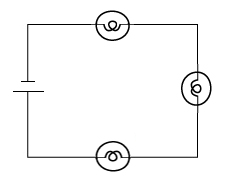
The picture shows an electrical circuit. This circuit is a series circuit because:
a)
It has 3 light bulbs.
b)
The same current flows through all three light bulbs.
c)
It uses a single battery.
d)
The electrical current is divided between the three light bulbs.
75.
In a parallel circuit if one light bulb goes OUT; then they ALL go out. TRUE OR FALSE?
a)
TRUE
b)
FALSE
76.
Which best describes a parallel circuit?
a)
Electricity flows along one pathway.
b)
The flow of electricity comes from more than one source.
c)
Electricity flows along more than one pathway.
d)
The flow of electricity comes from more than 1 load.
77.
A closed circuit allows charges to flow.
a)
True
b)
False
78.
In a Series circuit the more lightbulbs you add the brighter they get
a)
False
b)
True
79.

In Circuit A, what will happen if bulb B burns out?
a)
Both bulb A and bulb C will go out.
b)
Bulb A will stay lit, but bulb C will go out.
c)
Bulb A and bulb C will stay lit.
d)
Bulb A will go out, but bulb C will stay lit.
80.

In Circuit A, the current at location 1 is _____ the current at location 2.
a)
greater than
b)
equal to
c)
less than
81.

Which bulb burning out would mean that no current could flow through the circuit?
a)
A
b)
B
c)
C
d)
D
82.

Dr. Fankenschnitzel builds the circuit shown, but can’t get the bulbs to light. What must he change in the circuit for all of the bulbs to light?
a)
Add a battery
b)
Open the switch
c)
Close the switch
d)
Reverse the battery
83.

This graph represents Ohm's Law. Based on this graph, resistance is equal to
a)
current divided by voltage.
b)
voltage times current.
c)
voltage divided by current.
d)
voltage divided by time.
84.

Ohm’s law proves which of the following statements must be true?
a)
as voltage increases, current increases.
b)
as voltage increases, current decreases.
c)
as resistance increases, current increases.
d)
as resistance decreases, current decreases.
100 %

