
 Worksheets
Energy Transfers, States of Matter, and Particle Motion
Total questions: 82
Worksheet time: 2hrs 20mins
Hot coffee is stirred with a spoon, the spoon gets hot due to...
Convection
Radiation
Conduction
A chair is placed several feet from a fire in a fireplace. The fireplace has a glass screen. The side of the chair facing the fireplace gets warm because of...
Convection
Radiation
Conduction
A certain type of decorative lamp contains colored liquids. These liquids form globs that break off and rise to the top of the liquid. The globs rise due to...
Convection
Radiation
Conduction
Near the ceiling of a room the air is warmer. The warm air rises because of...
Convection
Radiation
Conduction
A college student holds the back of his hand near an iron to see if it is hot. Heat is transferred to his hand by...
Convection
Radiation
Conduction
A heater is placed under one corner of a water bed mattress. Warm water moves throughout he mattress because of..
Convection
Radiation
Conduction
A certain type of stainless steel cookware has a layer of copper applied to the bottom to help it heat evenly. The copper transfers heat to the pan by...
Convection
Radiation
Conduction
In a swimming pool, the water near the surface is slightly warmer. The warm water rises because of...
Convection
Radiation
Conduction
A house burns down. On the house across the street, all of the vinyl siding is twisted and warped by the heat. The heat was transferred across the street by...
Convection
Radiation
Conduction
One end of a copper rod is placed in a flame of a Bunsen burner. Small pieces of wax placed along the rod melt at progressively larger distance from the flame. Heat is transferred through the rod by...
Convection
Radiation
Conduction
Warm air over the beach rises while cooler dense air from the ocean rushes in due to...
Convection
Radiation
Conduction
The metal skewer gets so hot that you drop your marshmallow in the campfire because of...
Convection
Radiation
Conduction
A huge rock at the state park gets so hot during the day that you can’t sit on it from...
Convection
Radiation
Conduction
You lay on that same rock at night so that you can keep warm by...
Convection
Radiation
Conduction
A fireman feels a door and it is hot from the fire on the other side due to...
Convection
Radiation
Conduction
The cause of weather systems on earth is...
Convection
Radiation
Conduction
You are in the top bunk of a bunk bed and you want to turn the air conditioner on while your friend on the bottom bunk is fine is caused by...
Convection
Radiation
Conduction

The transfer of energy through molecules in direct contact is ...
Heat
Conduction
Convection
Radiation


As you touch a hot stove the heat transfers -
from your hand to the stove by conduction.
from the stove to your hand by conduction.
from your hand to the stove by radiation.
from the stove to your hand by radiation.
Which sentence explains why a cold metal spoon placed in a pot of boiling water becomes hot?
Thermal energy is transferred from the spoon to the water by conduction
Thermal energy is transferred from the water to the spoon by conduction.
Thermal energy in the water is transformed into kinetic energy in the spoon by convection.
Thermal energy in the spoon is transformed into kinetic energy in the water by convection.


True or False?
Heat and temperature are different.
True
False
As thermal energy increases, kinetic energy also...
Increases
Decreases
Remains the same

What tool is used to measure temperature?
a stove
a beaker
a thermometer
a glove
Metal objects heat up more slowly than plastic or wooden objects?
True
False


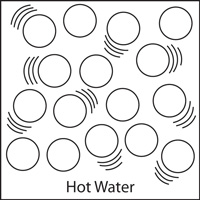
Which particles have the highest temperature?
A
B
C
What physical quantity is a measure of the average kinetic energy of particles in a substance?
Temperature
Heat
Convection
Which physical quantity is equal to the total sum of kinetic energy of all particles in a substance?
Temperature
Heat
Conduction

Which mode of heat transfer is shown in this example?
Conduction
Convection
Radiation

Which mode of heat energy transfer is shown in this example?
Conduction
Convection
Radiation

Which mode of heat energy transfer is shown in this example?
Conduction
Convection
Radiation

Do we need to supply high heat for evaporation of water to happen?
Yes, since evaporation cannot occur without significant heating.
No, because additional heating does not affect evaporation at all.
No, since evaporation will occur at room temperature anyway (but heating will speed up the process).
Another name for heat energy is:
kinetic energy.
spring energy.
thermal energy.
mechanical energy.
What are the units for measuring heat energy?
newtons
degrees Celsius
joules
degrees Fahrenheit
If you leave a cup of hot tea standing in the kitchen for a whole day, what will happen to its temperature?
It will stay the same
It will get only a little bit cooler.
It will end up the same temperature as the air in the kitchen.
It will be colder than the air in the kitchen

Molecules in cold things move more _________
than in hot things.
quickly
slowly
speedy
Rapidly

Cool air
rises
moves east
moves west
falls


As temperature rises ___________.
an atom's kinetic energy stays the same
an atom's kinetic energy increases
an atom's kinetic energy decreases
an atom's mass increases
Kinetic Energy means...
energy that a particle possesses by virtue of being in motion.
energy that a particle possesses by stored energy due to height.
energy stored in the bonds of chemical compounds.
radiant energy emitted by the sun
Which state of matter has defined volume but not shape?
Solid
Liquid
Gas
The stronger the attraction between molecules, the ______ the melting and boiling points.
Higher
Lower
Attraction does not effect melting and boiling points
What kind of energy is added to or removed from matter to cause a phase change?
Radiation
Thermal
Solar
Wind


state of matter that has a fixed volume BUT changes it's shape to fit the container
solid
liquid
gas
plasma
state of matter that has a fixed volume and a fixed shape
solid
liquid
gas
plasma
Convert 35⁰F to Celsius (5/9 x (0F - 32))
1.6⁰
1.7⁰C
2.0⁰
16.6⁰C
Convert 72⁰F to Celsius (5/9 x (0F - 32))
2.2⁰C
222⁰C
22.2⁰C
161.6⁰C
Which of the follow represents a normal body temperature of 98.6°F in °Celsius? 5/9 x (0F - 32)
37°C
370°C
72.5°C
72.6°C
100 Celsius is ? Kelvin (K = Celsius + 273)
173 K
373K
273 K
0 K
°C = (°F-32) x (5/9)
°F = (9/5) x °C + 32
Celsius = Kelvin - 273
Kelvin = Celsius + 273
Convert the temperature:
97 °C = _______ °F
97.3 °F
10.2 °F
206.6 °F
°C = (°F-32) x (5/9)
°F = (9/5) x °C + 32
Celsius = Kelvin - 273
Kelvin = Celsius + 273
Convert the temperature:
25 °F = _______ °C
-3.9 °C
-10 °C
13 °C
°C = (°F-32) x (5/9)
°F = (9/5) x °C + 32
Celsius = Kelvin - 273
Kelvin = Celsius + 273
Convert the temperature:
25 °C = _______ K
157.15 K
298.15 K
89.15 K

