
 Worksheets
PS M3 Extra Credit Test Review
Total questions: 89
Worksheet time: 2hrs 1mins
An object in motion at a constant velocity will change its motion only if a balanced force acts on it.
True
False
In a car crash, inertia could cause you to crash into the windshield.
True
False
The greater an object's mass, the weaker the gravitational force on it.
True
False
When a ball is dropped, it falls down due to the force of friction.
True
False
Pushing a box up a hill, you have to overcome static friction.
True
False
A box does not move when you push it because of static friction.
True
False
Forces that are equal in size but opposite in direction are called unbalanced forces.
True
False
Earth exerts an unbalanced force on a ball thrown into the air.
True
False
An object with a mass of 9.0 kg has an acceleration of 3 m/s². The force acting on it is (a) N.
When you push downward on Earth to make a pole vault, Earth exerts an equal force on the pole.
True
False
The acceleration of an object is always in the direction of the net force acting on it.
True
False
Inertia varies depending on __.
force
mass
velocity
motion
Newton's first law of motion is also called the law of __.
inertia
force
constant velocity
The upward force on an object falling through the air is __.
air resistance
inertia
momentum
terminal velocity
The relationship among mass, force, and acceleration is explained by __.
conservation of momentum
Newton's first law of motion
Newton's second law of motion
Newton's third law of motion
A feather will fall through the air more slowly than a brick because of ____.
air resistance
gravity
inertia
momentum
In the absence of air, a penny and a feather that are dropped from the same height at the same time will ____.
fall at different rates
fall at the same rate
float
not have momentum
The acceleration due to gravity is ____.
98 m/s²
9.8 m/s²
9.8 m/s
0.98 m/s
According to Newton's second law of motion, ____.
F = m × a
F = m × v
F = p × a
F = p × v
When an object moves in a circular path, it accelerates toward the center of the circle as a result of ____.
centripetal force
frictional force
gravitational force
momentum
For any object, the greater the force that's applied to it, the greater its ____ will be.
acceleration
gravity
inertia
velocity
The size of the gravitational force between two objects depends on their ____.
frictional forces
inertia
masses and the distance between them
speed and direction
As you get farther from the center of Earth, your weight will ____.
decrease
increase
remain the same
can't tell from information given
The statement "to every action there is an equal and opposite reaction" is ____.
the law of conservation of momentum
Newton's first law of motion
Newton's second law of motion
Newton's third law of motion
When two balls collide, the momentum of the balls after the collision is explained by ____.
the law of conservation of momentum
Newton's first law of motion
Newton's second law of motion
Newton's third law of motion
A 300-N force acts on a 25-kg object. The acceleration of the object is ____.
7500 m/s²
300 m/s²
25 m/s²
12 m/s²
A 3000-N force acts on a 200-kg object. The acceleration of the object is ____.
50 m/s²
26 m/s²
15 m/s²
150 m/s²
An object that is in free fall seems to be ____.
not moving
slowed by air resistance
speeded up by air resistance
weightless
When the drag force on an object falling through the air equals the force of gravity, the object has reached ________.
terminal force.
terminal acceleration.
terminal illness.
terminal velocity.
Forces that are equal in size but opposite in direction are ________.
balanced forces
frictional forces
inertial forces
net forces
Newton's first law of motion states that an object remains at rest unless a(n) ________ force acts on it.
balanced
frictional
gravitational
unbalanced
Air resistance ________ as you move faster.
increases
decreases
remains the same
eventually disappears
The force you have to overcome to start an object moving is ________.
rolling friction
static friction
sliding friction
air resistance
Whenever a body is in motion, there is always ________ to oppose the motion.
friction
inertia
gravity
acceleration
The upward force on an object falling through the air is ________.
air resistance
inertia
gravity
terminal velocity
The relationship among force, mass, and acceleration is stated in ____.
the law of conservation of momentum
Newton's first law of motion
Newton's second law of motion
Newton's third law of motion
A feather falls through the air more slowly than a brick because of ____.
gravity
air resistance
inertia
momentum
According to Newton's second law of motion, ____.
F = mv
F = m/a
a = Fnet/m
F = ma
A 3000-N force gives an object an acceleration of 15 m/s². The mass of the object is ____.
45,000 kg
150 kg
200 kg
15 kg
A 300-N force acts on a 25-kg object. The acceleration of the object is ____.
7500 m/s²
300 m/s²
25 m/s²
12 m/s²
The statement "for every action, there is an equal but opposite reaction" is a statement of ____.
the law of conservation of momentum
Newton's first law
Newton's second law
Newton's third law
When a diver jumps off a diving board, gravity pulls him or her down to the water. What is the reaction force to Earth's gravity?
The diver's legs push against the board.
Friction between the diver and water slows the diver.
Air resistance slows the diver.
The diver pulls Earth up.

According to the graph, over which segments is the car’s speed changing?
a & c
b & d
a & c & e
c & e
Which of the following is not a factor when determining how fast an object is moving when it is dropped off a building?
mass of object
material of object
air resistance of object
gravitational strength
If the forces acting on an object at rest are (a) , the object will remain at rest.
At the same speed, a bowling ball is harder to stop than a soccer ball because the bowling ball has greater (a) .
According to Newton's second law of motion, a larger force acting on an object causes a greater (a) of the object.
(a) friction is the friction between two surfaces that are not moving past each other.
A car slides on ice because it doesn't have enough (a) friction.
(a) is the tendency of an object to resist any change in its motion.
A(n) (a) is a push or pull that one object exerts on another.
Newton's first law of motion states that an object stays in constant motion unless a(n) (a) force acts on it.
Friction always acts in a direction (a) to the direction of motion.
According to Newton's second law of motion, a larger force acting on an object causes a greater (a) of that object.
If you triple the net force on an object, the acceleration will (a) .
Mike has a mass of 60 kg. He pulls on a wagon of mass 30 kg with a force of 20 N. The wagon remains motionless. The wagon exerts a force of (a) on Mike.
A rocket launching is an example of Newton's (a) law.
When you are in a car and rounding a level turn (a) allows you to turn as opposed to traveling in a straight line.
What is necessary for an object to accelerate?
If two equal forces act on an object in opposite directions, what is the net force? What is the acceleration?
Can an object be in motion if the net force acting on it is zero? Explain.
State Newton’s first law of motion.
If you are running and you stub your toe, you fall forward. Explain.
Why is it necessary to wear a seat belt to hold you in place if you are riding in a car that stops suddenly?
A book and a piece of paper, the same size, fall at different rates. How can you change the shape of the paper so it will fall at nearly the same rate as the book? Explain your answer.
Two objects that have the same mass are dropped from a tall building. One object is larger and flatter than the other. Explain why the larger, flatter object hits the ground last.
Explain how mass and weight are different from each other.
Why is your weight less on the Moon than on Earth, but your mass is the same?
What is weight?
A bowling ball hits some pins. Explain what happens to the momentum of the ball and the momentum of the pins.
The space shuttle moves into a higher orbit farther from Earth. Explain what happens to the gravitational force on the shuttle.
What causes friction?
You push on a crate with a force of 10 N to the right, and your friend pushes on the crate with a force of 25 N to the left. Describe and explain the motion of the crate.
Explain the motions of a hockey puck during a hockey game in terms of Newton's first law.
You push a heavy crate. At first it doesn't move. You push harder, and it finally starts to move, but you still have to exert some force to keep it moving at a constant velocity. Explain.
A book and a piece of paper the same size fall at different rates. How can you change the shape of the paper so that it will fall nearly as fast as the book?
Calculate the force on an object that has a mass of 12 kg and an acceleration of 4 m/s².
A car of mass 1330 kg is traveling at 28.0 m/s. The driver applies the brakes to bring the car to rest in 5.6 s. Calculate the force of the brakes on the car.
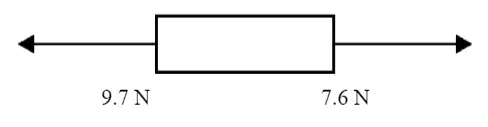
Two men pull a 31-kg box with forces 9.7 N and 7.6 N in the directions shown below. Find the acceleration of the box and the direction in which the box moves.
Two horizontal forces, 315 N and 145 N are applied to a sled resting on a frictionless skating rink. If they are applied in the same direction, what is the net horizontal force on the sled?
Two horizontal forces, 145 N and 315 N are applied to a sled resting on a frictionless skating rink. If they are applied in opposite directions, what is the net horizontal force on the sled?
An Eskimo pushes a loaded sled with a mass of 300 kg over the frictionless surface of hard-packed snow. He exerts a constant 170 N force as he does so. What is the sled’s acceleration?
A mouse pushes a piece of cheese with a mass of 6.4 g over the frictionless surface of an air hockey table. He exerts a constant 0.5 N force as he does so. What is the cheese’s acceleration?
If you have a mass of 80 kg and jump out of a plane, what must the force of the air resistance be in order for you to travel at terminal velocity?
Two students push a box across the ground while another student pushes on the box in the opposite direction. What is the force of friction? Each student pushes with a force of 50 N.
Balanced forces acting on an object cause the object to accelerate.
True
False
Gravity causes all falling objects to accelerate at a rate of 9.8 m/s².
True
False
What is Newton's second law of motion?
What is Newton's third law of motion?

