
 Worksheets
GCSE - what do you already know?
Total questions: 86
Worksheet time: 1hrs 28mins
What is the Equation for Weight?
Weight = Mass x Gravitational Field Strength
Weight = Mass / Gravitational Field Strength
Weight = Gravitational Field Strength / Mass
What is the Equation for Work Done?
Work Done = Force x Distance
Work Done = Force / Distance
Work Done = Distance / Force
What is the Equation for Force applied to a Spring?
Force applied to a Spring = Spring Constant x Extension
Force applied to a Spring = Spring Constant / Extension
Force applied to a Spring = Extension / Spring Constant
What is the Equation for a Moment of a Force?
Moment of a Force = Force x Distance
Moment of a Force = Force / Distance
Moment of a Force = Distance / Force
What is the Equation for Pressure?
Pressure = Force x Area of Surface
Pressure = Force / Area of Surface
Pressure = Area of Surface / Force
What is the Equation for Acceleration?
Acceleration = Change in Velocity x Time
Acceleration = Change in Velocity / Time
Acceleration = Time / Change in Velocity
What is the Equation for Resultant Force?
Resultant Force = Mass x Acceleration
Resultant Force = Mass / Acceleration
Resultant Force = Acceleration / Mass
What is the Equation for Momentum?
Momentum = Mass x Velocity
Momentum = Mass / Velocity
Momentum = Velocity / Mass
What is the Equation for Kinetic Energy?
Kinetic Energy = 0.5 x Mass x Speed²
Kinetic Energy = 0.5 x Mass² x Speed
Kinetic Energy = 0.5 x Mass² / Speed
What are Equations for Gravitational Potential Energy?
Gravitational Potential Energy = Mass x Gravitational Field Strength x Height
Gravitational Potential Energy = Weight x Height
Gravitational Potential Energy = Mass x Gravitational Field Strength / Height
Gravitational Potential Energy = Weight / Height
Which are the Equations for Power?
Power = Energy Transferred / Time
Power = Work Done / Time
Power = Energy Transferred x Time
Power = Work Done x Time
What is the Equation for Wave Speed?
Wave Speed = Wave Length x Frequency
Wave Speed = Wave Length / Frequency
Wave Speed = Frequency / Wave Length
What is the Equation for Charge Flow?
Charge Flow = Current x Time
Charge Flow = Current / Time
Charge Flow = Time / Current
What is another Equation for Power?
Power = Potential Difference x Current
Power = Potential Difference / Current
Power = Current / Potential Difference
What is another Equation for Power?
Power = Current² x Resistance
Power = Resistance² x Current
Power = Resistance² / Current
What are the Equations for Energy Transferred?
Energy Transferred = Power x Time
Energy Transferred = Power / Time
Energy Transferred = Charge Flow x Potential Difference
Energy Transferred = Charge Flow / Potential Difference
What is the equation that links gravitational field strength, mass and weight?
weight = mass x gravitational field strength
weight = mass ÷ gravitational field strength
weight = gravitational field strength ÷ mass
What is the equation that links distance, force and work done?
work done = force x distance
work done = force ÷ distance
work done = distance ÷ force
What is the equation that links extension, force applied to a spring and spring constant?
force applied to a spring = spring constant x extension
force applied to a spring = spring constant ÷ extension
force applied to a spring = extension ÷ spring constant
What is the equation that links distance, time and velocity?
velocity = time x distance
velocity = distance ÷ time
velocity = time ÷ distance
What is the equation that links acceleration, change in velocity and time?
acceleration = change in velocity x time
acceleration = change in velocity ÷ time
acceleration = time ÷ change in velocity
What is the equation that links acceleration, mass, and resultant force?
resultant force = mass x acceleration
resultant force = mass ÷ acceleration
resultant force = acceleration ÷ mass
What is the equation that links mass, momentum, and velocity?
momentum = mass x velocity
momentum = mass ÷ velocity
momentum = velocity ÷ mass
What is the momentum of a toy car of mass 500 g, travelling at a velocity of 30 m/s?
0.15 kgm/s
15 kgm/s
15 000 kgm/s
15 000 000 kgm/s
What is the unit of work?
Newton
Joule
Watt
meter
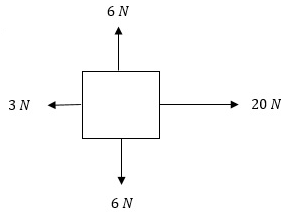
What is the resultant force in this diagram?
17 N, right
17 N, left
23 N, right
12 N, up
What equation links distance, speed and time?
speed = time ÷ distance
speed = distance ÷ time
speed = distance x time
speed = time x distance
Which of these can be measured in meters per second (m/s)
Distance
Time
Speed
Acceleration
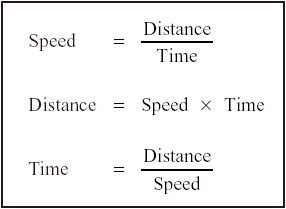
Calculate the average speed (in m/s) if a cheetah runs 180 metres in 10 seconds.
198 m/s
170 m/s
12 m/s
18 m/s
Acceleration is defined as the "change in..."
the time it takes to move from one place to another.
velocity of an object.
distance, divided by the time taken.
velocity, divided by the time taken.

A dog runs with an initial speed of 7.5 m/s on a waxed floor. It slides to a stop in 15 seconds. What is the acceleration?
-7.5 m/s
-7.5 m/s2
-0.5 m/s2
0.5 m/s
A spring has a spring constant of 5 N/cm. What is its extension when loaded with 15 N?
3 cm
5 cm
3 m
5 m

What is a typical value for walking speed?
10 m/s
5 m/s
3 m/s
1.5 m/s

What is a typical value for the speed of a car?
1.5 m/s
15 - 30 m/s
150 m/s
330 m/s

What is a typical value for the speed of a cyclist?
3 m/s
6 m/s
10 m/s
50 m/s

What is a typical value for the speed of a plane?
50 m/s
250 m/s
2500 m/s
25000 m/s

What is a typical value for the speed of a train?
5 m/s
35 m/s
50 m/s
95 m/s

What is a typical value for running speed?
3 m/s
15 m/s
30 m/s
55 m/s

What is a typical value for the speed of a boat?
1.5 m/s
3 m/s
6 m/s
10 m/s
A resultant force of 500N causes a body to accelerate at 20m/s2. What is the mass of the body ?
2.5kg
25kg
1000kg
10000kg
What is the Equation for Kinetic Energy?
Kinetic Energy = 0.5 x Mass x Speed²
Kinetic Energy = 0.5 x Mass² x Speed
Kinetic Energy = 0.5 x Mass² / Speed
What are Equations for Gravitational Potential Energy?
Gravitational Potential Energy = Mass x Gravitational Field Strength x Height
Gravitational Potential Energy = Weight x Height
Gravitational Potential Energy = Mass x Gravitational Field Strength / Height
Gravitational Potential Energy = Weight / Height
The formula for calculating kinetic energy (Ek) is...
2 x speed x mass2
1/2 x speed x mass2
2 x mass x speed
1/2 x mass x velocity2
The units for kinetic energy are...
Joules, J
degrees celsius, oC
kilograms, kg
metres per second m/s
What is the formula for elastic potential energy?
Ee=1/2ke2
Ep=1/2ke2
Ee=2ke2
Ep=2ke2
Is Nuclear energy, as a source of electricity, renewable or non-renewable?
Non-renewable
Renewable
What is the specific heat capacity of a material?
The energy required to heat 1kg of an object by 1°C
The energy required to heat a set mass of the material by a set temperature
100
4200
Which of these has the longest wavelength?
microwave
ultraviolet
visible light
infrared
What is the wave equation?
wave speed = frequency / wavelength
wave speed = frequency x wavelength
wave speed = wavelength / frequency
none of the above
A good/perfect reflector, such as a mirror, would be described as being s_______, s_____ and f____. Write down any one of these words in the space below.
(a)
A wave where the particles oscillate perpendicular to the direction of energy transfer is called a ___________ wave.
sound
high frequency
transverse
right angled
A wave where the particles oscillate parallel to the direction of energy transfer is called a ___________ wave.
parallel
perpendicular
transverse
longitudinal
According to the law of reflection, the angle of incidence is equal to the....
size of the mirror
shape of the light source
angle of refraction
angle of reflection
Which of these words describes the point of maximum displacement from the equilibrium position of a wave?
wavelength
frequency
amplitude
focal point
What is the speed of light?
3 × 10⁸ m/s
undefined m/h
undefined km/s
undefined km/h
If light passes from air to glass and the refractive index of the glass is 2.0, what happens to the speed of the light in the glass?
it doubles
it halves
it triples
it quaduples
A frequency of 50 MHz is the same as _________?
50 Hz
50, 000 Hz
50, 000, 000 Hz
50, 000, 000, 000 Hz
Do you know what a ray diagram for a lens is and how to draw it properly (i.e. with a focal point, rays of light, etc)?
Yes, I do.
Not sure, I think I do.
No, I have no idea what a diagram is never mind a ray diagram
No, I do not.
What does monochromatic light mean?
one colour
one speed
one direction
one plane
What is the human range of hearing?
20 - 50 Hz
20 - 50,000 Hz
20 - 20,000 Hz
50 - 50,000 Hz
What do we call sound waves below 20 Hz?
ultrasound
infrasound
loud sounds
quiet sounds
What do we call sound waves above 20,000 Hz?
ultrasound
infrasound
loud sounds
quiet sounds
Which of these is closest to the speed of sound in air?
30 m/s
300 m/s
3, 000 m/s
30, 000 m/s
Which of these is not a type of electromagnetic wave?
infrared
ultrasound
visible
gamma
The speed of light is (a) than the speed of sound (multiple words accepted, as long as it's correct).
Which of these values tell us how much a light wave will change direction when it enters a new medium?
refraction index
refraction number
refractive index
refractive number
Which of these has the highest frequency?
radio
gamma
infrasound
ultrasound at 50, 000 Hz

