wayground logo

Free Printable Worksheets

Font size

S
M
L
XL
Worksheets

1st Quarter EQT Review

Total questions: 82

Worksheet time: 1hrs 7mins

Name
Class
Date
1.
all matter is made of what 
a)
energy 
b)
atoms 
c)
electrons 
d)
compounds 
2.
The positive particles of an atom are 
a)
electrons 
b)
positrons 
c)
neutrons 
d)
protons 
3.
Particles in an atom that are neutral and have no charge are 
a)
negatrons 
b)
electrons 
c)
neutrons 
d)
protons 
4.
The particles that are found in the nucleus of an atom are
a)
neutrons and electrons
b)
electrons only
c)
protons and neutrons
d)
protons and electrons
5.
electrons have this type of charge?
a)
negative
b)
positive
c)
neutral
6.
The smallest part of an element is known as the 
a)
Periodic Table
b)
Atom
c)
Group
d)
Period
7.

Where is the element's atomic NUMBER located?

a)

the top

b)

the bottom

c)

the top + the bottom

d)

the number of protons + the number of neutrons

8.

Where is the element's atomic MASS located?

a)

at the top

b)

at the bottom

c)

the top number + the bottom number

d)

the number of protons + the number of neutrons

9.

What are the 3 subatomic particles of an atom?

a)

carbon atom, proton, electron

b)

quarks, neutrons, protons

c)

nucleus, protons, electrons

d)

protons, neutrons, electrons

10.
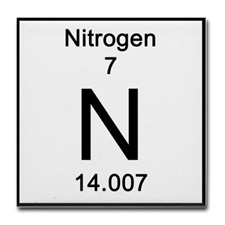
What is the number of protons that the element in this image contain?
a)
14
b)
7
c)
15
d)
18
11.
What is the atomic mass of "F"
a)
9
b)
18
c)
17
d)
19
12.
an atom with atomic number 6 would have how many protons 
a)
6
b)
12
c)
3
d)
cannot be determined 
13.
a)
2
b)
8
c)
3
d)
13
14.
a)
2
b)
6
c)
10
d)
16
15.

Valence electrons are the number of

a)

protons in the atom

b)

electrons in the atom

c)

protons + neutrons in the nucleus

d)

electrons in the outside shell of the atom

16.
What is the number of protons that the element in this image contain?
a)
14
b)
7
c)
15
d)
18
17.

UP and DOWN columns on the periodic table are

a)

groups

b)

periods

18.

SIDE TO SIDE rows on the periodic table are

a)

groups

b)

periods

19.

The group number tells you the number of

a)

protons

b)

valence electrons

c)

energy levels

20.

The period number tells you the number of

a)

protons

b)

energy levels

c)

valence electrons

21.

Which two elements have properties in common?

a)

Nitrogen and Phosphorous

b)

Oxygen and Nitrogen

c)

Sulfur and Nitrogen

22.

How many protons does Lithium have?

a)

3

b)

4

c)

7

23.

These elements are in a:

a)

group

b)

period

24.

These elements are in a:

a)

group

b)

period

25.

Which elements are stable?

a)

Group 1

b)

Group 8

c)

Group 18

26.

Which elements have 1 valence electron?

a)

period 1

b)

group 1

c)

group 4

27.

which elements have 4 valence electrons?

a)

group 3

b)

group 4

c)

group 14

28.
What is the correct formula for Boyle's Law?
a)
V1/T1=V2/T2
b)
P1V1=P2V2
c)
P1/T1=P2/T2
d)
PV=nRT
29.
Which variable is held constant when using Boyle's Law?
a)
Temperature
b)
Pressure
c)
Volume
d)
number of moles
30.
Which of the following temperatures is appropriate to convert 25oC into the Kelvin scale?
a)
373K
b)
272K
c)
372K
d)
273K
31.
What would you expect to see if temperature increased if you were using Charles's Law?
a)
volume would decrease proportionally
b)
volume would increase proportionally
c)
pressure would increase proportionally
d)
pressure would decrease proportionally
32.
Which gas law would you need to use a constant to solve for temperature?
a)
Boyle's Law
b)
Charles's Law
c)
Gay-Lussac's Law
d)
Some other gas law
33.
Gay-Lussac's law shows the directly proportional relationship between which two variables?
a)
pressure-temperature
b)
volume-temperature
c)
volume-pressure
d)
temperature-number of moles
34.
Gay-Lussac's law shows the directly proportional relationship between which two variables?
a)
pressure-temperature
b)
volume-temperature
c)
volume-pressure
d)
temperature-number of moles
35.
What is the correct temperature on the Kelvin scale equal to 30oC?
a)
303K
b)
243K
c)
313K
d)
253K
36.
Using Gay-Lussac's law, if the pressure of a gas starts out at 200kPa and increases to 600kPa, what would the initial temperature be if it ended up at 300K?
a)
50K
b)
200K
c)
400K
d)
100K
37.
If a balloon is cooled what will happen to the volume?
a)
Volume will increase
b)
Volume will decrease
c)
Volume will not change
d)
Balloon freezes to death
38.
You have a gas that has a pressure of 2 ATM and a volume of 10L.  What would be the new volume if the pressure was changed to 1 ATM?
a)
5 L
b)
20 L
c)
It would stay at 10L
d)
1 L
39.
In order to convert to Kelvin, you add ______ to the Celsius measurement.
a)
372
b)
273
c)
237
d)
732
40.
What is 50 °C in Kelvin?
a)
223
b)
323
c)
100
d)
50
41.
What is the device that measures atmospheric pressure?
a)
Aerometer
b)
Annemeter
c)
Barometer
d)
Humidity Detector
42.
If 200 mL of a gas at 27°C is cooled to -33°C at a constant pressure, the volume will be
a)
250 mL
b)
204 mL
c)
196 mL
d)
160 mL
43.
What will happen to the volume of a gas under constant temperature if the pressure increases?
a)
Increase
b)
Decrease
c)
Nothing
d)
Explosion!
44.
Boyle's law :  The pressure and volume of a gas show a _____ relationship. 
a)
Inverse 
b)
Direct 
45.
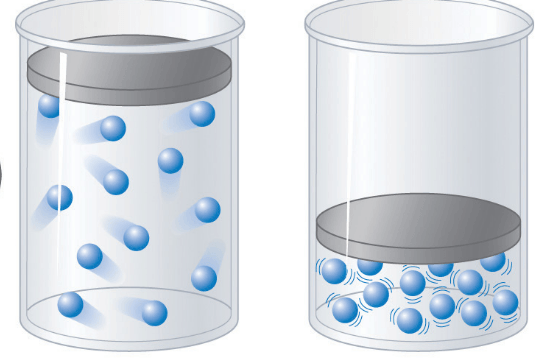
Which container will have a lower pressure?
a)
left
b)
right
c)
they both have the same pressure
d)
I don't know
46.
The following graph shows ______ law. 
a)
Charles
b)
Boyle's
c)
Gay Lussac's
d)
Newtons 
47.
This graph is an example of two variables that are:
a)
directly proportional
b)
inversely proportional
c)
Straight line
d)
No relation
48.
NaCl
a)
58.5
b)
23
c)
35.5
d)
67.6
49.
Cs2SO4
a)
361.9
b)
361.8
c)
313.9
d)
180
50.
K2S
a)
110.3
b)
110
c)
78.2
d)
110.2
51.
magnesium fluoride
a)
62.3
b)
43.3
c)
73.9
d)
92.9
52.
aluminum nitrate
a)
213
b)
89
c)
41
d)
150.9
53.
How many atoms of carbon (C) are in C6H12O6?
a)
3
b)
6
c)
12
d)
24
54.
How many Sodium (Na) are in 6NaCl?
a)
1
b)
12
c)
6
55.
How many Aluminum are in Al2O3?
a)
3
b)
2
c)
5
56.
How many Hydrogen are in 4H2O?
a)
6
b)
8
c)
2
d)
4
57.
 Mg  +  ___ HCl  →   MgCl2  +   H2
a)
1
b)
2
c)
3
d)
4
58.

__ Al + __ FeO → Al2O2 + __ Fe

a)

1, 1, 2

b)

2,1,2

c)

2, 2, 2

d)

2,4,2

59.

PCl5 + ___ H2O → ___ HCl + H3PO4

a)

4, 5

b)

1, 6

c)

3, 8

d)

2,2

60.
Which side of a chemical equation is the reactant side?
a)
Left (before the yields sign)
b)
Right (after the yields sign)
61.
Which side of a chemical equation os the product side?
a)
Left (before the yields sign)
b)
Right (after the yields sign)
62.
Which problem is balanced?
a)
PbO2 + 2H2
b)
SO2 + H20 --> H2SO4
c)
2Na + 2H2O --> 2NaOH + H2
63.
Balance this equation.
_CF+ _Br-- _CBr+ _F2
a)
2,1,2,1
b)
1,2,2,1
c)
1,2,1,2
d)
2,2,2,2
64.
What is the little number after an element in a chemical equation called.
Example: H2
a)
Coefficient 
b)
Subscript
c)
Atom
d)
Equation
65.
Is this equation balanced?
a)
yes
b)
no
c)
Not enough information
66.
When balancing equations a ____ can be placed to the left of a formula of a substance to make the equations balanced
a)
charge
b)
subscript
c)
random number
d)
coefficient
67.

The two sides of a chemical equation are called?

a)

Reactants (left) and Products (right)

b)

Ingredients (left) and Product (right)

c)

Cations and Anions

d)

Reactants (left) and Results (right)

68.
Which has a pH below 7?
a)
Acid
b)
Base
69.
Which has a bitter taste?
a)
Base
b)
Acid
c)
flagella
d)
cila
70.
Which has a slippery texture?
a)
Acid
b)
Base
71.
Turns litmus red
a)
Acids
b)
Bases
c)
All
72.

What pH is the strongest base?

a)

1

b)

7

c)

4

d)

14

73.

What colour does a base turn red litmus paper?

a)

Red

b)

Blue

74.
What methods can you use to measure the pH of a solution?
a)
Observing color or clarity
b)
Measuring mass or volume
c)
Measuring density or electrical conductivity
d)
Using acid base-indicators or pH meters
75.
Which of the following is most likely to be basic:
a)
Lemon juice
b)
Vinegar
c)
Laundry detergent
d)
Coke
76.
Tastes Sour
a)
Acids
b)
Bases
c)
Salts
d)
All
77.
Why are bases useful as cleaning products?
a)
They dissolve fats and oils
b)
they are corrosive, so they eat anything
c)
they don't mix with water
d)
since bases are slippery, they slip dirt off of surfaces
78.
Human blood has a pH between 7.35 and 7.45. Which of the following best describes human blood?
a)
strongly acidic
b)
slightly acidic
c)
strongly basic
d)
slightly basic
79.

Solutions that have more OH– ions than H+ ions are

a)

acids

b)

bases

c)

enzymes

d)

neutral

80.

A scientist runs tests on an unknown substance. He finds that it is extremely corrosive. It produces H+ ions in solution. And, it has a pH of 1. What type of substance has he identified?

a)

weak acid

b)

strong acid

c)

weak base

d)

strong base

81.

A substance is found to have the following characteristics:


Very bitter taste

Feels slippery to the touch

Produces OH- ions when dissolved in water


In what category would the substance be classified?

a)

acid

b)

base

c)

enzyme

d)

fatty acid

82.

Which of the following is the weakest acid among the choices listed here?

a)

lemon juice - 2.5

b)

sodium hydroxide - 14

c)

soap - 10

d)

urine - 6