
 Worksheets
Motion & Forces Test
Total questions: 90
Worksheet time: 2hrs 12mins
What is the definition of velocity?
Speed with direction
Change in distance over time
Change in velocity over time
Change in position
Which two measurements are needed to determine the speed of an object?
distance and time
distance and direction
position and time
position and direction
A car travels 30 miles/hr for 3 hours, calculate the distance it will travel. [Speed = distance÷time]
Acceleration is the
Rate of change in speed
Rate of change in velocity
Rate of change in momentum
Time needed for an object to arrive at its destination
Acceleration can be measured in
Meters/second
Seconds
Meters/Second2
Miles/Hour
Negative acceleration is the same as
Terminal velocity
An increase in speed
An increase in velocity
Deceleration
You are riding the Himalaya at Wonderland Park. After the Himalaya reaches a constant speed, you continue to be squished towards the outside of your seat. Are you being accelerated?
Yes, you are moving in a circle and you are constantly changing direction so you are accelerating
No, you are moving at a constant speed so you are not accelerating

The speed on a distance vs. time graph can be determined by using which of the following?
The slope of the line
The x axis measurement
The y axis measurement
What is the difference between speed and velocity?
Speed has both a size and direction
Velocity has both a size and direction
Velocity and speed are the same thing

Which of the following describes a measurement that has both magnitude and direction?
Scalar quantity
Vector quantity

A racecar rounds a curve on the track at a constant speed of 180mi/hr. Is the car accelerating?
Yes, its speed is changing
Yes, its direction is changing
No, its speed is constant
A school bus traveling at constant speed
If JT Barrett throws the football 30 meters to the Michigan cornerback in 2.5 seconds, what is the speed of the football?
10 m/s
75 m/s
12m/s
The Lamborghini Murcielago can accelerate (approx.) to a speed of 300m/s in 3 seconds. What is the car’s rate of acceleration?
100 m/s/s

This is a distance graph.
What is the car doing on line "a"?
speeding up
slowing down
moving at a constant speed
not moving
What is the car doing on line "c"?
speeding up
slowing down
moving at a constant speed
not moving

This graph represents the motion of a cart. What is the average speed of the cart?
0.83m/s
1.17m/s
m/s
65m/s

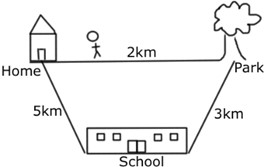
Jerry walked from home to school, then from the school to the park. What is his total displacement?
2 km
5 km
8 km
10 km
Jerry walked from home to school, then from the school to the park. What is his total distance?
2 km
5 km
8 km
10 km
An object is _____ if its position changes.
in motion
at reset
a frame of reference
magical

The image shows a Distance vs. Time graph. What is the speed of the BLUE line at 2 seconds?
10 m/s
2 m/s
5 m/s
20 m/s
The image shows a Distance vs. Time graph. What is the speed of the RED line at 2 seconds?
4 m/s
2 m/s
8 m/s
6 m/s

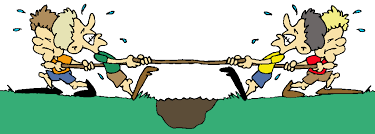


If two forces are said to be equal in magnitude and have opposite direction, then the object is said to have ___________.
Balanced forces
Unbalanced force
Accelerating
None of these

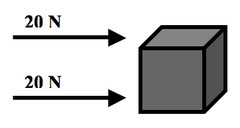
Refer to the picture. What is the net force?
15N
5N
50N
2N

These forces are...
Balanced
Unbalanced
Only solids can produce friction
true
false
The motion of an object will change when an unbalanced force is applied to it
true
false
What is acceleration?
transfer of energy to an object
going faster
a change in velocity (speed, direction, or both)
an object remaining in motion or at rest until something changes it

Which type of friction is shown in the picture?
rolling
fluid
static
sliding

Which type of friction is shown in the picture?
rolling
static
fluid
sliding
_____________ friction acts on objects that are not moving.
sliding
rolling
static
fluid
Types of friction include
static friction.
sliding friction.
rolling friction
all of the above
You use _____ friction when you leave marks on paper with a pencil “lead.”
static friction.
sliding friction.
rolling friction.
Newton's 2nd Law says the acceleration of an object depends on its _______ and ______. (Choose two answers)
force or applied force
weight
gravity
mass

What will be the effect on the boy in the picture if the driver stops quickly?
Because of inertia he will remain in the same position.
He will be pushed back into the car seat.
He will move from one side of the car seat to the other.
He will move forward pressing against the seatbelt.
Which of Newton’s Laws explains a rocket’s movement during launch?
Newton's First Law of Motion
Newton's Second Law of Motion
Newton's Third Law of Motion
Newton's Fourth Law of Motion
A bowling ball accelerates less than a golf ball when thrown with the same force because it has more mass.
A 12.5 kg bike accelerates at 2 m/s2. what was the force? (F = ma)
25 Newtons
20 Newtons
200 Newtons
10 Newtons

The masses of four objects are given in this table. If all objects are struck with the same amount of force of 150 N, which one will have an acceleration of 1.5 m/s2? (F = ma)
Object 1
Object 2
Object 3
Object 4

Examine the table provided. Which of the objects is producing the least amount of force? (F = ma)
Soccer Ball
Tennis Ball
Marble
Ping-Pong Ball

A basketball with a mass of 0.60 kg is accelerated with a force of 12.8 N. If resisting forces are ignored, what is the acceleration of the basketball to the nearest m/s2? (F = ma)
16 m/s2
21 m/s2
18 m/s2
7 m/s2
On which celestial object (outer space) would your mass be the greatest?
Earth
Jupiter
Sun
Your mass doesn't change on different celestial objects
As an object's mass decreases, its gravitational pull will ____________.
If an object mass = 45 kg on the Earth, what would be it's weight on Earth? (W = mg where g=9.8 m/s2)
450 N
45 kg
4.6 N
441 N
A child has a mass of 56.6 kg on Earth. If the gravity on Moon is one sixth that of the Earth what is the mass of the child on Moon?
5.7 Kg
554.6 Kg
56.6 Kg

The astronaut floats in international space station. It proves that...
His weight is less in space
His mass is less in space
His weight does not change
His mass is more in space

Which ball will hit the ground first if dropped at the same time and at the same height?
Metal first, then plastic, then wood last
Wood first , then plastic, then metal last
They will all hit at the same time
There is no way to tell
What is the weight of your backpack in Newtons? The mass of your backpack is 2.0 kg. (W = mg; assume: g = 9.8 m/s2)
19.6 N
9.8 N
98 N
196 N

Calculate the weight in Newton's of the large stack of textbooks. (Mass = 6 kg; W = mg; Assume on Earth g = 9.8 m/s2)
0.61 N
58.8 N
29.4 N
88.2 N
A car decelerates from 100 m/s to a complete stop in 10 seconds. What is the acceleration?
10m/s2
-10m/s2
1000m/s2
0.1m/s2
A dog runs with an initial speed of 75 m/s on a waxed floor. It slides to a stop in 15 seconds. What is the acceleration?
5 m/s2
-0.5 m/s2
-5 m/s2
0.5 m/s2

Use the graph to answer the question: How fast is the car traveling at 50 seconds?
50m/s
A car starts from rest at a stop light and reaches 20 m/s in 5 s. Determine the acceleration of the car.
50 m/s2
100 m/s2
4 m/s2
0.25 m/s2
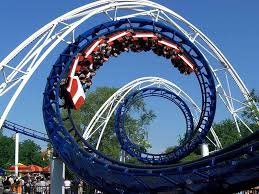
A roller coasters accelerates from an initial velocity of of 60 m/s to a final velocity of 70 m/s over 2 seconds. What's the acceleration?
30 m/s2
65 m/s2
5 m/s2
5 m/s
F= mass * acceleration
A 300 kg bike accelerates at 10 m/s2. what is the force acting upon it?
3 Newtons
300 Newtons
3000 Newtons
30 Newtons
When force is 2 N, mass is 5 kg, what is acceleration? (F=mass×acceleration)
4 m/s/s
2.5 m/s/s
10 m/s/s
0.4 m/s/s
An object with a mass of 60.0 kg accelerates 4.0 m/s2 when an unknown force is applied to it. What is the amount of the force? (F=mass×acceleration)
An object accelerates 5 m/s2 when a force of 100 newtons is applied to it. What is the MASS of the object? (F=mass×acceleration)
500 kg
20 kg
0.05 kg
2 kg

According to Newton's second Law, which would take less force to slow down?
The silver car
The green car
They would both take the same force
What is acceleration?
transfer of energy to an object
going faster
a change in velocity (speed, direction, or both)
an object remaining in motion or at rest until something changes it

