wayground logo

Free Printable Worksheets

Font size

S
M
L
XL
Worksheets

Electricity Unit Practice Quiz

Total questions: 84

Worksheet time: 57mins

Name
Class
Date
1.

The electricity generated from the power plant is

a)

Alternating Current

b)

Direct Current

c)

Delayed Current

d)

Alternating Voltage

2.

Super heated steam is used to turn a ______________?

a)

Transformer

b)

Battery

c)

Turbine

d)

Toothed Gear

3.
What is meant by fossil fuels?
a)
Fuels that are derived from fossils
b)
Fuels that are derived from old people
c)
Fuels that are derived from using plant material
d)
Fuels that are derived from the decomposition of faeces
4.
Most forms of electrical generation rely on a turbine. Which form doesn't?
a)
Tidal
b)
Hydro
c)
Solar
d)
Wind
5.
Biodiesel can be considered ...
a)
Finite
b)
Infinite
c)
Renewable
d)
Recycled
6.

How is electricity measured and billed by the power company?

a)

watts

b)

kilowatts

c)

watt hours

d)

kilowatt hours

7.

which type of renewable energy is currently creating the most electricity generation?

a)

geothermal

b)

hydroelectric

c)

solar

d)

wind

8.

What is given off as waste in a hydrogen fueled car?

a)

H2

b)

O2

c)

H2O2

d)

H2O

9.

fuel cells that use a chemical reaction to generate electricity are using

a)

hydrogen gas

b)

methane gas

c)

water

d)

oil

10.

Which of the following are the most energy efficient light bulbs?

a)

incandescent

b)

compact florescent

c)

LED

d)

halogen

11.

which of the following is the least energy efficient light bulbs?

a)

incandescent

b)

compact fluorescent

c)

LED

d)

halogen

12.

if a tractor trailer truck is 20% efficient, what happened to the other 80%

a)

energy is destroyed

b)

energy is lost as heat

c)

the 80% is still in the gas tank

d)

energy is converted into matter

13.
Where does geothermal energy come from?
a)
The Earth's atmosphere
b)
The Earth's asthenosphere
c)
The Earth's crust
d)
The Earth's troposphere
14.
How is energy transported in a circuit with a solar panel and an electronic device?
a)
neutrons
b)
electrons
c)
protons
d)
nucleus
15.
What is the popular name for an electrochemical cell? Choose one answer. 
a)
 A fuel cell.
b)
A catalytic cell. 
c)
A battery.
d)
A galvanometer
16.
A battery is 
a)
Electricity generated from water
b)
Electricity created from wind
c)
one or more cells that supply energy
d)
Can only be used once
17.
A primary cell is 
a)
a rechargeable battery
b)
a non-rechargeable battery
c)
a flow of electricity
d)
device that stops the flow of electricity
18.
A secondary cell is
a)
Electricity that flows
b)
recharegable battery 
c)
non-rechargeable battery
d)
electricity that flows
19.
Fuel cells produce
a)
Fossil Fuels
b)
Hydrogen gas
c)
Electricity
d)
Gasoline
20.
Can people drink the exhaust from a hydrogen fuel cell?
a)
Yes
b)
No
21.
2 different metals that lose or gain electrons in a battery (zinc and copper
a)
wet cells
b)
dry cells
c)
electrolytes
d)
electrodes
22.
liquid in a battery that allows electrons to move from one metal to the other (fruit juice, vinegar)
a)
Wet Cells
b)
Dry Cells
c)
Electrolyte
d)
Electrodes
23.
a type of cell that contains solid or pastelike electrolytes
a)
Wet Cells
b)
Dry Cells
c)
Electrolytes
d)
Electrodes
24.
a cell that has a liquid electrolyte
a)
wet cells
b)
dry cells
c)
electrolytes
d)
electrodes
25.
Voltage is measured in __.
a)
volts.
b)
watts.
c)
coulombs. 
26.
If the voltage across the battery was 10V in this diagram. What would the voltage across each bulb be?
a)
10V
b)
5V
c)
20V
d)
0V
27.
What is the rule for voltage in a parallel circuit?
a)
stays the same
b)
adds up
c)
inverse of the sum of the reciprocals
28.
The difference in electrical potential energy between two places is called
a)
resistance
b)
friction
c)
induction
d)
voltage
29.
Adding more bulbs to a series circuit will make each bulb burn less brightly.
a)
True
b)
False
30.
Adding more bulbs to a parallel circuit will make each bulb burn less brightly.
a)
True
b)
False
31.
The lamps are identical.  What is the voltage across each lamp?
a)
6 V
b)
12V
c)
3 V
d)
2.5 V
32.
The voltage across each bulb is 9V.  What is the voltage across the cell?
a)
4.5
b)
9
c)
18
d)
27
33.
What is the voltage across the bottom lamp?
a)
3 V
b)
6 V
c)
12 V
d)
18 V
34.
The actual flow of electrons is called _______.
a)
Molecule
b)
Magnetism
c)
Current
d)
Electrica
35.
What is current measured in?
a)
Inches
b)
Amperes
c)
Centimeters
d)
Newtons
36.
Current is...
a)
moving protons
b)
moving electrons
c)
measured in volts
d)
measured in ohms
37.
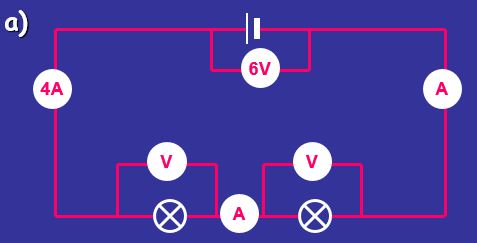
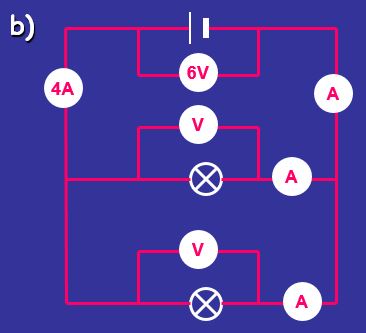
What is the current reading at the two question marks in the diagram?
a)
12 A
b)
8 A
c)
4 A
d)
1 A
38.
Assuming the lamps are identical, what is the current running though each lamp?
a)
3 A
b)
2 A
c)
1 A
d)
0 A
39.
What would the current reading be on the ammeter returning to the cell?
a)
1 A
b)
2 A
c)
3 A
d)
6 A
40.
What would the current be on the second resistor?
a)
9 A
b)
15 A
c)
6 A
d)
1 A
41.
What is the current after the first resistor?
a)
6 A
b)
4 A
c)
2 A
d)
0 A
42.
What is the current on the top branch of the parellel portion of this circuit?
a)
6 A
b)
4 A
c)
2 A
d)
0 A
43.
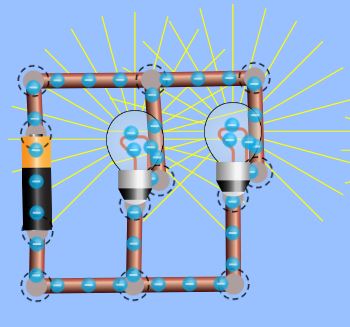
The picture shows an electrical circuit. This circuit is a series circuit because: 
a)
It has 3 light bulbs.
b)
The same current flows through all three light bulbs.
c)
It uses a single battery.
d)
The electrical current is divided between the three light bulbs.
44.
The current has only has one loop to flow through in this circuit. 
a)
Series Circuit 
b)
Parallel Circuit 
45.
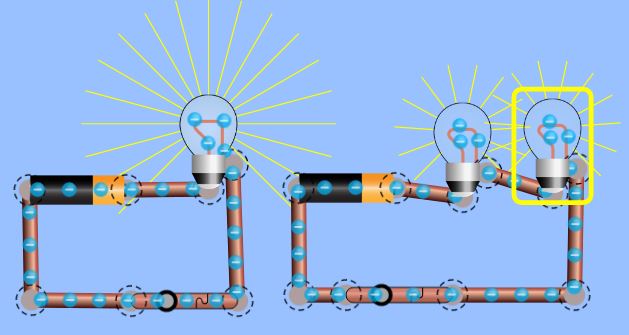
Which of the two circuits would have the brightest bulbs? 
a)
A
b)
B
46.
When you remove a bulb from a three bulb circuit, and the other two bulbs go off, then the bulbs must have been connected in __________.
a)
parallel
b)
series
c)
open
d)
closed
47.
Does this statement best describe a parallel or a series circuit.
 
When more light bulbs are added they all remain bright. 
a)
Parallel circuit
b)
Series circuit
48.
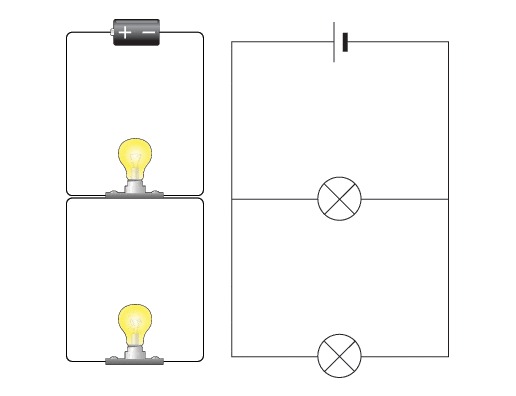
Does this diagram represent a series or parallel circuit?
a)
series circuit
b)
parallel circuit
49.
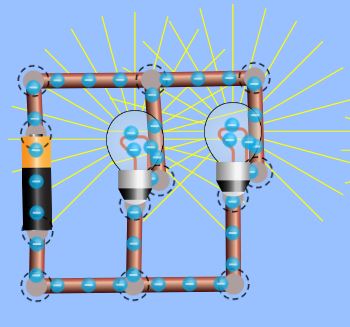
What kind of circuit is this?
a)
Series
b)
Consecutive
c)
Parallel
d)
Training
50.
What kind of circuit is this?
a)
series
b)
parallel
51.
a)
Series circuit - Bulbs are lit
b)
Series circuit - Bulbs are off
c)
Parallel circuit - Bulbs are lit
d)
Parallel circuit - Bulbs are off
52.
How many different types of circuits are there? 
a)
1
b)
3
c)
2
d)
4
53.
this is the symbol for a _____?
a)
switch
b)
light 
c)
battery
d)
wires
54.
This is the symbol for a ...
a)
Bulb
b)
Battery
c)
Horn
d)
Fuse
55.
This is the circuit symbol for ...
a)
an AC current source
b)
a DC current source
c)
an ammeter
d)
a voltmeter
56.
This is the circuit symbol for ...
a)
an AC current source
b)
a DC current source
c)
an ammeter
d)
a voltmeter
57.
This is the circuit symbol for ...
a)
an AC current source
b)
a DC current source
c)
a battery
d)
a single cell
58.
This is the symbol for a _____?
a)
Lamp
b)
Water wheel
c)
Loudspeaker
d)
Motor
59.
a)
push switch
b)
diode
c)
circuit breaker
d)
fuse
60.
Which is NOT an insulator.
a)
Wool
b)
Plastic
c)
Copper
d)
Glass
61.
Something electricity can't move through is called a(n) ______.
a)
conductor
b)
wire
c)
shoe
d)
insulator
62.
What is a example of a conductor?
a)
wood 
b)
metal
c)
rubber
d)
rock
63.
What is a example of a insulator?
a)
metal 
b)
rubber
c)
water
64.

Salt Water

a)

Insulator

b)

Conductor

65.
Glass
a)
Insulator
b)
Conductor 
66.
What is one problem with using a series circuit? 
a)
It has a lot of series. 
b)
If one goes down, they all go down! 
c)
It doesn't work properly.
d)
There are no problems. 
67.
If a negatively charged rod touches a conductor, the conductor will be charged by what method? 
a)
Friction
b)
Conduction
c)
Induction
d)
Convection
68.
The process of transferring charge between objects by touching or rubbing
a)
charging by induction
b)
static discharge
c)
charging by contact
d)
proton
69.
An object becomes negatively charged by
a)
losing protons
b)
gaining electrons
c)
losing electrons
d)
gaining protons
70.
An object becomes positively charged by
a)
losing protons
b)
gaining electrons
c)
losing electrons
d)
gaining protons
71.
Charging by friction requires rubbing. Charging by contact requires ...
a)
rubbing
b)
touching
c)
no contact
72.
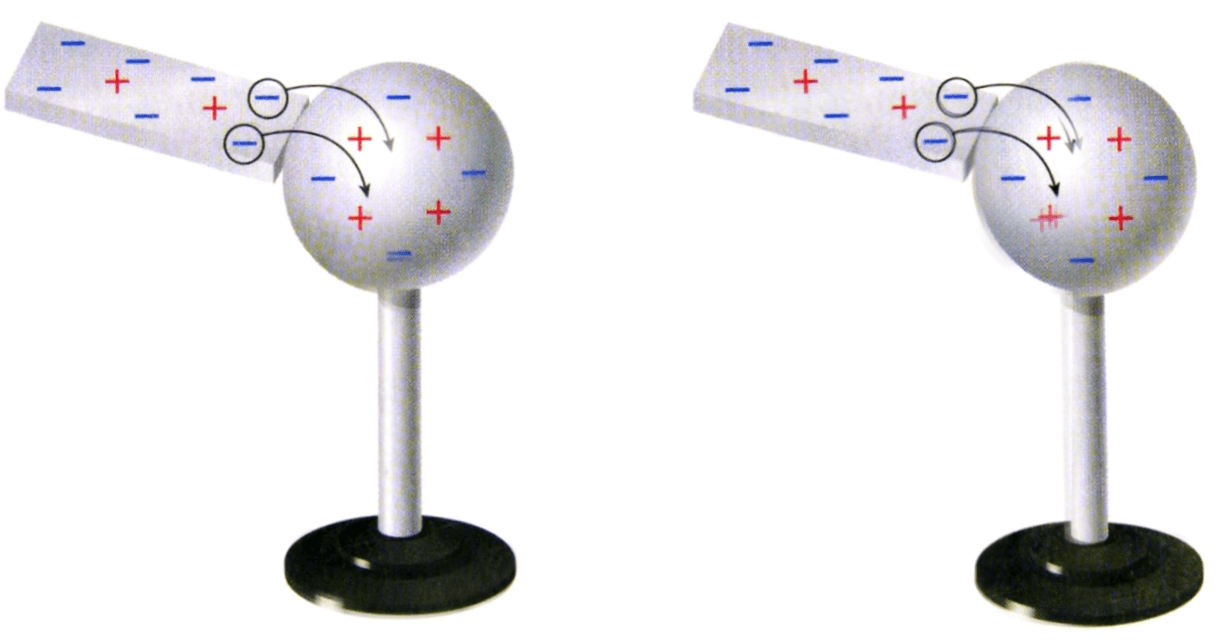
What method of static charging is shown in this picture
a)
Polarization
b)
Friction
c)
Induction
d)
Conduction
73.
Charging by contact results in both objects having the same charge.
a)
True
b)
False
74.
Charging by Friction results in two objects with the same charge.
a)
True
b)
False
75.

What parts of an atom are in the nucleus?

a)

Protons

b)

Neutrons

c)

Electrons

d)

Protons and Neutrons

76.
Protons are located in the nucleus of the atom.
A proton has _______________.
a)
No charge
b)
 A negative charge
c)
A positive charge
77.
The negatively charged particles in an atom are called _____.
a)
electrons
b)
neutrons
c)
negatrons
d)
protons
78.
Two like charges:
a)
 neutralize each other.
b)
repel each other. 
c)
must be neutrons. 
d)
attract each other.
79.

What types of charges attract?

a)

Positive and Positive

b)

Positive and Neutral

c)

Negative and Neutral

d)

Positive and Negative

80.
If a substance has a higher number of electrons than protons on its surface, what type of charge does it have?
a)
A positive charge.
b)
A negative charge.
c)
A neutral charge
d)
No charge at all
81.
The subatomic particle with a neutral charge is:
a)
protons
b)
electrons
c)
neutrons
d)
cloud
82.
When objects have equal numbers of positive and negative charges, they are
a)
positively charged
b)
negatively charged
c)
electrically neutral
d)
unbalanced
83.
Which type of charges do these balloons have?
a)
like charges
b)
opposite charges
84.
What type of charge do these balloons have?
a)
like charges
b)
opposite charges