wayground logo

Free Printable Worksheets

Font size

S
M
L
XL
Worksheets

Chapter 17 Waves

Total questions: 87

Worksheet time: 1hrs 16mins

Name
Class
Date
1.
If this wave chain represents 1 second, What is the frequency of the waves?
a)
1 Hz
b)
9 Hz 
c)
3 Hz
d)
6 Hz 
2.
How many waves are in this wave chain?
a)
6
b)
3
c)
4
d)
5
3.
One end of the rope is vibrated to produce a wave with a wavelength of .25 m.  The Frequency of the wave is 3.0 Hz.  What is the speed of the wave?
a)
3.00 m/s
b)
2.50 m/s
c)
.75 m/s
d)
1.25 m/s
4.
Transverse and longitudinal waves both_____
a)
Have compression and rarefaction 
b)
transfer energy through a medium 
c)
move at right angles to the vibration of the medium 
d)
are capable of moving the medium over a long distance 
5.
What does the picture represent?
a)
diffraction 
b)
reflection 
c)
Interference 
d)
refraction 
6.
Sound is which type of wave?
a)
Longitudinal wave 
b)
Transverse wave 
c)
Standing wave
d)
Surface Wave 
7.
Which wave causes the medium to vibrate only in the direction parallel to the wave's motion?
a)
S Waves 
b)
Transverse waves 
c)
Longitudinal waves 
d)
Standing waves 
8.
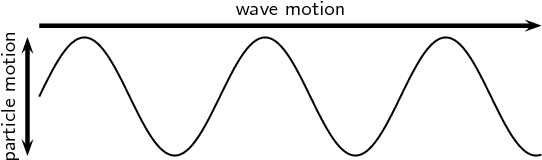
What type of wave is this?
a)
Surface Wave 
b)
Standing Wave
c)
Electromagnetic Wave
d)
Transverse Wave
9.
A surface sends ripples across the lake water.  These ripples are an example of _____
a)
Rarefaction 
b)
Compression 
c)
Longitudinal Wave 
d)
Surface Wave
10.
For refraction to occur in a wave, the wave must_____
a)
Enter a new medium head on
b)
Enter a new medium at an angle 
c)
Change the direction within a medium 
d)
Strike an obstacle larger than the wavelength 
11.
The picture is an example of what?
a)
Diffraction 
b)
Constructive Interference 
c)
Destructive Interference 
d)
Reflection
12.
When the surfer rides an ocean wave on her surfboard, she is actually riding on_____
a)
A crest that is toppling over
b)
The rest position of the wave
c)
A trough of the wave 
d)
A region of rarefaction
13.
What does letter B stand for?
a)
Crest 
b)
Rarefaction 
c)
Trough 
d)
Compression 
14.
A period is the length of time it takes for ________
a)
a disturbance to start a wave
b)
two complete wavelengths
c)
a wave to travel the length of a rope 
d)
one complete wavelength to pass a fixed point 
15.
What is the formula for wave speed?
a)
speed = wavelength x period
b)
speed = wavelength x amplitude 
c)
speed = frequency x amplitude 
d)
speed = wavelength x frequency 
16.
Amplitude of a wave is dependent on which other characteristic of a wave?
a)
Frequency 
b)
Wavelength 
c)
Energy 
d)
Wave Speed 
17.
To find the amplitude, measure_____
a)
From a trough to the rest position 
b)
from the crest to the rest position 
c)
neither a or b 
d)
either a or b 
18.
How does reflection differ from refraction and diffraction?
a)
reflection is the only process that involves a change in the wave
b)
reflection affects all types of mechanical waves but refraction and diffraction doesn't
c)
Reflection is the only process in which the wave does not continue moving forward
d)
Reflection is the only process that changes the direction of the wave
19.
In refraction, when a wave travels from one medium to another, it ____
a)
Stays in step 
b)
Changes speed 
c)
Always moves in the same direction
d)
Travels in the opposite direction
20.
What is one property of a wave that determines how much it will diffract when it encounters an obstacle?
a)
speed
b)
amplitude 
c)
polarization 
d)
wavelength 
21.
The Picture is an example of ________
a)
Diffraction 
b)
Longitudinal wave 
c)
Constructive Interference 
d)
Destructive Interference 
22.
Pitch of a sound is directly related to what characteristic of a wave?
a)
Amplitude 
b)
Wavelength 
c)
Compression 
d)
Frequency 
23.
As Frequency increase what happens to wavelength?
a)
lower than when source Increases 
b)
Remains the same 
c)
Decreases 
24.
_________is a disturbance in matter that carries energy from on place to another 
a)
Electromagnetic wave
b)
Surface Wave
c)
Mechanical Wave 
d)
Crest
25.
Which type of wave is represented in this picture 
a)
Electromagnetic wave 
b)
transverse wave 
c)
surface wave 
d)
longitudinal wave 
26.
_____is the bending of a wave as it moves around an obstacle or passes through a narrow opening.
a)
Interference 
b)
Diffraction 
c)
Reflection 
d)
Refraction 
27.
__________is the bending of a wave as it enters a new medium at an angle.
a)
Refraction 
b)
Reflection 
c)
Diffraction 
d)
Interference 
28.
the top of something, especially a mountain or hill.
a)
rarefaction 
b)
crest 
c)
compression 
d)
Amplitude 
29.
Which type of energy needs a source of energy to produce it?
a)
Surface Wave 
b)
Transverse Wave 
c)
Longitudinal Wave
d)
All of the above 
30.
When a wave strikes a solid barrier, it behaves like a basketball hitting a blackboard.  This behavior is called_____
a)
reflection 
b)
constructive interference 
c)
diffraction 
d)
rarefaction 
31.
A wave vibrating at right angles to the direction of the waves motion.
a)
surface wave 
b)
medium 
c)
transverse wave 
d)
P waves 
32.
A mechanical wave generally does NOT _____
a)
move the medium from one place to another 
b)
move through a medium 
c)
move through a solid 
d)
disturb the medium 
33.
the lowest point of a transverse wave
a)
mechanical wave
b)
medium
c)
crest
d)
trough
34.
What does this picture represent?
a)
Diffraction 
b)
Constructive Interference 
c)
Standing Waves
d)
Destructive Interference 
35.
What does this picture represent?
a)
Diffraction 
b)
Constructive Interference 
c)
Standing Waves
d)
Destructive Interference 
36.
What is represented at letter J?
a)
Amplitude 
b)
Crest 
c)
Trough 
d)
Wavelength 
37.
What is represented by letter G?
a)
Wavelength 
b)
Crest 
c)
Trough 
d)
Amplitude 
38.
A mechanical wave moves through a medium, which can be _______
a)
a liquid 
b)
a gas 
c)
a solid 
d)
all of the above 
39.
A string is clamped at both ends and plucked so it vibrates in a standing mode as shown below. How many nodes and antinodes are there?
a)
2 nodes, 3 antinodes
b)
3 nodes, 2 antinodes
c)
4 nodes, 3 antinodes
d)
3 nodes, 4 antinodes
40.
What kind of wave is pictured below?
a)
compressional wave
b)
transverse wave
c)
sound wave
d)
mechanical wave
41.
Amplitude reflects the amount of ____________________ in a wave.
a)
Energy 
b)
compression
c)
rarefaction
d)
speed
42.
Waves are a transfer of what?
a)
Heat
b)
Light
c)
Energy
d)
Food
43.
Sound is caused by? 
a)
force
b)
vibrations
c)
instruments
d)
medium
44.
The units for frequency are measured in _____________.
a)
hertz
b)
seconds
c)
m/s
d)
m
45.
This is what you get when sound waves are reflected, or bounce back, off of a hard surface.
a)
Amplitude
b)
Pitch
c)
Volume
d)
Echo
46.
What is vibration?
a)
how loud a sound is
b)
the back and forth movement of matter
c)
how high or low a sound is
d)
the loudness or softness of a sound
47.
The number of wavelengths that pass a point each per second is:
a)
frequency
b)
period
c)
longitudinal 
d)
transverse wave 
48.
The type of waves that require medium to pass:
a)
Mechanical Waves
b)
Electromagnetic Waves
49.
A mechanical wave cannot travel through...
a)
a vacuum(empty space).
b)
water.
c)
air. 
d)
glass.
50.
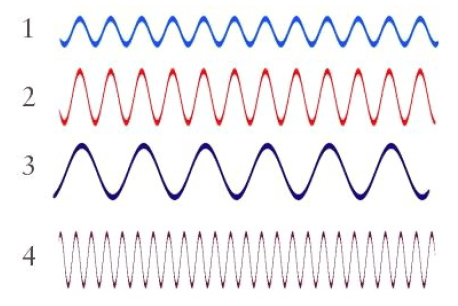
Which wave in the diagram has the greatest frequency?
a)
1
b)
2
c)
3
d)
4
51.
which material does sound travel the fastest?
a)
solid 
b)
liquid 
c)
gases
52.
What is the wavelength of the sound wave that has a frequency of 340 hertz as it travels through the air at 680 m/s?
a)
0.01 m
b)
0.5 m
c)
2.0 m
d)
200 m
53.
The combination of two or more waves that result in a single wave
a)
A. diffraction
b)
B. resonance
c)
C. reflection
d)
D. interference
54.
This image represents what kind of wave behavior?
a)
Diffraction
b)
Reflection
c)
Refraction
d)
Resonance
55.
Which statement can be made based on these data?
a)
Sound waves are slowest in liquids and fastest in gases.
b)
Sound waves are fastest in solids and slowest in gases.
c)
Speed of a sound wave increases from one medium to another.
d)
Speed of a sound wave decreases from one medium to another.
56.
If 3 complete wavelengths pass a fixed point in 2 seconds What is the frequency of the wave?
a)
3 Ha
b)
1.5 Hz
c)
3 Hz
d)
6 Hz
57.
Reflection does not change the speed or frequency of a wave, but the wave can be…
a)
thrown in a circle
b)
multiplied
c)
flipped upside down
d)
lengthened
58.

The wave that oscillates parallel to the wave direction with compress and expanse motion?

a)

Longitudinal wave

b)

Transverse wave

c)

Sinusoidal wave

d)

Micro wave

59.

What is Echo?

a)

It is the reflection of the sound waves

b)

It is the propagation of the sound wave

c)

It is the ultraviolet radiation reflection

d)

It is a sound made by transmitter

60.

How sound is made?

a)

From vibration that disturbs the surround molecules

b)

Ultrasonic transmission from transmitter

c)

The ossicles detection pass into the inner ear

d)

The ability to perceive sounds by detecting vibrations
61.
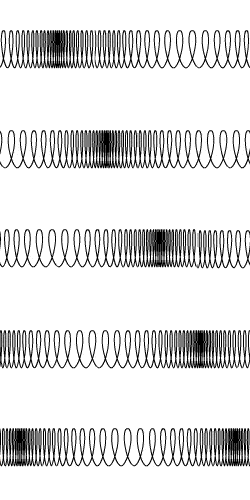
What type of wave is this?
a)
Longitudinal
b)
Transverse
62.
Long sound waves are...
a)
high pitched
b)
low pitched
c)
medium pitched
63.
When the car moves AWAY from you, its horn seems...
a)
Low pitched
b)
High pitched
c)
Normal
64.

As objects move in space, their wavelengths change. This phenomenon is called the...

a)

Coriolis Effect

b)

Doppler Effect

c)

Movement Effect

d)

Black Hole Effect

65.

The pitch of a sound wave relates to the wave's _________________.

a)

Amplitude

b)

Frequency

c)

Wavelength

d)

Period

66.

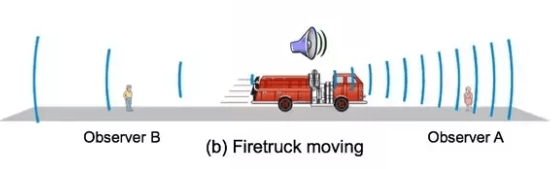
Look at the picture. Who is experiencing a lower pitched sound?

a)

Observer A

b)

Observer B

c)

There is no difference

67.
Short sound waves are...
a)
high pitched
b)
low pitched
c)
medium pitched
68.
What can you tell about this object's motion?
a)
Moving to the North (up).
b)
Moving to the South (down). 
c)
Moving to the West (left). 
d)
Moving to the East (right). 
69.
What can you tell about the motion of this object?
a)
Moving left.
b)
Moving right quickly.
c)
Standing still. 
d)
Moving up slowly. 
70.

You are standing on the side of the road when a police car races past you with its siren on. After the police car passes you, what happens to the pitch of the siren?

a)

It increases

b)

It decreases

c)

It turns red

71.
When a sound is louder what measurement gets bigger?
a)
Frequency 
b)
Amplitude 
c)
Wavelength 
d)
Crest
72.

Astronauts cannot hear each other on the moon because

a)

Moon has no atmosphere

b)

They are wearing helmets

c)

Moon has less gravity compared to earth

d)

None of these

73.

Sound travels through which medium?

a)

Solids

b)

Liquids

c)

Gases

d)

All of those

74.
Sound is produced by
a)
music
b)
vibrations of molecules
c)
Electromagnetic Waves 
d)
Transverse Waves 
75.

Diagram shows 3 types of sound waves generated from speaker. Which of the following statements is true?

a)

P has a higher pitch than Q

b)

Q has a higher pitch than R

c)

R has the highest pitch

d)

P, Q and R have the same pitch

76.

The material through which a wave travels

a)

Mechanical Wave

b)

Medium

c)

Crest

d)

Trough

77.
A wave transfers:
a)
a. Energy
b)
b. Matter
c)
c. Time
d)
d. Both a and b
78.
The most dense part of a longitudinal wave.
a)
Density
b)
Compression
c)
Rarefaction
d)
Amplitude
79.

What is created when a source of energy causes a vibration?

a)

Matter

b)

Mass

c)

A vacuum

d)

A wave

80.

Which of the following properties controls pitch?

a)

Amplitude

b)

Frequency

c)

Speed

81.
What is the speed of a sound wave that has a frequency of 250 hertz and a wavelength of 8 meters? 
a)
31 m/s
b)
250 m/s
c)
2000 m/s
d)
5280 m/s
82.
This is an example of which type of wave behavior?
a)
Reflection
b)
Diffraction
c)
Constructive Interference
d)
Destructive Interference
83.

If the time taken to complete 2 waves is 4 seconds. Find the time period of this wave?

a)

2 s

b)

1 s

c)

4 s

d)

8 s

84.

……………. is a device that uses ultrasonic waves to measure the distance, direction and speed of underwater bodies.

a)

Echo

b)

Reverberation

c)

SONAR

d)

Ultrasound

85.
What is the resulting direction of a surface wave?
a)
parallel
b)
circular
c)
opposite
d)
perpendicular
86.
Unlike a longitudinal wave, the disturbance in a transverse wave is
a)
perpendicular to the wave motion.
b)
in a circular motion.
c)
parallel to the wave motion.
d)
in the opposite direction of the wave motion.
87.
Unlike a transverse wave, the disturbance in a longitudinal wave is
a)
in a circular motion.
b)
parallel to the wave motion.
c)
perpendicular to the wave motion.
d)
in the opposite direction of the wave motion