
 Worksheets
AIR Test Review
Total questions: 94
Worksheet time: 2hrs 9mins
Name
Class
Date
1.
The passing of traits from parent to offspring
a)
Heredity
b)
Genetics
c)
Hybrid
d)
Probability
2.
which is heterozygous ?
a)
Tt
b)
TT
3.
Which is homozygous ?
a)
Zz
b)
SS
4.
the genetic makeup of an organism
a)
heterozygous
b)
punnet square
c)
genotype
5.
A homozygous dominant dog with brown fur is crossed with a heterozygous dog with brown fur. What are the percentages of the possible genotypes?
a)
100% BB
b)
75% BB and 25%Bb
c)
50 % BB and 50% Bb
d)
50% Bb and 50% bb
6.

Squidward has light blue skin, and his genotype for this trait is Bb. Would Squidward be considered a purebred or hybrid for light blue skin?
a)
Purebred
b)
Hybrid
7.
Which of the following is a phenotype?
a)
BB
b)
Bb
c)
bb
d)
Blue eyes
8.

An offspring will receive how many alleles from each parent to determine a specific trait?
a)
one
b)
two
c)
three
d)
five
9.
What is a phenotype
a)
The genetic make up (code)
b)
The physical trait
10.
having two of the same genes for the trait (sometimes called purebred).
a)
homozygous
b)
hetrozygous
c)
protein
d)
chromosome
11.
having two different genes for a trait (sometimes called hybrid).
a)
protein
b)
homozygous
c)
heterozygous
d)
genotype
12.
Magda is a tall, 11 year old drummer. She has a scar on her right cheek. She is good at swimming. Which of her traits did Magda most likely inherit?
a)
height
b)
the scar
c)
ability to swim
d)
ability to play drums
13.
Two brown eyed parents (Bb) have a baby. What is the chance the baby is blue eyed?
a)
0 %
b)
25%
c)
50%
d)
75%
14.
G = green, g = yellow
The genotype for a yellow plant is...
The genotype for a yellow plant is...
a)
GG
b)
Gg
c)
gg
d)
all of the choices result in yellow
15.
An allele whose trait only shows up when no dominant allele is present.
a)
hidden allele
b)
dominant allele
c)
recessive allele
d)
present allele
16.
What is the process of moving sediments from location to another?
a)
Deposition
b)
Erosion
c)
Weathering
d)
Compaction
17.
The process of breaking up Earth's surface into sediment is called...
a)
sediment
b)
erosion
c)
weathering
d)
deposition
18.
What is the movement of soil from one place to another?
a)
weathering
b)
deposition
c)
discharge
d)
erosion
19.
When would a river form a delta?
a)
when the river meanders across a plain
b)
when the river leaves the mountains
c)
when it is in the mountain
d)
when it enters the ocean
20.

Which Rock layer or intrusion is the youngest?
a)
A
b)
B
c)
C
d)
D
21.

According to the law of superposition, the oldest fossils are found
a)
At the top of the rock layers
b)
Near the bottom of the rock layers
c)
In the middle of the rock layers
d)
Somewhat near the surface
22.

Which rock layer in the diagram seems to be the oldest?
a)
F
b)
E
c)
B
d)
A
23.

According to the law of superposition, which layer is the youngest?
a)
A
b)
B
c)
C
24.

Letter "F" is a....
a)
inclusion
b)
intrusion
c)
fault
d)
unconformity
25.

The rock formation labeled "P" is a(n)...
a)
fault
b)
intrusion
c)
inclusion
d)
unconformity
26.

Which of the following correctly lists the layers in order from oldest to youngest?
a)
A, B, C, D, E
b)
E, B, C, D, A
c)
E, D, C, B, A
d)
C, B, A, D, E
27.
What happens when two north poles of a magnet are placed together?
a)
they repel
b)
they attract
c)
they cancel each other out
d)
the strength of the magnet is doubled
28.
What are the parts of the magnet that is attracted to the paper clips with the most force?
a)
the center
b)
the poles
c)
the equator
d)
the horseshoe
29.
Which is a factor that affects the strength of gravitational, magnetic, and electrostatic force fields?
a)
Mass
b)
Volume
c)
Distance
d)
Density
30.
Surrounding every magnet is a __________ __________.
a)
magnetic field
b)
electrical current
c)
another magnet
31.
Magnets can interact without touching.
a)
True
b)
False
32.

Consider the electric field lines shown in the diagram below. From the diagram, it is apparent that object A is ____ and object B is ____.
a)
+,+
b)
+,-
c)
-,+
d)
-,-
33.
The closer together the gravitational field lines.....
a)
the weaker the gravitational field strength
b)
the stronger the gravitational field strength
c)
the more repulsive the gravitational field strength
34.

What is the net force?
a)
40 N left
b)
0 N Balalnced
c)
400 N right
d)
40 N right
35.

How will this object move?
a)
It won't move.
b)
It will move to the right.
c)
It will move to the left.
d)
It will move in both directions.
36.
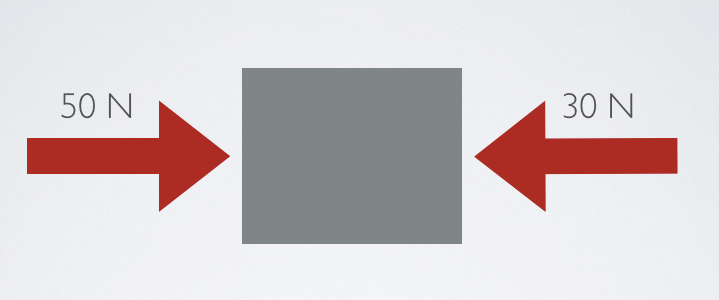
How will this object move?
a)
It won't move.
b)
It will move to the right.
c)
It will move to the left.
d)
It will move up.
37.
Which could be an example of an unbalanced force?
a)
A plate sitting on a dining table
b)
A ball at the top of a hill that is not moving
c)
Earth orbiting the Sun
d)
A baseball that has been thrown to home plate.
38.
You and your dad are moving the couch from one side to another. Your dad pushes with a force of 35 N to the right and you push with a force of 25 N right. What is the net force on the couch?
a)
60 N right
b)
10 N left
c)
60 n right
d)
50 N left
39.

Forces that have a net force of zero ( the object is still).
a)
Balanced force
b)
Unbalanced force
40.

Balanced or Unbalanced?
a)
Balanced
b)
Unbalanced
41.
What is a change in an organism that allows for it to survive in its environment?
a)
homologous
b)
vestigial
c)
variation
d)
adaptation
42.

What is this an example of?
a)
diversity of species
b)
variation
c)
vestigial structures
d)
DNA studies
43.
The cause of artificial selection is…
a)
The environment
b)
Humans
c)
Mutation
d)
Gene Flow
44.
Which of the following is NOT an example of natural selection?
a)
People selectively breeding hamsters.
b)
Insect populations developing resistance to certain pesticides.
c)
Bacteria becoming resistant to antibiotics.
d)
Male birds of certain species developing colorful feathers to attract female mates.
45.
Which term refers to the process by which individuals that are better suited to the environment survive and reproduce therefore passing down their genes to their offspring?
a)
Evolution
b)
Variation
c)
Adaptation
d)
Natural Selection
46.
The environment around Manchester, England, changed during the Industrial Revolution. How did this change affect peppered moths living in the area?
a)
Natural selection favored moths with dark wings because predators could not see them on the soot-colored trees.
b)
Natural selection favored moths with white wings that were easy for predators to see.
c)
Natural selection favored moths with white wings because predators could not see them on the soot-colored trees.
d)
Natural selection caused moths with white wings to become extinct.
47.
Gravitational potential energy depends on the ________ and ________ of the object.
a)
Height and mass
b)
Friction and movement
c)
Mass and Movement
d)
Height and Friction
48.
When you stretch a rubber band, you are storing __________ energy.
a)
kinetic
b)
potential
c)
none of the above
d)
all of the above
49.

which point has the most potential energy
a)
G
b)
f
c)
b
d)
a
50.
Can energy be destroyed
a)
no
b)
yes
51.
Which would have the greatest gravitational potential energy?
a)
A 4lb rat on a school desk
b)
A 45lb dog in an oak tree
c)
A 14 pound platypus on a swing
d)
A 45lb child on a bike
52.
Which is an example of elastic potential energy?
a)
A toy rocket that is launched from push of air
b)
Straws that are shot across the room using a rubberband
c)
A seesaw
d)
Throwing a football
53.
Which of following has the most electrical potential energy?
a)
A lamp plugged into a wall.
b)
A flashlight
c)
A car battery
54.
Which are chemical changes
a)
Iron rusting
b)
Glass breaking
c)
Clothing ripping
d)
Hair cut
55.
An object's potential energy increases as its height ________________.
a)
Increases
b)
Decreases
56.
Energy is the ability to do work.
a)
True
b)
False
57.
How many parents do you have in asexual reproduction?
a)
1
b)
3
c)
2
d)
4
58.
How many parents do you have in sexual reproduction
a)
1
b)
2
c)
3
d)
4
59.
How much DNA do you receive from one parent in sexual reproduciton
a)
25%
b)
50%
c)
75%
d)
100%
60.
In asexual reproduction the offspring look ________ as their parent.
a)
identical
b)
different
c)
the opposite
d)
as happy
61.
Which of the following is an advantage of sexual reproduction for a species.
a)
It produces more offspring
b)
Offspring can better adapt to changing environments because they are diverse
c)
Off spring are more likely to die because they are all 100% identical to their parent.
d)
It produces fewer offspring
62.
What is a disadvantage of sexual reproduction?
a)
It produces fewer offspring
b)
it produces more offspring
c)
It generate genetically diverse offspring
d)
It generates identical offspring
63.
What is an advantage of asexual reproduction?
a)
It produces more offspring
b)
It produces fewer offspring
c)
It requires a mate
d)
It produces identical offspring
64.
What is a disadvantage to asexual reproduction?
a)
It produces more offspring
b)
It produces fewer offspring
c)
They are all the same and do not have diversity
d)
They are all different and have diversity
65.
When a cell divides in mitosis, what do we call the 2 new cells?
a)
mother cells
b)
father cells
c)
daughter cells
d)
son cells
66.
In which type of cells will mitosis occur?
a)
egg cells
b)
sperm cells
c)
jail cells
d)
Body cells except the sperm and egg cells
67.
When you start with 1 cell, at the end of mitosis, how many identical cells will you have?
a)
1
b)
2
c)
3
d)
4
68.
Cells of organism must replicate for ?
a)
growth
b)
repair of damaged cells
c)
replacement of dying cells.
d)
All of the above
69.
The cells produced via meiosis are called:
a)
sex cells (gametes)
b)
somatic cells
c)
body cells
d)
skin cells
70.
Which of the following cells is a gamete?
a)
egg
b)
bone
c)
heart
d)
muscle
71.
After meiosis is complete how many cells will there be?
a)
1
b)
2
c)
3
d)
4
72.
After meiosis is complete, the new cells:
a)
are all identical
b)
are all different
c)
are half identical and half different
d)
are all stretched out
73.

The deeper into Earth you go the...
a)
greater the pressure
b)
less pressure
c)
pressure remains the same
74.
Scientists think that convection currents flow in Earth's
a)
continents
b)
mantle
c)
lithosphere
d)
inner core.
75.
The soft layer of the mantle on which pieces of lithosphere move is called
a)
mesosphere
b)
lithosphere
c)
asthenosphere
d)
outer core
76.
Which layer of Earth is LIQUID?
a)
upper mantle
b)
lower mantle
c)
outer core
d)
inner core
77.
Which layer of Earth is the thinnest?
a)
crust
b)
mantle
c)
outer core
d)
inner core
78.
Which layer of Earth is made up of tectonic plates?
a)
outer core
b)
inner core
c)
asthenosphere
d)
lithosphere
79.
Which layer of Earth has the GREATEST density?
a)
crust
b)
mantle
c)
outer core
d)
inner core
80.

Which is the source extremely high temperatures in the Earth?
a)
Volcanoes
b)
Solar Radiation
c)
Earthquakes
d)
Heat created by the formation of the earth
81.
Earth's magnetic field results from movements in the
a)
mantle
b)
outer core
c)
inner core
d)
crust
82.
What is the correct order (starting from the surface) of Earth's layers?
a)
crust, outer core, inner core, mantle
b)
mantle, outer core, inner core, crust
c)
crust, mantle, outer core, inner core
d)
outer core, inner core, crust, mantle
83.
Earth's inner core is...
a)
a dense ball of solid iron and nickel.
b)
a layer of molten iron and nickel.
c)
a layer of hot rock.
d)
a layer of rock that forms Earth's outer skin.
84.
The type of plate boundary where two plates come together is a .....
a)
Convergent Boundary
b)
Divergent Boundary
c)
Transform Boundary
d)
Plate Boundary
85.
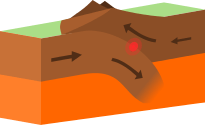
What type of plate boundary is this?
a)
Plate
b)
Divergent
c)
Convergent
d)
Transform
86.

What type of event will occur at this boundary?
a)
Earthquake
b)
Volcano Eruption
c)
Tornado
d)
Mountain Building
87.
A divergent boundary occurs when plates ....
a)
Pull apart
b)
Come together
c)
Slide past each other
d)
subducting
88.
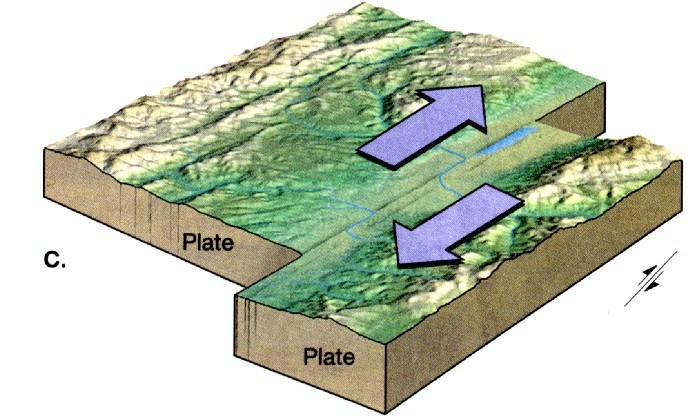
What type of plate boundary is this?
a)
Transform
b)
Convergent
c)
Divergent
d)
Plate
89.
The theory that says Earth's continents once made up an ancient supercontinent, and have been drifting apart ever since, is called the theory of...
a)
Pangea
b)
Plate Tectonics
c)
Natural Selection
d)
Gravity
90.
Oceanic Trenches are formed by _______ plate boundaries
a)
Convergent
b)
Transform
c)
Plate
d)
Divergent
91.
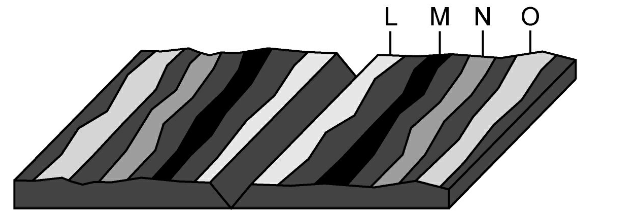
Where would the oldest rock be found?
a)
L
b)
M
c)
N
d)
O
92.
Mountains are created when....
a)
Two continental plates collide
b)
Two oceanic plates pull apart
c)
An Oceanic plate subducts under a Continental Plate
d)
Two continental plates pull apart
93.
What are the two types of crust
a)
continental and oceanic
b)
ocean and upper
c)
lower and upper
d)
pizza and subway
94.
The area where two tectonic plates meet.
a)
mantle
b)
focus
c)
plate boundary
d)
convection
100 %

