
 Worksheets
Astronomy Unit Test
Total questions: 100
Worksheet time: 2hrs 40mins
Name
Class
Date
1.
As the moon's shape appears to get smaller, we say that the moon is _.
a)
swelling
b)
waxing
c)
waning
d)
disappearing
2.
About how long does it take the moon to make one complete cycle around the earth?
a)
65 days
b)
8 days
c)
365 days
d)
28 days
3.
Which moon phase is when you can't see the moon at all?
a)
Waning crescent
b)
Full moon
c)
Waxing gibbous
d)
New moon
4.
Phases of the moon in which the moon appears to be getting larger are referred to as _.
a)
waxing
b)
waning
c)
new
d)
eclipse
5.

If the Northern Hemisphere is experiencing Summer, What season is the Southern Hemisphere experiencing?
a)
Summer
b)
Winter
c)
Spring
d)
Fall
6.

What phase comes BEFORE this one?
a)
New Moon
b)
Third Quarter
c)
Waxing Crescent
d)
Full Moon
7.

Where does fusion normally occur?
a)
In Earth's core
b)
The Sun
c)
Comet's tail
d)
The Moon
8.

Why does a comet's tail point away from the Sun?
a)
The comet is heading towards Earth
b)
Solar winds are blowing it away from the Sun
c)
Black hole is pulling it closer
d)
Heading to Mars
9.

What best explains Earth's motion?
a)
Earth moves in an elliptical motion around the Sun
b)
No unbalanced force acting on the planet
c)
The sun moves in orbit around Earth
d)
The gravitational forces are equal between Earth and the Sun
10.

Which object is closer to Earth?
a)
Mars
b)
Venus
c)
Jupiter
d)
Saturn
11.

For what reason can we see the moon at different places in the sky?
a)
Moon always produces light
b)
Moon's distance from Earth changes
c)
Moon's axis is tilted
d)
Moon revolves around Earth
12.
Unlike previous space mission the space shuttle was unique because it could be landed like an ________________________ and be reused.
a)
boat
b)
car
c)
airplane
d)
capsule
13.
The vast majority of galaxies in our universe are moving away from us. We know this because we observe __________ in the galaxies absorption spectra.
a)
Redshift
b)
Blueshift
c)
Turbulance
d)
Superposition
14.
What does Reflecting Telescope have?
a)
Lens
b)
Mirrors
c)
Bat ears
15.
What does Refracting Telescope have?
a)
Sand
b)
Mirrors
c)
Lens
d)
Batmobile
16.

This astronomer thought that all of the planets revolve around the sun in elliptical orbits, and that the sun is not in the exact center of the orbits:
a)
Kepler
b)
Brahe
c)
Galileo
d)
Newton
17.
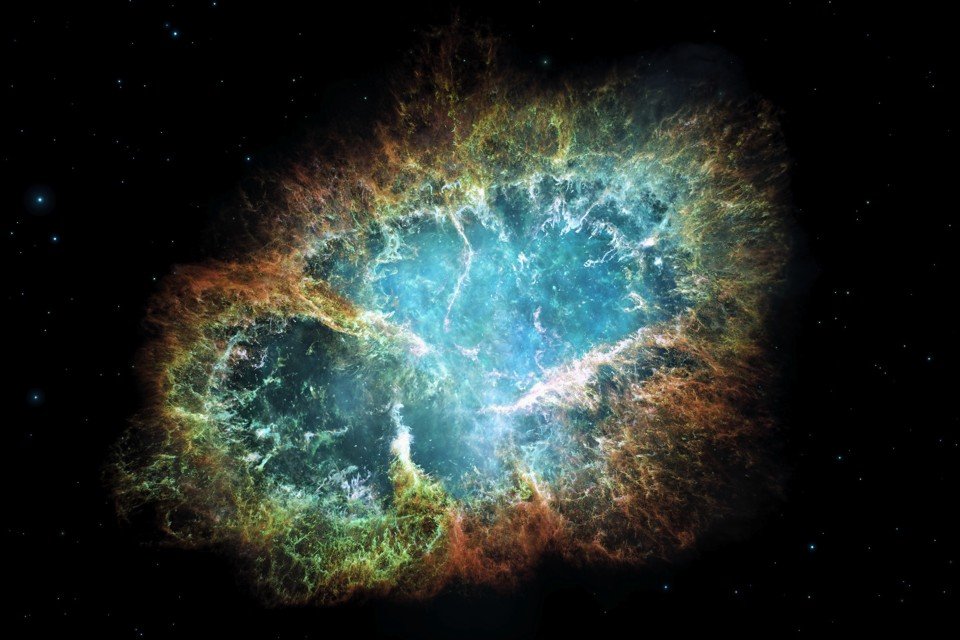
What is the name of the explosion at the death of a massive star?
a)
Supergiant
b)
Supernova
c)
Black Hole
d)
Nebula
18.

The order of the planets is:
a)
Mars,Venus,Earth,
Mercury,Saturn
Jupiter, Uranus, Neptune
Mercury,Saturn
Jupiter, Uranus, Neptune
b)
Earth,Venus,Mars
Jupiter, Neptune,
Mercury,Saturn,
Uranus
Jupiter, Neptune,
Mercury,Saturn,
Uranus
c)
Mercury,Venus,Earth
Mars,Jupiter,
Saturn,Uranus
Neptune
Mars,Jupiter,
Saturn,Uranus
Neptune
19.

What force keeps the planets orbiting the sun?
a)
Gravity
b)
Magnetism
c)
Electricity
d)
Friction
20.
The age of our universe
a)
12-13 million years
b)
13-14 billion yers
c)
13-14 million years
d)
100 million
21.
From all of the evidence scientist have collected, they believe that the universe is
a)
Drying rapidly
b)
shrinking
c)
expanding
d)
both shrinking and expanding
22.

What is a galaxy?
a)
Group of billions of stars and their planets, gas, and dust within the universe.
b)
All matter and energy including everything in intergalactic space, regarded as a whole.
c)
A system of planets or other bodies orbiting another star
d)
A supermassive Black Hole
23.
How long ago was our sun formed?
a)
10 million years ago
b)
5 million years ago
c)
4.5 billion years ago
d)
2 billion years ago
24.
A cloud of gas and dust from which bodies in space are formed
a)
photosphere
b)
nebula
c)
solar flare
d)
Sunspot
25.

Approximately how much time passes between the new moon and full moon?
a)
one month
b)
two weeks
c)
3 days
d)
24 hours�
26.
A solar eclipse only happens during a ________ moon.
a)
New
b)
Cresent
c)
Gibbous
d)
Full
27.
A lunar eclipse only happens during a ________ moon.
a)
New
b)
Cresent
c)
Gibbous
d)
Full
28.
What do we call the sun's outer atmosphere that you see during a solar eclipse?
a)
an umbra
b)
a corona
c)
an orbit
d)
a shadow
29.
Which of the following is not true about a total solar eclipse?
a)
It can be viewed once a year from every spot on earth
b)
It is dangerous to look at without the proper device
c)
When it happens, the moon blocks all of the sun except the corona
d)
You must be within the moon's umbra to see it
30.
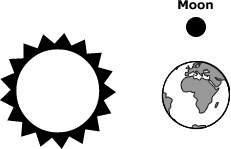
What type of tide is occurring on Earth?
a)
Reverse tide
b)
Quarter tide
c)
Neap tide
d)
Spring tide
31.

Which season is taking place in the Northern Hemisphere in Position 3?
a)
Winter
b)
Spring
c)
Summer
d)
Fall
32.
The Earth's axis is tilted _____ degrees.
a)
23.5
b)
25.3
c)
30.2
d)
24
33.

At position A, which hemisphere would have summer?
a)
Northern hemisphere
b)
Southern hemisphere
34.

Which season is taking place in the Southern Hemisphere in Position 1?
a)
Winter
b)
Spring
c)
Summer
d)
Fall
35.

Which season is taking place in the Northern Hemisphere in Position 1?
a)
Winter
b)
Spring
c)
Summer
d)
Fall
36.
This gas giant has a large storm in its atmosphere known as The Red Spot
a)
Jupiter
b)
Saturn
c)
Uranus
d)
Neptune
37.

This image shows the:
a)
Geocentric Solar System
b)
Heliocentric Solar System
38.
What is in the center of the Heliocentric Model?
a)
Sun
b)
Comet
c)
Jupiter
d)
Earth
39.
Which category is our Sun located in?
a)
White Dwarfs
b)
Supergiants
c)
Main Sequence
d)
Giants
40.

Red stars are the _____________.
a)
hottest
b)
coolest
c)
biggest
41.

Blue stars are the _____________.
a)
hottest
b)
coolest
c)
smallest
42.

Which one shows the correct location of the Sun in the Milky Way galaxy?
a)
A
b)
B
c)
C
d)
none of the above
43.

Which star has the lowest temperature?
a)
A
b)
B
c)
C
d)
D
44.
A light year is a unit of
a)
time
b)
distance
c)
mass
d)
density
45.
In the orbit of a planet or other body in the solar system, the point that is farthest from the sun.
a)
Gravity
b)
Aphelion
c)
Perihelion
d)
Solar Nebula
46.
What type of galaxy do we live in?
a)
Spiral
b)
Elliptical
c)
Irregular
d)
Coaxial
47.

Which diagram shows a neap tide?
a)
1
b)
2
c)
3
d)
4
48.

What three events can occur with this alignment of the sun, earth, and moon?
a)
solar eclipse, new moon, neap tide
b)
solar eclipse, full moon, neap tide
c)
solar eclipse, new moon, spring tide
d)
solar eclipse, full moon, spring tide
49.

What is designed and built to transport people and cargo between Earth and space?
a)
space rocket
b)
space shuttle
c)
space probe
d)
telescope
50.

A group of stars in the sky whose patterns form a picture is a
a)
constellation
b)
cave painting
c)
milky way
d)
sun
51.
A[n] ___________ tide occurs when the sun, Earth, and the moon are nearly in a line.
a)
spring
b)
high
c)
low
d)
neap
52.

Which body has the greater effect on Earth's tides?
a)
Sun
b)
Saturn
c)
Moon
d)
Venus
53.

Label part 1
a)
#1 Core
b)
#1 Radiation zone
c)
#1 Convection zone
d)
#1 Photosphere
54.

Label part 6
a)
#6 Prominences
b)
#6 Corona
c)
#6 Sunspots
d)
#6 Photosphere
55.
The direction of both the earth’s rotation and its revolution around the sun is:
a)
clockwise
b)
to the right
c)
counterclockwise
d)
to the left
56.
The darker part of the shadow created from an eclipse
a)
umbra
b)
penumbra
c)
waning
d)
waxing
57.
Why does a person on earth always see the same side of the moon?
a)
the moon turns on its axis and orbits the earth in the same amount of time
b)
the moon does not turn on its axis as it orbits the earth
c)
the moon orbits earth while earth turns on its own axis
d)
the moon and earth both turn on their axes in the same amount of time
58.

Name the phase
a)
Waxing Gibbous
b)
Waning Crescent
c)
First Quarter
d)
Waxing Crescent
59.

When the visible (lit) portion of the moon is increasing, the moon is:
a)
waning
b)
full
c)
waxing
d)
new
60.
Approximately how much time passes between the new moon and full moon?
a)
one month
b)
two weeks
c)
3 days
d)
24 hours�
61.
Changes in the moon's appearance are
a)
phases
b)
eclipses
c)
stages
d)
cycle
62.

The moon is covered in round pits called
a)
craters
b)
highlands
c)
mountains
d)
seas
63.
Mrs. Smith says "the moon looks larger than the stars!" What explains this?
a)
The moons soaks up the star's light
b)
The moon is larger than Earth
c)
The moon is larger than stars
d)
the moon is closer to Earth than stars
64.

Name the moon phase
a)
Waning Crescent
b)
Waxing Crescent
c)
Waning Gibbous
d)
Waxing Gibbous
65.
What is the correct order of the moon phases?
a)
new, full, 1st quarter, 3rd quarter
b)
new moon, 1st quarter, full moon, 3rd quarter
c)
1st quarter, 3rd quarter, new moon, full moon
d)
new, 1st quarter, 3rd quarter, full
66.

Name the phase of the moon for letter a
a)
First Quarter
b)
Last Quarter
c)
Waxing Gibbous
d)
Waning Gibbous
67.

Which number shows a waning crescent moon?
a)
2
b)
4
c)
6
d)
8
68.
Phases of the Moon depend on how much _____.
a)
distance is between Earth and the Moon
b)
of the lighted side of the Moon faces Earth
c)
shadow Earth makes on the Moon
d)
shadow the Moon makes on Earth
69.

What causes Day and Night on Earth?
a)
The rotation of the Earth
b)
Earth moving farther from and closer to the Sun
c)
The Revolution of Earth
d)
The Sun moving around Earth
70.

Which tide causes the biggest change in ocean levels?
a)
Spring Tide
b)
Neap Tide
c)
Summer Tide
d)
Leap year Tide
71.

What phase is this?
a)
Full Moon
b)
First Quarter Moon
c)
Last Quarter Moon
d)
New Moon
72.

What phase is this?
a)
Full Moon
b)
New Moon
c)
Waxing Gibbous Moon
d)
Waning Gibbous Moon
73.

What phase is this?
a)
First Quarter Moon
b)
Last Quarter Moon
c)
Waning Gibbous Moon
d)
Waxing Gibbous Moon
74.

What phase is this?
a)
First Quarter Moon
b)
Last Quarter Moon
c)
Waxing Gibbous Moon
d)
Waning Gibbous Moon
75.

Which type of eclipse is being modeled: Lunar or Solar
a)
Lunar Eclipse
b)
Solar Eclipse
76.

In 1972 what space mission was responsible for getting a man on the moon?
a)
Challenger
b)
Voyager
c)
Gemini
d)
Apollo
77.
Who was the very first astronaut to ever step foot on the moon?
a)
Yuri A. Gargarin
b)
Alan B. Sheppard
c)
John Glenn
d)
Neil Armstrong
78.

Used to fly astronauts into space
a)
Space Shuttle
b)
Space suit
c)
Neil Armstrong & Buzz Aldrin
d)
light- year
79.

The first satellite launched into space by Russia
a)
Space Suit
b)
Sputnik
c)
ISS
d)
Astronaut
80.
What separates the inner planets from the outer planets?
a)
an inter-stellar fog
b)
a dense fog
c)
an asteroid belt
d)
solar flares
81.
On which planet is Olympus Mons, the largest mountain in the solar system, located?
a)
Mercury
b)
Saturn
c)
Mars
d)
Jupiter
82.
The Hubble Space Telescope is a telescope that NASA launched into space in 1990. Scientists most likely prefer to use the Hubble Space Telescope instead of a land-based telescope because it provides better accuracy at?
a)
predicting the phases of the Moon
b)
investigating the size of Venus
c)
predicting solar eclipses
d)
investigating far away galaxies
83.
How are Earth and Venus alike?
a)
They are about the same size
b)
they both have life
c)
they both have a breathable atmosphere
d)
They are not alike at all
84.
Which planet is usually the brightest in the sky?
a)
Venus
b)
Jupiter
c)
Mercury
d)
Mars
85.
The Solar System formed:
a)
8 billion years ago.
b)
15 billion years ago.
c)
approximately 4.6 billion years ago.
d)
at 9:00 a.m. on 29 October 4004 B.C.
86.
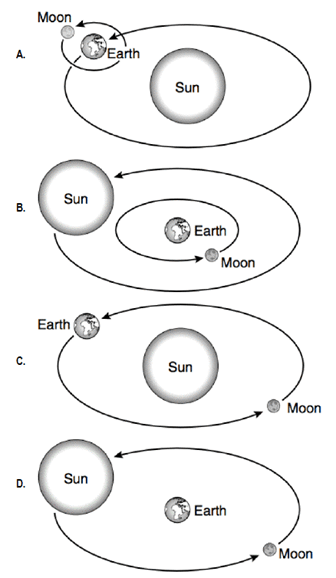
Which of these best shows that the Earth revolves around the sun as the moon revolves around the Earth?
a)
Picture A
b)
Picture B
c)
Picture C
d)
Picture D
87.
This is when sunlight shines equally on the northern and southern hemispheres
a)
equinox
b)
solstice
c)
waning
d)
waxing
88.
This is when the area of sunlight is at a maximum in one hemisphere and a minimum in the other hemisphere
a)
solstice
b)
equinox
c)
umbra
d)
penumbra
89.
Tides are the results of:
a)
Moon's Gravity
b)
Moon's Seasons
c)
Earth's Gravity
d)
Rogue Waves
90.
What type of galaxy has no defined pattern or shape?
a)
Spiral
b)
Elliptical
c)
Irregular
d)
Constellation
91.

What is the process of stars giving off heat?
a)
Blowy gas
b)
Helium conversion
c)
Heat
d)
Nuclear fusion
92.
The type of death a star has will depend on the star's __________ .
a)
Color
b)
Shape
c)
Mass
d)
Luminosity
93.
Less massive stars turn into ___ when they die
a)
White Dwarfs
b)
Black Holes
c)
Neutron Stars
d)
Super Giants
94.

What type of galaxy does this image depict?
a)
Elliptical
b)
Spiral
c)
Barred Spiral
d)
Irregular
95.
Place these objects in order from smallest to largest.
a)
Planets, solar system, universe, galaxy
b)
Solar system, planets, galaxy, universe
c)
Planets, solar system, galaxy, universe
d)
Galaxy, solar system, planets, universe
96.
Which sequence listed below shows the correct order in the lifecycle of a low mass star?
a)
Red Giant, Nebula, Main Sequence, Protostar
b)
Nebula, Protostar, Main Sequence, Red Giant
c)
Nebula, Main Sequence, Protostar, Red Giant
d)
Red Giant, Nebula, Protostar, Main Sequence
97.
Where is the Sun found in our Galaxy?
a)
the center
b)
near the center
c)
outside of the galaxy
d)
on one of the arms
98.
The event that marks the beginning of our known universe
a)
Theory of Evolution
b)
Big Bang Theory
c)
Cell Theory
d)
Blackhole theory
99.
When do scientist theorize the big bang occured?
a)
5 million years ago
b)
4.6 billion years ago
c)
13.7 billion years ago
d)
100 billion years ago
100.
How is the density of inner planets different from that of the outer planets?
a)
The inner planets are MORE dense than the outer planets because they're solid.
b)
The inner planets have the same density as the outer planets.
c)
The inner planets are LESS dense than the outer planets because they're solid.
d)
The inner planets have no density when compared to the outer planets.
100 %

