
 Worksheets
Unit 4, Plate Tectonics & Paleontology
Total questions: 93
Worksheet time: 1hrs 13mins
Name
Class
Date
1.
How have scientists been able to study Earth's mantle?
a)
In some places, Earth's crust thins enough to see mantle.
b)
Earth's surface heat warms the crust turning it into mantle.
c)
Cooling crust material becomes mantle over time.
d)
In some places, mantle rock pushes to Earth's surface.
2.
Which layer of the earth is rock made mostly of iron?
a)
Lithosphere
b)
Core
c)
Asthenosphere
d)
Mantle
3.
What part of the earth is a layer of rock that comprises 67% of Earth’s mass?
a)
mesosphere
b)
mantle
c)
asthenosphere
d)
lithosphere
4.
What is the rigid layer of the Earth's surface made up of the crust and upper mantle called?
a)
asthenosphere
b)
lithosphere
c)
mesosphere
d)
continental crust
5.
How many layers of the Earth's CORE are there?
a)
one
b)
two
c)
three
d)
four
6.
Is the outer core a liquid or solid?
a)
liquid
b)
solid
7.
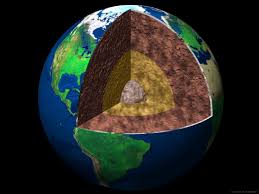
Which layer of Earth is located above the outer core?
a)
crust
b)
inner core
c)
mantle
d)
lithosphere
8.
What is the top layer of the Earth's surface called?
a)
Mantle
b)
Innercore
c)
Outercore
d)
Crust
9.
Temperature _____________________ as you go deeper into the earth.
a)
increases
b)
decreases
c)
goes up and down depending on the layer
d)
stays the same
10.
Pressure ______________________ as you go deeper into the Earth
a)
increases
b)
decreases
c)
goes up or down depending on the layer
d)
stays the same
11.
Which layer of Earth is characterized by rock that is plastic, or soft enough to flow?
a)
asthenosphere
b)
crust
c)
lithosphere
d)
inner core
12.

Which layer of Earth is located above the outer core?
a)
crust
b)
inner core
c)
mantle
d)
lithosphere
13.
A dense ball of solid iron and nickel.
a)
crust
b)
inner core
c)
mantle
d)
outer core
14.
Which best describes the asthenosphere?
a)
molten metal
b)
dense, solid metal ball
c)
solid that flows
d)
dry land and ocean floor
15.
If you traveled from the center of Earth to the surface, the pressure would...
a)
increase
b)
decrease
c)
stay the same
d)
unsure
16.
What are the two types of crust?
a)
top crust,bottom crust
b)
oceanic crust, continental crust
c)
water,land
d)
none of the above
17.
If we compare the temperature and pressure of the Earth’s mantle to the core, what differences can we expect as we move downward into the Earth?
a)
Both the temperature and pressure increase.
b)
Both the temperature and pressure decrease.
c)
The temperature increases and the pressure decrease.
d)
The temperature decreases and the pressure increases.
18.

Identify each layer - #15.
a)
Lithosphere
b)
Mantle
c)
Crust
d)
Asthenosphere
19.
What is the outer core composed of?
a)
Basalt
b)
Granite
c)
Solid Metals
d)
Molten (liquid) Metals
20.

Identify each layer - #19.
a)
mantle
b)
lithosphere
c)
inner core
d)
outer core
21.

Identify each layer - #20.
a)
mantle
b)
asthenosphere
c)
inner core
d)
outer core
22.

What part of the crust is the arrow pointing to?
a)
Continental Crust
b)
Oceanic Crust
c)
Bread Crust
23.
What layer of Earth do we live on?
a)
Crust
b)
Core
c)
Mantle
24.

What Layer is 3?
a)
Crust
b)
Mantle
c)
Outer Core
d)
Inner Core
25.
What was the name given to all the continents when they were joined as one super continent?
a)
Supreme Continent
b)
Eurasia
c)
Plate tectonics
d)
Pangea
26.
Which of the following occurs because of convection currents?
a)
Tectonic plates on the crust move.
b)
The mantle increases in size.
c)
Pressure in the crust increases.
d)
Pressure in the crust decreases.
27.

Scientists think that convection currents that move the plates flow in Earth's
a)
Continental crust
b)
Oceanic crust
c)
Asthenosphere
d)
Lithosphere
28.
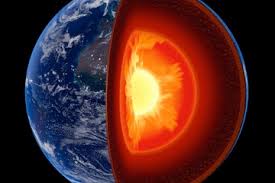
As you travel from the inner core to the crust, how would temperature, pressure and density of the material change?
a)
The would all increase
b)
The would all decrease.
c)
They would stay the same.
d)
Temperature would decrease, but pressure and density would increase.
29.
Where does the heat come from that drives this convection current in the mantle?
a)
The sun
b)
The crust
c)
the mantle
d)
the core
30.
What does the theory of continental drift state?
a)
The continents were once joined in a super-continent and have moved over time
b)
Continents are stationary and do not move
c)
The Earth is broken into lithospheric plates that move due to convection currents
d)
none of the above
31.
During sea floor spreading, molten material rises up from the mantle...
a)
along the continents
b)
at the mid ocean ridges
c)
deep ocean trenches
d)
at north and south poles
32.
Which of the following is where one plate slides under another plate?
a)
submarine zone
b)
divergence zone
c)
subduction zone
d)
lower zone
33.

Identify the letter in the diagram. Identify letter A
a)
Lithosphere
b)
Asthenosphere
c)
Mantle
d)
Outer Core
34.
Identify the letter in the diagram. Identify letter E
a)
Lithosphere
b)
Asthenosphere
c)
Mantle
d)
Outer Core
35.
Identify the letter in the diagram. Identify letter F
a)
Lithosphere
b)
Asthenosphere
c)
Mantle
d)
Outer Core
36.
Identify the letter in the diagram. Identify letter G
a)
Crust
b)
Convection Current
c)
Inner Core
d)
Outer Core
37.
Identify the letter in the diagram. Identify letter B
a)
Crust
b)
Convection Current
c)
Inner Core
d)
Outer Core
38.
Identify the letter in the diagram. Identify letter D
a)
Lithosphere
b)
Asthenosphere
c)
Mantle
d)
Outer Core
39.
The driving force of the tectonic plates are convection currents, where can these be found?
a)
inner core
inner core
inner core
b)
crust
c)
mantle
d)
outer core
40.
Identify the letter in the diagram. Identify letter C
a)
Lithosphere
b)
Asthenosphere
c)
Mantle
d)
Inner Core
41.
What is the order of the layers?
a)
inner core, lithosphere, mesosphere, outer core, asthenosphere
b)
asthenosphere, lithosphere, mesosphere, outer core, inner core
c)
lithosphere, asthenosphere, mesosphere, outer core, inner core
d)
crust, core, mantle
42.

Which liquid is the least dense?
a)
oil
b)
water
c)
syrup
d)
plastic bottle
43.

What would happen to the convection currents if the heat from the inner core disappeared?
a)
They would stop.
b)
They would change directions.
c)
It would not change.
d)
They would speed up.
44.
Which type of plate boundary would cause mountains to form?
a)
Transform
b)
Convergent
c)
Divergent
d)
Reform
45.
The Great Rift Valley in Africa and the Mid-Ocean Ridge were all created by this boundary
a)
Divergent
b)
Convergent
c)
Reform
d)
Transform
46.
subduction zones in the ocean can create which features?
a)
islands
b)
volcanoes
c)
earthquakes
d)
all of the above
47.
Earthquakes and volcanoes are most likely found in which locations?
a)
At plate boundaries
b)
in oceans
c)
in the middle of continents
d)
in the middle of plates
48.
When one plate sides under neath another, it _________ and the magma _________.
a)
hardens, sinks
b)
melts, sinks
c)
hardens, rises
d)
melts, rises
49.
The Himalayas in Asia are an example of what type of plate boundary?
a)
divergent
b)
continent-to-continent convergent
c)
ocean-to-continent convergent
d)
transform
50.
Transform boundaries are most likely to produce what phenomenon?
a)
volcanoes
b)
deep sea trenches
c)
underwater mountain ranges
d)
earthquakes
51.
When an oceanic plate and a continental plate collide, which one will subduct?
a)
oceanic
b)
continental
c)
neither
52.
Which of the following is NOT a tectonic boundary?
a)
Convergent
b)
Divergent
c)
Sedergent
d)
Transform
53.

What is this image...
a)
Revolving boundary
b)
San Andreas (Transform)
c)
Convergent
54.
Two tectonic plates collide at a _______ plate boundary.
a)
convergent
b)
divergent
c)
transform
55.
The area where two tectonic plates meet.
a)
mantle
b)
focus
c)
plate boundary
d)
convection
56.
This landform can occur at a divergent plate boundary.
a)
ocean trench
b)
mid-ocean ridge
c)
tall mountains
d)
transform fault
57.
A continental rift valley can be formed from stretching continental crust at...
a)
transform plate boundaries
b)
convergent plate boundaries
c)
divergent plate boundaries
d)
all plate boundaries
58.

What is the name of the plate boundary that slides past each other?
a)
Divergent
b)
Convergent
c)
Transform
d)
Mr. C the Slide Man
59.

Which of these events can ONLY happen on a DIVERGENT BOUNDARY?
a)
Rift Valley
b)
Mountain
c)
A peninsula
d)
An Insanely complex, long answer that you will click out of instinct.
60.
The area around the pacific plate where boundaries form is called...
a)
death ring
b)
fire zone
c)
ring of fire
d)
zone of fire
61.
Which is true about hotter material in the mantle?
a)
more dense, sinks
b)
less dense, sinks
c)
less dense, rises
d)
more dense, rises
62.
During sea floor spreading, molten material rises up from the mantle...
a)
along the continents
b)
at the mid ocean ridges
c)
deep ocean trenches
d)
at north and south poles
63.
Which of the following is where one plate slides under another plate?
a)
submarine zone
b)
divergence zone
c)
subduction zone
d)
lower zone
64.
Associated with transform boundaries.
a)
Volcanoes
b)
mountains
c)
trenches
d)
earthquakes
65.
This land formation occurs at a divergent boundary.
a)
mid ocean ridge
b)
deep ocean trench
c)
pacific hot spot
d)
rift valley
66.
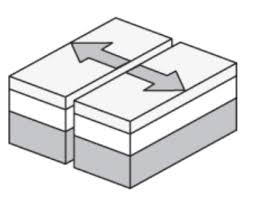
Name the boundary
a)
convergent boundary
b)
divergent boundary
c)
transform boundary
d)
sergent boundary
67.

Name the boundary
a)
convergent boundary
b)
divergent boundary
c)
transform boundary
d)
sergent boundary
68.
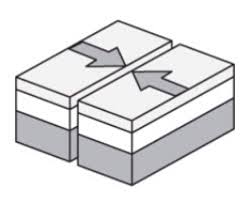
Name the boundary
a)
convergent boundary
b)
divergent boundary
c)
transform boundary
d)
sergent boundary
69.
Which ocean is expanding due to a mid-ocean ridge (divergent boundary)?
a)
Indian
b)
Dead Sea
c)
Atlantic
d)
Artic
70.
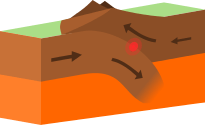
What type of plate boundary is this?
a)
Plate
b)
Divergent
c)
Convergent
d)
Transform
71.

What type of event will occur at this boundary?
a)
Earthquake
b)
Volcano Eruption
c)
Tornado
d)
Mountain Building
72.
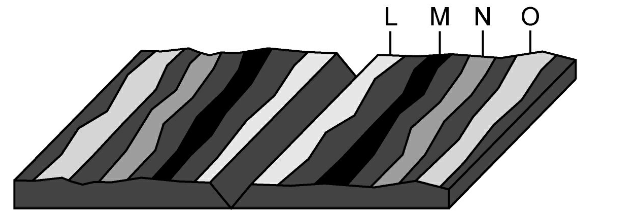
Where would the oldest rock be found if this was a divergent boundary?
a)
L
b)
M
c)
N
d)
O
73.
What type of boundary does not destroy or create new crust?
a)
Divergent
b)
Transform
c)
Convergent
74.
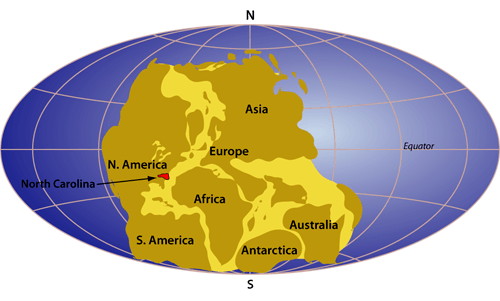
What is this a picture of?
a)
plate tectonics
b)
continental drift
c)
pangea
d)
glacier scaring
75.
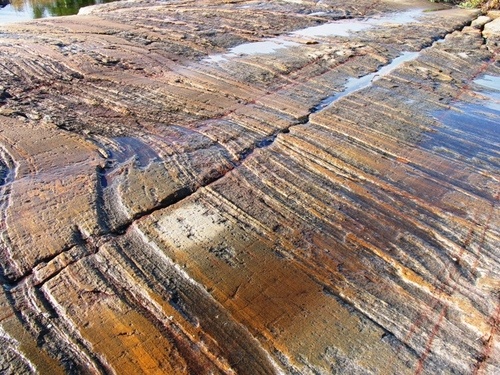
This is a picture of glacier scars found in Africa. What are these evidence for?
a)
Africa has always been near the equator
b)
Africa was once in an area of the Earth that had a very cold climate
c)
The continents have not moved
d)
sea floor spreading
76.
What does the theory of continental drift state?
a)
The continents were once joined in a super-continent and have moved over time
b)
Continents are stationary and do not move
c)
The Earth is broken into lithospheric plates that move due to convection currents
d)
none of the above
77.
What evidence did Wegener use in his theory?
a)
Continents and fossils fitting together/matching-up like puzzle pieces
b)
glacier scars and evidence from temperature
c)
mountain ranges and coal deposits line up across continents
d)
all of the above
78.
What two specific continents fit together most noticeably?
a)
Africa and North America
b)
South America and Europe
c)
South America and Africa
d)
Antartica and Africa
79.
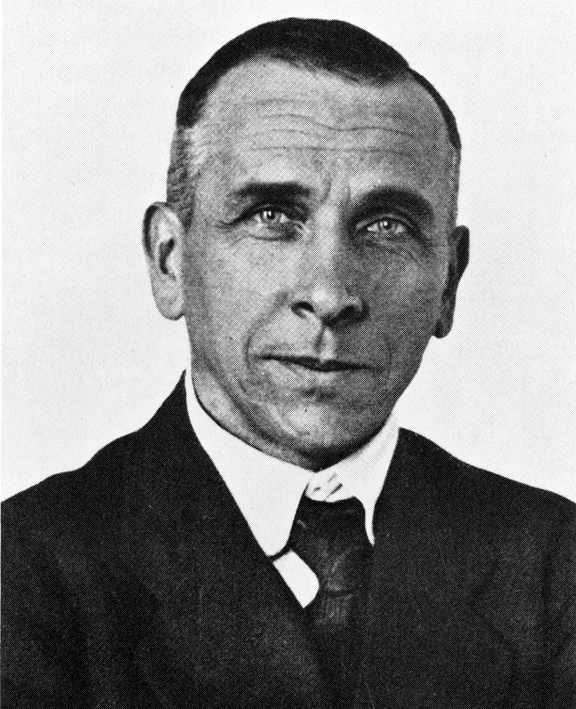
Who is the person credited with developing the theory of continental drift?
a)
Harry Hess
b)
Galileo
c)
Alfred Wegener
d)
Newton
80.
Why did no one believe Wegener's thoery?
a)
He could not explain HOW the continents moved
b)
He didn't have evidence
c)
His data was wrong
d)
He didn't use the right technology to gather data
81.
What type of evidence was NOT used by Alfred Wegener to support his continental drift hypothesis?
a)
evidence from landforms
b)
evidence from fossils
c)
evidence from human remains
d)
evidence from climate
82.
The geological theory that states that pieces of Earth's lithosphere are in constant, slow motion is the theory of
a)
subduction
b)
plate tectonics
c)
evolution
d)
seafloor spreading
83.
The process by which the ocean floor sinks beneath a deep ocean trench and back into the mantle is known as
a)
convection
b)
continental drift
c)
subduction
d)
conduction
84.
A collision between two pieces of continental crust at a converging boundary produces a
a)
mid-ocean ridge
b)
deep ocean trench
c)
volcanic mountain range
d)
folded mountain range
85.
The best evidence that the continents were once connected is that they have matching
a)
Weather, fossils, and Rock Types
b)
Rock types, fossils, coastlines
c)
Coastlines, weather, rock types
d)
Coastlines, weather, fossils
86.
Of the following statements, which best supports the continental drift theory?
a)
All oceans are salty
b)
Igneous rocks are found on all continents
c)
Fossils of the same species of extinct land plants have been found in both South America and Africa
d)
Early humans migrated to North America over a land bridge from eastern Asia
87.
Which of the following is the best evidence that Earth's continents were once in vastly different positions than they are today?
a)
Penguins only found in southern hemisphere
b)
Fossils of tropical plants found in Antartica
c)
Volcanoes encircling Pacific Ocean
d)
Major rivers from deltas from continental erosion
88.
What do you call the evidence of Wegener's Theory that tells about the remains of an organism that lived long time ago?
a)
Ashes
b)
Bones
c)
Follicles
d)
Fossils
89.

What are the remains of organism noticed by Wegener that are found the same in two continents?
a)
Leaves and flowers
b)
Ice and mountains
c)
Plants and animals
d)
Dinosaurs and reptiles
90.
The following are animal fossil evidences of the Continental Drift theory except?
a)
Glossopteris
b)
Cynognathus
c)
Lystrosaurus
d)
Mesosaurus
91.

Mesosaurus fossils are found between where?
a)
India
b)
Africa and South America
c)
Antartica
d)
Australia
92.

Cynognathus fossils are found between where?
a)
India
b)
Africa and South America
c)
Antartica
d)
South America only
93.

Glossopteris fossils are found between where?
a)
India
b)
I really don't know 😭😂
c)
Antarctica
d)
All of them
100 %

