
 Worksheets
Natural Resources
Total questions: 89
Worksheet time: 3hrs 33mins
Name
Class
Date
1.
A natural resource that can be replaced at the same rate at which the resource is consumed.
a)
nonrenewable resource
b)
renewable resource
c)
oil
d)
gas
2.
A resource that forms at a rate that is much slower than the rate at which it is consumed.
a)
non renewable resource
b)
renewable resource
3.
The process of recovering valuable or useful materials from waste or scrap; the process of reusing some items.
a)
recycling
b)
nonrenewable resources
c)
oil
4.
A nonrenewable energy resource formed from the remains of organisms that lived long ago; examples include oil, coal, and natural gas.
a)
oil
b)
coal
c)
fossil fuels
d)
natural gas
5.
A fossil fuel that forms underground from partially decomposed plant material.
a)
coal
b)
smog
c)
acid percipitation
d)
natural gas
6.
Precipitation, such as rain, sleet, or snow, that contains a high concentration of acids, often because of the pollution of the atmosphere.
a)
smog
b)
acid precipitation
c)
coal
d)
natural gas
7.
Photochemical haze that forms when sunlight acts on industrial pollutants and burning fuels.
a)
acid precipitation
b)
natural gas
c)
smog
d)
fossils
8.
The energy released by a fission or fusion reaction; the binding energy of the atomic nucleus.
a)
chemical energy
b)
nuclear energy
9.
the energy received by the earth from the sun in the form of radiation.
a)
wind power
b)
solar energy
c)
hydroelectric energy
d)
gasohol
12.
The use of a windmill to drive an electric generator.
a)
solar energy
b)
wind energy
c)
hydroelectric energy
d)
nuclear energy
11.
Electrical energy produced by falling water.
a)
wind power
b)
solar energy
c)
hydroelectric energy
d)
biomass
12.
The use of a windmill to drive an electric generator.
a)
solar energy
b)
wind energy
c)
hydroelectric energy
d)
nuclear energy
13.
Which statements describe global warming?
a)
Global warming can be decreased through deforestation.
b)
Global warming results from the buildup of nutrients in runoff
c)
Global warming is likely increased by humans
d)
Global warming is enhanced by nonnative species
14.
Takes millions of years to form.
a)
hydroelectric
b)
renewable
c)
solar
d)
fossil fuels
15.
Which of the following would you need to convert hydropower to electricity?
a)
Coal Plants
b)
Solar Panels
c)
A Wind Turbine
d)
A Dam
16.
Which of the following energy resource is a fossil fuel?
a)
Coal
b)
Oil
c)
Natural Gas
d)
All of the above
17.
All of the things we use from the environment or the world around us...
a)
Living Resources
b)
Nonrenewable Resources
c)
Renewable Resources
d)
Natural Resources
18.
Which of the following energy resources is renewable?
a)
Energy from Crude Oil
b)
Energy from Coal
c)
Energy from Wind
d)
Energy from Natural Gas
19.
Nuclear energy is renewable or nonrenewable
a)
renewable
b)
nonrenewable
20.

Animals are what type of resource?
a)
Renewable
b)
Nonrenewable
21.

Which of the following resources is renewable?
a)
coal
b)
trees
c)
petroleum
d)
natural gas
22.

Which group includes ALL nonrenewable resources?
a)
coal, trees, water, and sun
b)
carbon, sun, water, oil
c)
oil, coal, natural gas
d)
water, wind, sun
23.
A resource is considered (thought of as) renewable if it ____
a)
can be replaced in a short time
b)
takes over a million years to replace
c)
is made from minerals
d)
can be turned into energy
24.
Pollution is ________
a)
people contaminating, or dirtying an area with waste.
b)
people cleaning, or fixing up an area.
c)
people gathering, or collecting the trash in the area.
25.
Which of these is recycling?
a)
Making a small plastic windmill out of plastic bottles
b)
Fixing up a windmill
c)
Destroying a windmill
26.

Fossil fuels are considered nonrenewable resources because of -
a)
Where they come from
b)
How they are produced
c)
How useful they are
d)
How long they take to form
27.
Which is an example of how not to conserve water?
a)
Check your faucets and pipes for leaks and fix them, if needed.
b)
Letting the water run while you brush your teeth.
c)
Cleaning your driveway with a hose.
d)
Insulate your water pipes.
28.

Coal is a __________ energy resource.
a)
Renewable
b)
Nonrenewable
29.

Natural Gas is a __________ energy resource.
a)
Renewable
b)
Nonrenewable
30.

Wind is a __________ energy resource.
a)
Renewable
b)
Nonrenewable
32.

Geothermal Power is a __________ energy resource.
a)
Renewable
b)
Nonrenewable
32.
Geothermal Power is a __________ energy resource.
a)
Renewable
b)
Nonrenewable
33.
What does reduce mean?
a)
make bigger
b)
add things
c)
make smaller
d)
make different
34.
What does reuse mean?
a)
Use again
b)
Throw away
c)
To buy again
d)
To make again
35.
An example of reducing would be....?
a)
recycling a waterbottle
b)
reusing a piece of paper
c)
cutting down on waste
d)
reusing a plastic bag
36.

__________ is an energy resource that WILL run out in the next several hundred years.
a)
Renewable Energy Resource
b)
Nonrenewable Energy Resource
37.

__________ is an energy resource that WILL NOT run out in the next several hundred years.
a)
Renewable Energy Resource
b)
Nonrenewable Energy Resource
38.

The sun is the source of all energy on Earth.
a)
true
b)
false
39.

Which of the following compounds is considered to be a greenhouse gas?
a)
water
b)
carbon dioxide
c)
urea
d)
sodium hydroxide
40.
Why do we not have more nuclear power plants?
a)
It doesn't produce a lot of electricity
b)
risk of radioactive leaks
c)
we are running out of uranium
d)
we are using the uranium for bombs instead of energy
41.
Which stage of coal is the final stage?
a)
Lignite Coal
b)
Bituminous Coal
c)
Anthracite Coal
d)
Peat
42.
Which of the following is Not a Non-Renwable Resource?
a)
Coal
b)
Animals
c)
Petroleum
d)
Natural Gas
43.
One way a factory could help conserve the river water as a natural resource is?
a)
filter the water before dumping it into the river
b)
remove all the animals from the area for their protection
c)
set up nets down river to remove contaminated fish
d)
post signs that say "No swimming in the river"
44.
Which of the following is a renewable resource?
a)
gold
b)
iron
c)
coal
d)
plants
45.
A farmer decides that he is going to produce his own energy on the farm by creating a renewable resource. The renewable resource could come from....
a)
having a coal furnice
b)
setting up wind turbines
c)
burning oil
d)
using natural gas
46.
What is the best way to recycled water used in an experiment in class?
a)
use it to water plants
b)
pour it down the sink
c)
drink the water from the beakers
47.

What should be shown in picture 2 to show that trees are a renewable resource?
a)
young sapling trees have been planted
b)
there is a pond in which fish live
c)
a log cabin has been built within the trees
d)
the stumps are removed from the leveled land
48.
Fossil Fuels such as coal, oil, and natural gas are non renewable because....
a)
we have already run out of them
b)
it takes millions of years for them to form
c)
they are buried decay animals that are difficult to mine
d)
scientists wants to save as many types as possible
49.
A loose mixture of small mineral fragments, organic material, and water that support the growth of vegeation
a)
Humus
b)
soil
50.
Things we take from the environment and use are called:
a)
rocks
b)
natural resources
c)
pollutants
d)
energy
51.
Which of the following is a way a person could conserve natural resources?
a)
recycling waste materials like plastic, glass, paper, and aluminum
b)
limiting water use when showering, brushing teeth, and shaving
c)
using rechargeable batteries
d)
all of the above are good conservation practices
52.
Layers of air (gas) surrounding earth
a)
Recycle
b)
Atmosphere
c)
Replenish
d)
Soil Erosion
53.
Primary energy source made from organic material
a)
Replenish
b)
Nonrenewable
c)
Renewable
d)
Fossil Fuel
54.
Natural resources that can be replaced within a lifetime
a)
Renewable
b)
Nonrenewable
c)
Pollution
d)
Conservation
55.
Natural resources that cannot be replaced within a lifetime.
a)
Renewable
b)
Nonrenewable
c)
Pollution
d)
Conservation
56.
To give back a supply that was used
a)
Replenish
b)
Soil Erosion
c)
Natural Resource
d)
Conservation
57.
The wise use of resources to keep them for future generations
a)
Conservation
b)
Recycle
c)
Natural Resources
d)
Fossil Fuel
58.
The reuse of material that would be waste
a)
Replenish
b)
Recycle
c)
Natural Resources
d)
Fossil Fuel
59.
Which of the following is an example of a non-renewable resources?
a)
cotton
b)
trees
c)
cattle
d)
uranium
60.
Renewable resources ____.
a)
can be replenished over months, years, or decades
b)
are all living resources
c)
have finite supplies that will one day be used up
d)
include iron, natural gas, and copper
61.
Which of the following is an example of a renewable resource?
a)
cotton
b)
copper
c)
natural gas
d)
coal
62.
The advantages of solar energy include the fact that it is ____.
a)
nonrenewable
b)
non-polluting
c)
expensive
d)
abscent at night
63.
Harnessing the sun’s energy to produce heat or electricity is ____.
a)
non-polluting
b)
inexpensive
c)
possible only in coastal areas
d)
a major source of air pollution
64.
What is one of the drawbacks to the extensive use of solar energy?
a)
nonrenewable
b)
Necessary equipment and installation are expensive
c)
It is avalable only at night
d)
It produces toxic pollution
65.
The fuel for nuclear fission in nuclear reactors is ____.
a)
petroleum
b)
carbon
c)
hydrogen
d)
uranium
66.
Which of the following is a problem associated with the increased use of nuclear energy?
a)
cost of building safe nuclear facilitiesve
b)
major hazards involved in nuclear waste disposal
c)
concern over the possibility of a serious nuclear accident
d)
all of the above
67.
One problem with wind energy as a major source of electricity is ____.
a)
it is nonrenewable
b)
it causes major air pollution
c)
it does not work during the night
d)
the expense of large tracts of land in populated areas
68.
Hydroelectric power is produced by ____.
a)
falling water that turns a turbine
b)
tides that pour through a dam barrier
c)
hot water that comes from deep underground
d)
electric current that flows across a dam
69.
What is the source of geothermal energy?
a)
sunlight heating surface waters
b)
the splitting of atoms to release energy
c)
natural underground reserviors of steam and hot water
d)
very hot minerals deep underground
70.

According to Figure 4-2, what is the single largest source of air pollutants?
a)
solid waste disposal
b)
transportation
c)
stationary source fuel combustion
d)
industrial processes
71.
What is the function of the atmospheres ozone layer?
a)
shields Earth from harmful solar radiation
b)
provides the oxygen needed by human life
c)
protects Earth from the sun's heat
d)
removes pollution from the atmosphere
72.
The greenhouse gas carbon dioxide helps to ____.
a)
deflect harmful radiation from space
b)
increase precipitation in arid areas
c)
form clouds in the atmosphere
d)
maintain warmth near Earth's surface
73.
Which of the following products do petroleum resources provide in addition to energy?
a)
aggregate
b)
plastic
c)
nickle
d)
cardboard
74.
One way that mining for mineral resources damages the land is by ____.
a)
adding greenhouse gases to the environment
b)
depleting the world's ozone
c)
causing salinization
d)
increasing soil erosion
75.
Cars with hybrid and electric motors ____.
a)
use more fuel than conventional cars
b)
create less air pollution than conventional cars
c)
use solar panels for power
d)
are no longer produced
76.
carbon dioxide is a gas produced by _ and used by -
a)
plants and animals
b)
carbon and photosynthesis
c)
animals and plants
d)
photosynthesis
77.
plants require _, _, and _ for photosynthesis
a)
sunlight
b)
water
c)
carbon
d)
sunlight,water and carbon dioxide
78.
Using fossil fuels is a safe for the environment.
a)
True
b)
False
79.
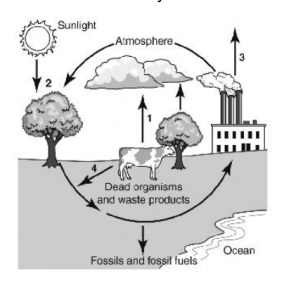
What is happening at 1?
a)
respiration: releasing CO2
b)
decomposing CO2 in the soil
c)
photosynthesis: absorbing CO2
d)
turning CO2 from the atmosphere into organic molecules
80.
Where is a lot of the CO2 located on earth?
a)
space
b)
absorbed in the ground
c)
in the atmosphere acting as a greenhouse gas
d)
in plants
81.
Photosynthesis
a)
absorbs CO2
b)
releases CO2
82.
Respiration
a)
absorbs CO2
b)
releases CO2
83.
Greenhouse gases....
a)
make plants green
b)
increase the temperature of the earth
c)
produce oxygen
d)
decrease the temperature of the earth
84.
Organisms that do not decompose can be buried and become what?
a)
water
b)
nutrients
c)
air
d)
fossil fuels
85.
Carbon is....
a)
the least common element in all living things.
b)
found only in the atmosphere and rocks.
c)
the most common element in all living things.
d)
is found mostly in dead things.
86.
Which of the following is not a decomposer
a)
Vulture
b)
Fungus
c)
Worm
d)
Bacteria
87.
In the food web, which organisms release the carbon from dead things back into the environment?
a)
Producers
b)
Consumers
c)
Scavengers
d)
Decomposers
88.
These gases, such as carbon dioxide, trap heat in the Earth's atmosphere causing global warming
a)
Global warming gases
b)
Hot House gases
c)
Green House gases
d)
Thermal pollution
89.
Which process takes Carbon Dioxide from the air and converts it into a form of carbon used by living things?
a)
Precipitation
b)
Photosynthesis
c)
Respiration
d)
Bioremdiation
100 %

