
 Worksheets
WATER CYCLE & Water Distribution & Ocean Floor
Total questions: 84
Worksheet time: 2hrs 28mins
Name
Class
Date
1.
What is the water cycle
a)
the 3 forms of water
b)
the process from which rain occurs
c)
when water melts
d)
when clouds form
2.

What part of the water cycle does this picture show?
a)
condensation
b)
precipitation
c)
evaporation
d)
sublimation
3.

Does evaporation happen before or after condensation?
a)
before
b)
after
c)
during
d)
dont know
4.
what is the main source of freshwater on earth
a)
ocean water
b)
well water
c)
pond water
d)
rainwater
5.
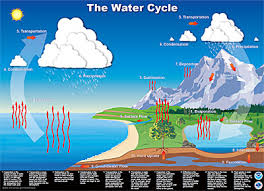
During which stage do clouds form?
a)
condensation
b)
evaporation
c)
precipitation
6.
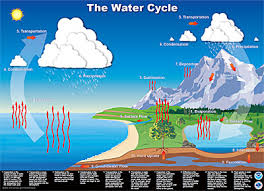
Which stages does liquid water from the ocean turn into water vapor?
a)
condesantion
b)
evaporation
c)
precipitation
d)
run off
7.
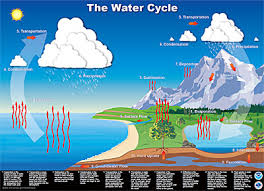
Which stage does ground water try to return to the ocean or soak into the ground?
a)
condensation
b)
evaporation
c)
precipitation
d)
run off
8.
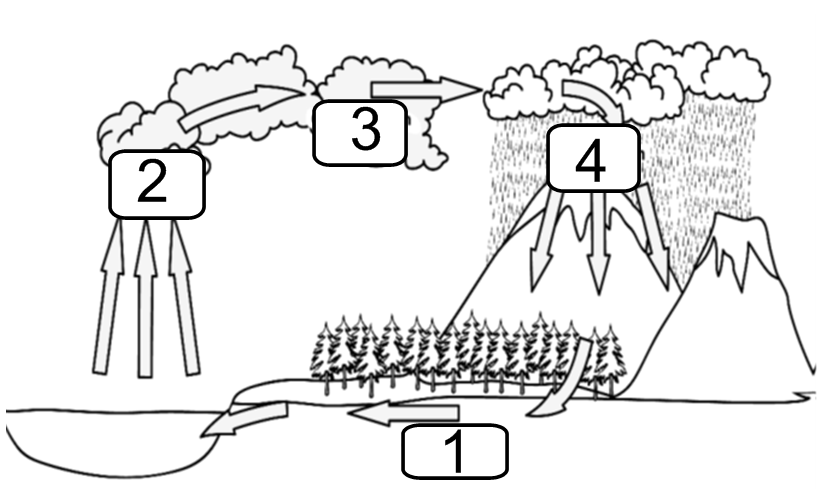
Which stage does the #2 show in the diagram?
a)
condensation
b)
evaporation
c)
precipitation
d)
run off
9.

Which stage does the #3 show in the diagram?
a)
condensation
b)
evaporation
c)
precipitation
d)
run off
10.

what does the #4 show in the diagram?
a)
condensation
b)
evaporation
c)
precipitation
d)
run off
11.

What is it called when plants give off water vapor as a waste product?
a)
condensation
b)
evaporation
c)
sublimation
d)
transpiration
12.
What happens after groundwater at the very end/beginning of the water cycle?
a)
Evaporation
b)
Transpiration
c)
Condensation
d)
Groundwater
13.

What is it called when WATER is FORMED from an LIQUID to a WATER VAPOR Oor an [GAS]?
a)
EVAPORATION
b)
PRECIPITATION
c)
TRANSPIRATION
14.

What is the hydrosphere?
a)
Water on the earth's surface
b)
Oceans of the Earth
c)
Rivers, oceans and lakes of the Earth
d)
None of the above
15.
When water _________, dew and clouds forms.
a)
Melts
b)
Evaporates
c)
Condenses
d)
Precipitates
16.
what causes water vapor to move
a)
wind
b)
snow
c)
water
d)
lava
17.
Where does the energy that powers the water cycle come from?
a)
plants
b)
wind
c)
sun
d)
gravity
24.
What are three stages of the water cycle?
a)
evaporation, condensation, precipitation
b)
condensation, precipitation, hibernation
c)
precipitation, dehydration, evaporation
d)
transpiration, dehydration, condensation
19.
____________ is the name for water that flows off of land forms back into the ocean.
a)
transpiration
b)
run off
c)
condensing
d)
snowmelt
20.
What is the water cycle?
a)
the 3 forms of water
b)
the movement of water on, above, or below the surface of the Earth
c)
when water melts
d)
when clouds form
21.

What is the process of humans putting water into the air through pores in their bodies called?
a)
transpiration
b)
accumulation
c)
perspiration
d)
evaporation
22.
What drives condensation?
a)
the sun
b)
gravity
c)
cooling
23.
What drives precipitation, runoff, and infiltration?
a)
the sun
b)
gravity
c)
cooling
24.
What are three stages of the water cycle?
a)
evaporation, condensation, precipitation
b)
condensation, precipitation, hibernation
c)
precipitation, dehydration, evaporation
d)
transpiration, dehydration, condensation
25.
Breaking down rocks into smaller pieces..
a)
Erosion
b)
Sediment
c)
Weathering
d)
Transpiration
26.
Water is pulled up through the roots and exits through leaves of plants
a)
Precipitation
b)
Evaporation
c)
Condensation
d)
Transpiration
27.
When water turns from water vapor (gas) into a liquid.
a)
Precipitation
b)
Evaporation
c)
Condensation
d)
Transpiration
28.
Water hits the Earth's surface and then travels on the surface without going in the ground...
a)
Collection
b)
Transportation
c)
Infiltration
d)
Runoff
29.
John only washes his clothes after he has worn them several times. John is helping the environment by____________?
a)
wasting water
b)
reusing water
c)
recycling water
d)
conserving water
30.
When water evaporates, it changes into a__________?
a)
solid
b)
mixture
c)
gas
d)
solution
31.

what is the percentage of water on the earth?
a)
baked patoes
b)
97.13
c)
72
d)
blank
32.
in what 3 percent of water on earth is in what .............
a)
ice caps,Glaciers
b)
ground water
c)
ocean water
d)
swiming pools
33.
Water that fills spaces between particles of rock and soil is
a)
rainwater
b)
salt water
c)
groundwater
d)
reservoir water
34.
What carries warm water toward the poles?
a)
tides
b)
rivers
c)
waves
d)
currents
35.
The oceans cover about what percentage of Earth?
a)
25 percent
b)
50 percent
c)
75 percent
d)
90 percent
36.
97% of Earth's water is __________ water.
a)
Fresh
b)
Salt
37.
3% of Earth's surface water is _________ water.
a)
Fresh
b)
Salt
38.
Which represents the distribution of water on Earth?
a)
3% freshwater, 97% salt water
b)
97% freshwater, 3% salt water
c)
71% freshwater, 29% salt water
d)
29% freshwater, 71% salt water
39.
What do we call the land area that supplies water to a river system?
a)
runoff
b)
recharge
c)
watershed
d)
valley
40.

Saltwater makes up what percent of the water on Earth?
a)
65%
b)
70%
c)
755
75
5
5%
75
5
5%
d)
75%
41.

A watershed is an
a)
area that drains into a stream or river
b)
section of land that juts into the ocean
c)
the shoreline of the ocean
d)
the end of a continent
42.
What is an underground layer of rock or soil filled with water called?
a)
Aquifer
b)
Spring
c)
Well
d)
Reservoir
43.
When water soaks the ground it becomes groundwater through what process?
a)
Runoff
b)
Infiltration
c)
Transpiration
44.
There were tables set up outside on the ______ so we could enjoy dinner with a view.
a)
terrestrial
b)
terrain
c)
territory
d)
terrace
45.
Any type of moisture that falls to the Earth.
a)
evaporation
b)
precipitation
c)
condensation
d)
transpiration
46.
The release of moisture by living plants.
a)
evaporation
b)
precipitation
c)
condensation
d)
transpiration
47.
Which source of freshwater is not easily available for human use?
a)
oceans
b)
freshwater lakes
c)
rivers
d)
icecaps/glaciers
48.
Where is most of the freshwater found on Earth?
a)
lakes
b)
glaciers
c)
oceans
d)
rivers
49.

Most of the Earth's water is in
a)
salty oceans
b)
freshwater lakes
c)
freshwater ponds
d)
glaciers
50.
The flow of water from land into a body of water.
a)
groundwater
b)
headwaters
c)
run-off
d)
infiltration
51.
What follows evaporation during the water cycle? How does this occur?
a)
Water evaporates into water vapor
b)
Water vapor condenses and forms a cloud
c)
Water precipitates to the ground
d)
Water runs down into the hydrosphere
52.

Approximately what percent of the Earth is covered by water?
a)
71%
b)
29%
c)
50%
d)
97%
53.
Which represents the distribution of water on Earth?
a)
3% freshwater, 97% salt water
b)
97% freshwater, 3% salt water
c)
71% freshwater, 29% salt water
d)
29% freshwater, 71% salt water
54.

The amount of dissolved solids present in the water
a)
salinity
b)
chlorine
c)
nitrogen
d)
density
55.
Where does condensation occur (forming the clouds)?
a)
Hydosphere
b)
Geosphere
c)
Lithosphere
d)
Atmosphere
56.
What follows evaporation during the water cycle? How does this occur?
a)
Water evaporates into water vapor
b)
Water vapor condenses and forms a cloud
c)
Water precipitates to the ground
d)
Water runs down into the hydrosphere
57.
When water _________, dew forms.
a)
Melts
b)
Evaporates
c)
Condenses
d)
Precipitates
58.

What is D?
a)
Evaporation
b)
Condensation
c)
Precipitation
d)
Runoff
59.

What is C?
a)
Evaporation
b)
Condensation
c)
Precipitation
d)
Runoff
60.
What do you call an underwater mountain?
a)
trench
b)
abyssal plain
c)
seamount
d)
volcanic island
61.
The large, flat part of the ocean floor is called the _____________.
a)
trench
b)
continental shelf
c)
continental slope
d)
abyssal plain
62.
A volcanic mountain that rises above the surface of the water is called ____________
a)
trench
b)
island
c)
mid-ocean ridge
d)
seamount
63.
What is a deep, underwater valley or canyon on the ocean floor?
a)
seamount
b)
trench
c)
continental rise
d)
continental slope
64.
The shallowest(least deep) part of the ocean is the ____________________
a)
trench
b)
abyssal plain
c)
continental shelf
d)
continental slope
65.
A trench is _______________
a)
cold and shallow
b)
deep and warm
c)
deep and cold
d)
warm and shallow
66.
If you are on the beach, laying on a beach towel and playing in the sand, you are on the _______________________
a)
continent
b)
continental slope
c)
abyssal plain
d)
continental shelf
67.
If you are walking into the ocean you would be on the continental...
a)
shelf
b)
slope
c)
rise
68.
A steep drop after the continental shelf is the continental...
a)
slope
b)
shelf
c)
rise
69.
mountain ranges in the ocean
a)
mid -ocean ridge
b)
trenches
c)
rift
d)
ocean basin
70.
Which process adds more crust to the ocean floor?
a)
earthquakes
b)
sea floor spreading
c)
subduction
d)
convection
71.
This boundary is also called a colliding boundary.
a)
transform
b)
convergent
c)
divergent
72.
This boundary moves away from another boundary.
a)
divergent
b)
convergent
c)
transform
73.
Alfred Wegener believed that all the continents were connected at one time. What did he call this one large land mass?
a)
Pancakes
b)
Pangaea
c)
Pancreas
d)
Patches
74.
A valley found in the middle of the mid-ocean ridge
a)
rift
b)
trenches
c)
abyssal plain
d)
ocean basin
75.
Coral reefs are found on...
a)
continental slopes
b)
continental shelves
c)
abyssal plains
d)
trenches
76.
What type of boundary do earthquakes usually occur along?
a)
transform
b)
divergent
c)
convergent
81.

Letter D is pointing to the...
a)
continental slope
b)
continental shelf
c)
trench
d)
mid-ocean ridge
78.

The ocean makes up about ________ % of the Earth's surface.
a)
100%
b)
53%
c)
70 %
d)
90%
79.
When you are building a sand castle on the beach, what feature are you standing on?
a)
abyssal plain
b)
continental shelf
c)
seamount
d)
continental rise
80.

What is letter C pointing to?
a)
abyssal plain
b)
seamount
c)
mid-ocean ridge
d)
continental shelf
81.
Letter D is pointing to the...
a)
continental slope
b)
continental shelf
c)
trench
d)
mid-ocean ridge
82.
The tops of underwater mountains that show above the surface of the ocean form _______________.
a)
islands
b)
trenches
c)
mountains
d)
coral reefs
83.

Letter A is pointing to the _______________________.
a)
Continental shelf
b)
Mid-ocean ridge
c)
Continental slope
d)
Trench
84.
_____________ is the measure of how salty the ocean's water is.
a)
salinity
b)
solution
c)
coral
d)
plankton
100 %

