wayground logo

Free Printable Worksheets

NEW

Font size

S
M
L
XL
Worksheets

Waves and Eye Review for Test Part 2

Total questions: 80

Worksheet time: 1hrs 9mins
Name
Class
Date
1.

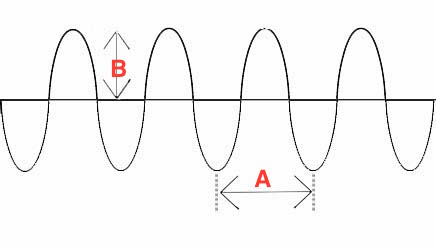
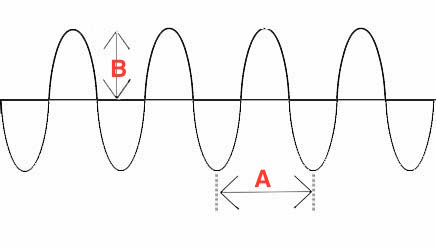
What property of this wave is represented by the letter "A"

a)

amplitude

b)

crest

c)

trough

d)

wavelength

2.
What property of the wave is represented by the letter "B"?
a)
amplitude
b)
crest
c)
trough
d)
wavelength
3.
The highest point on a wave is:
a)
the crest
b)
the trough
c)
the top
d)
the coast 
4.
The lowest point on a wave is the:
a)
Amplitude
b)
Crest
c)
Trough
d)
Wavelength
5.
The number of wavelengths that pass a point each per second is:
a)
frequency
b)
period
c)
longitudinal 
d)
transverse wave 
6.
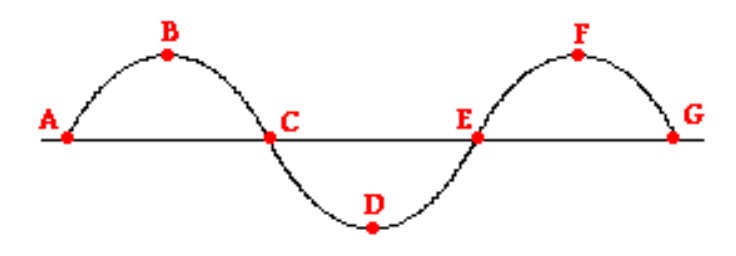
Which vocabulary term is used to identify the distance between points C & G?
a)
Amplitude
b)
Crest
c)
Frequency
d)
Wavelength
7.
When the frequency of a wave increases, what happens to the wavelength?
a)
The wavelength is not directly affected by the frequency of a wave.
b)
The wavelength increases.
c)
The wavelength decreases.
d)
More specific information is needed to form a conclusion about the wavelength.
8.
A mechanical wave cannot travel through...
a)
a vacuum(empty space).
b)
water.
c)
air. 
d)
glass.
9.
Which letter(s) represent the trough of the wave?
a)
A
b)
B & D
c)
D
d)
C & G
10.
Which letter(s) represent the crest of the wave?
a)
A
b)
B & D
c)
B & F
d)
F
11.
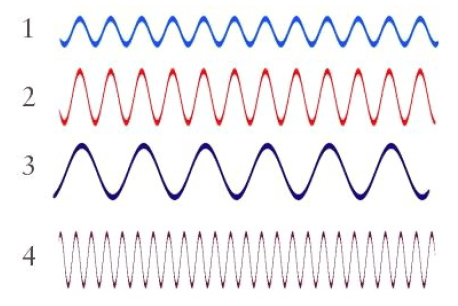
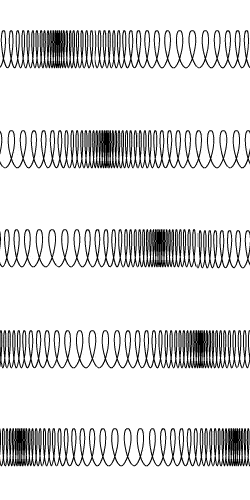
Which wave in the diagram has the greatest frequency?
a)
1
b)
2
c)
3
d)
4
12.
Which wave in the diagram has the greatest wavelength?
a)
1
b)
2
c)
3
d)
4
13.
Which of the following can sound travel through?
a)
solid
b)
liquid
c)
gas
d)
all of the above
14.
crest to crest or trough to trough
a)
crest
b)
trough
c)
amplitude
d)
wavelength
15.
Electromagnetic waves include the following except
a)
radio waves
b)
X-rays
c)
doing the wave at a football game
d)
microwaves
16.
regular disturbances that carry energy through matter or space
a)
crest
b)
energy
c)
wave
d)
trough
17.
which material does sound travel the fastest?
a)
solid 
b)
liquid 
c)
gases
18.
When a wave strikes and object and bounces off. (example echo)
a)
medium
b)
refraction
c)
reflection
d)
interference
19.
When a wave bends as it passes through at an angle from one medium to another.(example: pencil in a glass of water-)
a)
medium
b)
refraction
c)
reflection
d)
interference
20.
A wave carries...?
a)
energy only
b)
matter only
c)
energy and matter
d)
neither
21.
What kind of waves can travel through space?
a)
electromagnetic waves
b)
compressional waves
c)
longitudinal waves
d)
sound waves
22.
The lowest part of the wave is called the ?
a)
frequency
b)
crest
c)
amplitude
d)
trough
23.
What is the measure of how many waves pass a point in a second?
a)
frequency
b)
wavelength
c)
midpoint
d)
crest and trough
24.
A compressional wave is another name for a 
a)
longitudinal wave
b)
electromagnetic wave
c)
radio wave
d)
hair wave
25.
In a longitudinal wave, the particles move...?
a)
back and forth
b)
up and down
c)
not at all
d)
at a 90 degree angle
26.
Amplitude is a measure of how much _________ the wave is carrying
a)
energy
b)
matter
c)
medium
d)
frequency
27.
_____________________ is the distance between a point on one wave and the identical point of the next wave.
a)
Amplitude
b)
Wavelength
c)
Frequency
d)
Crest
28.
The longer the _____________  the ______________ the frequency.
a)
wavelength, lower
b)
wavelength, higher
c)
amplitude, lower
d)
amplitude, higher
29.
Which wave has a greater frequency?
a)
A
b)
B
30.
You can't hear sounds in outer space because there is no
a)
matter
b)
light
c)
energy
d)
heat
31.
What do seismic waves and sound waves have in common?
a)
they're mechanical waves
b)
they're electromagnetic waves
c)
they're transverse waves
d)
they're permanent waves
32.
When a wave's amplitude increases it means
a)
it's carrying more energy
b)
its wavelength gets longer
c)
its frequency increases
d)
its wavelength decreases
33.
Which is an example of a longitudinal wave?
a)
light wave
b)
sound wave
c)
visible wave
d)
radio wave
34.
Of the following, ________ have the greatest frequency of the electromagnetic spectrum.
a)
ultraviolet rays
b)
gamma rays
c)
radio
d)
visible waves
35.
All waves carry ________ as they travel from one place to another.
a)
matter
b)
space
c)
energy
d)
water
36.
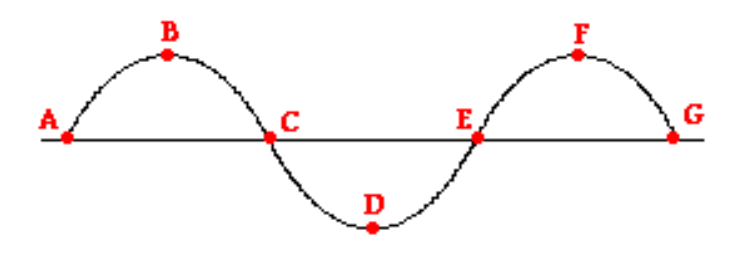
What property of the wave is represented by the letter "B"?
a)
amplitude
b)
crest
c)
trough
d)
wavelength
37.
When the frequency of a wave increases, what happens to the wavelength?
a)
The wavelength is not directly affected by the frequency of a wave.
b)
The wavelength increases.
c)
The wavelength decreases.
d)
More specific information is needed to form a conclusion about the wavelength.
38.
A mechanical wave cannot travel through...
a)
a vacuum(empty space).
b)
water.
c)
air. 
d)
glass.
39.
Which letter(s) represent the trough of the wave?
a)
A
b)
B & D
c)
D
d)
C & G
40.
Which letter(s) represent the crest of the wave?
a)
A
b)
B & D
c)
B & F
d)
F
41.
Which wave in the diagram has the greatest frequency?
a)
1
b)
2
c)
3
d)
4
42.
Which wave in the diagram has the greatest wavelength?
a)
1
b)
2
c)
3
d)
4
43.
Which of the following can sound travel through?
a)
solid
b)
liquid
c)
gas
d)
all of the above
44.
When a wave strikes and object and bounces off. (example echo)
a)
medium
b)
refraction
c)
reflection
d)
interference
45.
When a wave bends as it passes through at an angle from one medium to another.(example: pencil in a glass of water-)
a)
medium
b)
refraction
c)
reflection
d)
interference
46.
Sound is a form of? 
a)
energy
b)
pitch
c)
volume
d)
matter
47.
_______ carry the greatest amount of energy. 
a)
x-rays
b)
gamma rays
c)
infrared rays
d)
visible light
48.
Cell phones use_____________waves.
a)
Microwaves
b)
Gamma
c)
XRays
d)
Radio 
49.
Amplitude reflects the amount of ____________________ in a wave.
a)
energy
b)
compression
c)
rarefaction
d)
speed
50.
These waves carry the energy of earthquakes.
a)
seismic waves
b)
transverse waves
c)
longitudinal waves
51.
Which wave in the diagram has the greatest wavelength?
a)
1
b)
2
c)
3
d)
4
52.
What type of wave is this?
a)
Longitudinal
b)
Transverse
53.
This is a __________wave
a)
transverse
b)
longitudinal
c)
surface
d)
all of the above
54.

This image best depicts which of the following wave behaviors?

a)

Reflection

b)

Refraction

c)

Diffraction

d)

Resonance

55.

This image depicts which of the following wave behaviors?

a)

Reflection

b)

Refraction

c)

Diffraction

d)

Resonance

56.

The image depicts which of the following wave behaviors?

a)

Resonance

b)

Doppler Effect

c)

Interference

d)

Polarization

57.

The two blue and purple waves will undergo _________________ when they meet.

a)

Constructive interference

b)

Destructive interference

58.

The image of the two waves depicts

a)

Constructive interference

b)

Destructive interference

59.

Definition: the change in direction of a wave passing from one medium to another

a)

Reflection

b)

Refraction

c)

Diffraction

d)

Polarization

60.

Two waves that undergo constructive interference must be...

a)

In phase

b)

Out of phase

61.

Two waves that undergo destructive interference must be...

a)

In phase

b)

Out of phase

62.

Which part of the eye protects the front of the eye?

a)

Sclera

b)

Cornea

c)

Vitreous humor

d)

Optic nerve

63.

What is the name of the part represented by letter A?

a)

Conjunctiva

b)

Cornea

c)

Iris

d)

Retina

64.

This part of the eye changes shape to focus light on the retina...

a)

Iris

b)

Pupil

c)

Lens

d)

Ciliary body (muscle)

65.

What is the part of the eye represented by letter H?

a)

Suspensory ligaments

b)

Lens

c)

Iris

d)

Pupil

66.

This part of the eye is the opening that light passes through...

a)

F

b)

J

c)

H

d)

I

67.

Which part of the eye is represented by letter I?

a)

Pupil

b)

Lens

c)

Iris

d)

Aqueous humor

68.

This part of the eye sends nerve impulses of images to the brain...

a)

Retina

b)

Fovea

c)

Vitreous humor

d)

Optic nerve

69.

Which part of the eye is represented by letter B?

a)

Optic nerve

b)

Retina

c)

Cornea

d)

Ciliary muscles

70.

This part of the eye has light sensitive receptor cells that send color and detail of an image to the optic nerve...

a)

Optice nerve

b)

Lens

c)

Retina

d)

Cornea

71.

Which part is the iris?

a)

J

b)

F

c)

I

d)

G

72.

Which part of the eye is the cornea?

a)

E

b)

F

c)

H

d)

C

73.

Identify the part of the eye being described.


It is the outer layer of the eye where light passes through.

a)

cornea

b)

iris

c)

retina

d)

pupil

74.

Identify the part of the eye being described.


It is the colored part of the eye.

a)

cornea

b)

iris

c)

retina

d)

pupil

75.

Identify the part of the eye being described.


It is the opening behind the cornea.

a)

cornea

b)

iris

c)

retina

d)

pupil

76.

Identify the part of the eye being described.


It changes light to signals and forms an upside-down image.

a)

cornea

b)

iris

c)

retina

d)

pupil

77.

Identify the part of the eye being described.


It carries signal to the brain for interpretation.

a)

optic nerve

b)

pupil

c)

cornea

d)

retina

78.

Identify the part of the eye being described.


It bends and focuses light to the retina.

a)

lens

b)

pupil

c)

cornea

d)

retina

79.

Adjustable opening through which light enters

a)

retina

b)

optic nerve

c)

iris

d)

pupil

80.
The layer of receptor cells that lines the back of the eye where nerve impulses begin.
a)
Iris
b)
Lens
c)
Retina
d)
Pupil