
 Worksheets
ERMS- 8th Science: CA 1
Total questions: 82
Worksheet time: 2hrs 30mins
Name
Class
Date
1.

What is the smallest particles found in any element and still keep the properties of that element?
a)
molecule
b)
atom
c)
compound
d)
proton
2.

How do scientists make scientific explanations?
a)
Scientists find or make up evidence to make the explanations true.
b)
Scientists base explanations on personal opinions.
c)
Scientists base explanations on a tremendous amount of observations.
d)
Scientists base explanations on gut instincts.
3.

Which form of matter has a definite shape and definite volume. Like this picture?
a)
liquid
b)
solid
c)
gas
d)
clay
4.

Which state of matter has particles arranged like this?
a)
solid
b)
liquid
c)
gas
5.

Which form of matter has takes the shape of its container (no definite shape) but has definite volume?
a)
liquid
b)
solid
c)
glass
d)
gas
6.

What is happening when my water bottle in the freezer goes from a liquid state to a solid state?
a)
melting
b)
evaporating
c)
freezing
d)
cutting
7.

What is happening when my ice cream changes from a solid to a liquid?
a)
freezing
b)
melting
c)
burning
d)
evaporation
8.

What happens when the puddles in the driveway disappear when the sun comes out?
a)
freezing
b)
burning
c)
melting
d)
evaporation
9.

I pour a glass of ice cold lemonade and head outside. Water droplets start to form on the outside of the glass. What is happening?
a)
melting
b)
evaporation
c)
condensation
d)
freezing
10.
Which form of matter does not take the shape of its container (definite shape)?
a)
liquid
b)
gas
c)
solid
d)
air
11.

What phase change happens when water boils?
a)
gas to solid
b)
liquid to gas
c)
gas to liquid
d)
solid to liquid
12.
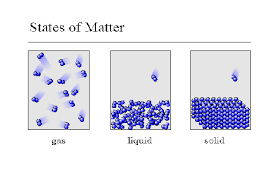
At higher temperatures what happens to the molecules inside a substance?
a)
Molecules have less energy, so they slow down.
b)
Molecules have more energy, so they move faster.
c)
Molecules have less energy, so they move faster.
13.
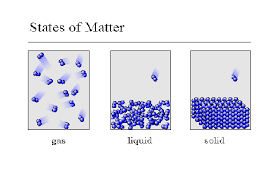
A gas....
a)
has a definite shape but no definite volume
b)
has a definite volume but no definite shape
c)
has fast-moving particles
d)
has slow moving particles
14.

Define a liquid.
a)
Indefinite shape, indefinite volume
b)
Definite shape, definite volume
c)
Found in stars
d)
Definite volume, indefinite shape
15.

Which state of matter has particles arranged like this?
a)
solid
b)
liquid
c)
gas
16.
The state of matter that has no definite size and no definite shape is a....
a)
Solid
b)
Liquid
c)
Gas
17.

Particles of a liquid
a)
are tightly packed together and stay in a fixed position.
b)
have no viscosity.
c)
decrease in volume with increasing temperature.
d)
are free to move around one another but still touch.
18.

What term describes a solid changing to a gas?
a)
Deposition
b)
Sublimation
c)
Evaporation
d)
Freezing
19.

What phase change happens with condensation?
a)
gas to solid
b)
gas to liquid
c)
liquid to solid
d)
solid to liquid
20.
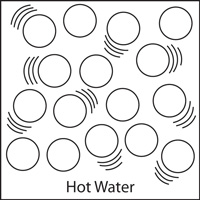
The speed of the molecules determines the _____.
a)
volume
b)
density
c)
pressure
d)
temperature
21.

The slower the particles in a substance move,
a)
the colder it is.
b)
the warmer it is.
c)
the more energy it has.
d)
the less energy it has.
22.

When the temperature of matter increases the particles...
a)
speed up and move closer
b)
speed up and move farther apart
c)
slow down and move closer together
d)
slow down and move farther apart
23.

Which of the following statements is NOT true of all different types of matter?
a)
They are made of atoms and molecules
b)
The particles are always in motion
c)
The particles always move at the same speed
d)
They are made of particles that are too small to see
24.

If the tops were removed from the cylinders, the following would happen:
a)
The solid would fly out of the container
b)
The liquid would fly out of the container.
c)
The gas would fly out of the container.
d)
They ALL would fly out of the container.
25.
When the temperature of matter decreases the particles ...
a)
speed up and move farther apart
b)
speed up and move closer together
c)
slow down and move farther apart
d)
slow down and move closer together
26.

The molecules in the picture are tightly held together with little movement. They have shape and energy. Therefore, the picture represents a _________.
a)
solid
b)
liquid
c)
gas
d)
plasma
27.

Which state of matter has particles arranged like this?
a)
solid
b)
liquid
c)
gas
28.
At what temperature does water boil?
a)
0° C
b)
100° C
c)
212° C
d)
50° C
29.
Heat is added to a substance. The particles of the substance move away from each other and speed up their movement.
a)
The substance is changing from a liquid to a solid.
b)
The substance is changing from a solid to a liquid.
c)
The substance is changing from a liquid to a gas.
d)
The substance is changing from a liquid to a gas to a liquid.
30.

How does fog form?
a)
Air particles liquefy.
b)
Water vapor in the air condenses into liquid drops.
c)
Water on the ground evaporates into air.
31.

How could you find the volume of irregular shaped object?
a)
Try to measure B x W x H as best you can.
b)
Place the object in water and see how much water is displaced.
c)
Weigh the object.
d)
All of the above and then write down the most reasonable.
32.

What happens when an astronaut goes into space?
a)
The mass stays the same and so does the weight.
b)
The mass changes and the weight stays the same.
c)
The weight changes and the mass stays the same.
d)
Both the mass and weight change.
33.

You go to Rocky's and get a double-dip cone. It is 90° outside, and the ice cream starts to melt. Its particles are...
a)
increasing in motion and energy.
b)
decreasing in motion and energy.
c)
increasing in motion and decreasing in energy.
d)
decreasing in motion and increasing in energy.
34.
Which of the following terms identifies the change from a liquid to solid?
a)
Melting
b)
Condensation
c)
Vaporization
d)
Freezing
35.
When the temperature of matter increases the particles...
a)
speed up and move closer
b)
speed up and move farther apart
c)
slow down and move closer together
d)
slow down and move farther apart
36.
No definite shape and no definite volume
a)
Gas
b)
Liquid
c)
Solid
37.
Definite shape and a definite volume.
a)
Gas
b)
Liquid
c)
Solid
38.
No definite shape, but has a definite volume
a)
Gas
b)
Liquid
c)
Solid
39.
Phase change from a solid to a liquid.
a)
melting
b)
sublimation
c)
boiling
d)
condensation
40.
Phase change from a liquid to a gas that only happens at the surface.
a)
evaporation
b)
boiling
c)
sublimation
d)
melting
41.
Change from liquid to gas is called....
a)
expansion
b)
evaporation
c)
condensation
d)
sublimation
42.
Change from Liquid to Solid is call......
a)
fusion
b)
Freezing
c)
sublimation
d)
evaporation
43.
Change from gas to liquid...
a)
condensation
b)
evaporation
c)
expansion
d)
movement
44.
What is it called when a solid turns directly into a gas?
a)
Sublimation
b)
Condensation
c)
Liquid
45.
The amount of matter in an object is its
a)
mass
b)
volume
c)
density
d)
weight
46.
The amount of space an object takes up is its
a)
mass
b)
volume
c)
density
d)
weight
47.
The amount that gravity pulls on you is called
a)
mass
b)
volume
c)
density
d)
weight
48.
Mass is measured with what units?
a)
grams (g)
b)
centimeters (cm)
c)
milliliters (mL)
d)
pounds (lbs)
49.
Volume is measured with what units?
a)
grams (g)
b)
centimeters (cm)
c)
milliliters (mL)
d)
pounds (lbs)
50.
How can volume be determined through water displacement?
a)
measure the graduated cylinder
b)
drop object in cylinder and measure amount water rises
c)
measure length, width, and height
d)
place on a scale
51.

What tool is this?
a)
scale
b)
graduated cylinder
c)
triple beam balance
d)
massonater
52.

What is the volume of liquid in this graduated cylinder?
a)
40.0 mL
b)
40.3 mL
c)
43.0 mL
d)
44.0 mL
53.
An empty beaker has a mass of 60 grams. When oil is added to the graduated cylinder, it has a mass of 200 grams. What is the mass of the oil?
a)
140 grams
b)
200 grams
c)
140 mL
d)
260 g
54.

What is the volume of the fish inside the graduated cylinder?
a)
38 mL
b)
6 mL
c)
32 mL
d)
Not enough information to solve
55.

What is the object pictured used to measure?
a)
Weight
b)
distance
c)
Volume
d)
Mass
56.

What is measured with a graduated cylinder?
a)
Passage of time
b)
Distance from one thing to another
c)
Weight of an object
d)
Volume of liquid
57.
A bar of copper has a mass of 216g and a volume of 24cm3. What is the density of copper?
a)
9g/cm3
b)
.11g/cm3
c)
5184g/cm3
d)
322mL
58.
What is the density of a plastic ball that has a volume of 6cm3 and a mass of 12g?
a)
2g/cm3
b)
.5g/cm3
c)
72g/cm3
d)
4mL
59.
What is the unit of measurement for mass?
a)
mL
b)
cm3
c)
g
d)
g/cm3
60.
To calculate density you would use the following equation
a)
D = M/V
b)
M = D x V
c)
V = M/ D
d)
NONE OF THESE
61.
Calculate the density of a sugar cube with a mass of 2.9 grams and a length of 1.5 cm, width of 1.5 cm. and height of 1.5 cm.
a)
0.859 g/cc
b)
0.528 g/cc
c)
1.93 g/cc
d)
4.35 gcc
62.

Which liquid is the least dense?
a)
oil
b)
water
c)
syrup
d)
plastic bottle
63.

Put the liquids in order from most dense to least dense?
a)
4, 3, 2, 1
b)
1, 2, 3, 4
c)
3, 4, 2, 1,
d)
4, 3, 1, 2
64.
Density is...
a)
the amount of mass in an object
b)
the amount of space an object takes up
c)
the amount of mass in a given space
d)
the weight of an object
65.
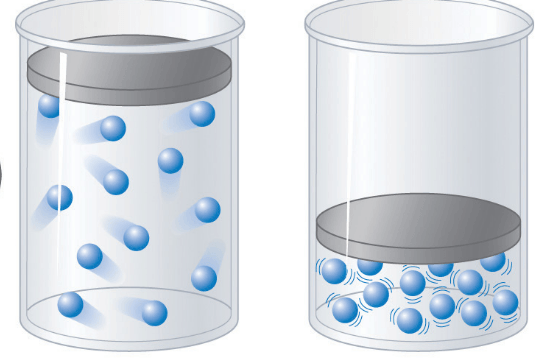
Which container will have a lower pressure?
a)
left
b)
right
c)
they both have the same pressure
d)
I don't know
66.

A sample of a gas in a cylinder as shown. If the temperature is kept constant and the piston moves down to decrease volume, the pressure increases because the gas particles...
a)
expand
b)
lose velocity within the container
c)
become smaller
d)
collide more frequently within the container
67.

What is the most accurate description of the motion of molecules in a solid at extremely frigid temperatures?
a)
no movement at all
b)
vibrating and closely packed together
c)
sliding around and bumping into one another
d)
none of the above
68.
When matter changes from a liquid to a solid, what type of change happens?
a)
physical change
b)
chemical change
c)
change in mass
d)
no change
69.

The diagram shows a chemical reaction. What is formed at the end (far right)?
a)
element
b)
compound
c)
molecule
d)
mixture
70.
What substance is always made up of a single type of atom?
a)
mixture
b)
compound
c)
molecule
d)
element
71.
Contains only one kind of atom.
a)
Element
b)
Compund
c)
Mixture
72.
Contains two or more atoms combined
a)
Elements
b)
Compound
c)
Mixtures
73.
The air is a _________.
a)
element
b)
mixture
c)
compound
d)
energy
74.
Elements can be broken down into simpler substances.
a)
false
b)
true
c)
sometimes
75.

What is salad?
a)
element
b)
compound
c)
mixture
76.

Classify the picture with the correct label.
a)
Element
b)
Compound
c)
Mixture of Elements
d)
Mixture of Compounds
77.

Classify the picture with the correct label.
a)
Element
b)
Compound
c)
Mixture of Elements and Compounds
d)
Mixture of Elements
78.

Classify the picture with the correct label.
a)
Element
b)
Compound
c)
Mixture of Elements & Compounds
d)
Mixture of Compounds
79.

Classify the picture with the correct label.
a)
Mixture of Elements
b)
Compound
c)
Mixture of Compounds
d)
Element
80.
How is a compound different from a mixture?
a)
Compounds have 2/more components.
b)
Each substance in a compound loses its original properties.
c)
Compounds are commonly found in nature.
d)
Solids, liquids, and gases can form compounds.
81.
When materials combine to form a mixture , they keep their original properties.
a)
True
b)
False
82.

A pure substance made of 2 or more elements that are chemically combined.
a)
compound
b)
metal
c)
element
d)
colloid
100 %

