wayground logo

Free Printable Worksheets

NEW

Font size

S
M
L
XL
Worksheets

Category 1

Total questions: 80

Worksheet time: 3hrs 24mins

Name
Class
Date
1.
How many TOTAL atoms are in the compound CaCO3?
a)
3
b)
5
c)
6
d)
4
2.
How many TOTAL atoms are on the compound 2NH3?
a)
5
b)
8
c)
6
d)
4
3.
How many TOTAL atoms are in the compound Ba(NO3)2?
a)
9
b)
7
c)
8
d)
10
4.
How many TOTAL atoms are in the compound 2Al2(SO4)3?
a)
12
b)
34
c)
28
d)
42
5.
Which of the following is NOT an element?
a)
Co
b)
SO
c)
Mg
d)
H
6.

In the compound 3H2O, the number 2 represents a __.

a)

Subscript

b)

Coefficient

c)

Reactant

d)

Product

7.
In the compound 3 H2O, the 3 represents the ___.
a)
Subscript
b)
Coefficient
c)
Product
d)
Reactant
8.
In the chemical equation
2H2 + O2 --> 2H2O
what does the 2H2 + O2 represent?
a)
subscipt
b)
coefficent
c)
Reactant
d)
Product
9.
In the chemical equation
2H2 + O2 --> 2H2O
what does the 2H2O represent?
a)
subscipt
b)
coefficent
c)
Reactant
d)
Product
10.

A pure substance that cannot be broken down into simpler substances.

a)

element

b)

compound

c)

molecule

d)

carbon dioxide

11.

Is this an example of an organic or inorganic compound?

a)

Organic

b)

Inorganic

12.

Is this an example of an organic or inorganic compound?

a)

Organic

b)

Inorganic

13.

2 or more elements chemically bonded is a

a)

compound

b)

element

c)

atom

14.

Organic or Inorganic?

a)

Organic

b)

Inorganic

15.

How many elements are in COSNaPMnMg?

a)

10

b)

7

c)

8

d)

9

16.
a)

energy levels

b)

valence electrons

c)

protons

d)

neutrons

17.
a)

energy levels

b)

valence electrons

c)

protons

d)

neutrons

18.
a)

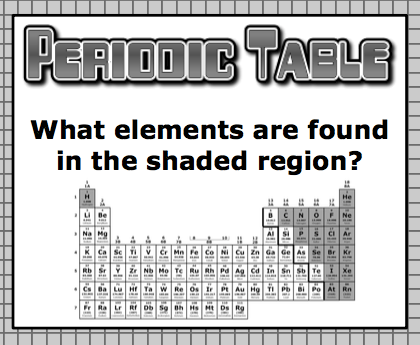
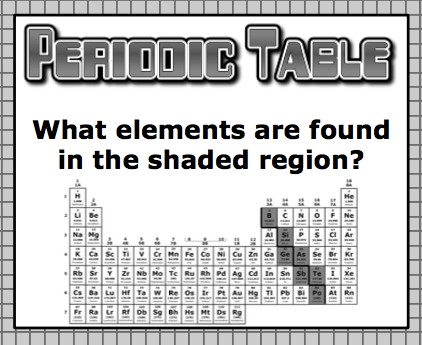
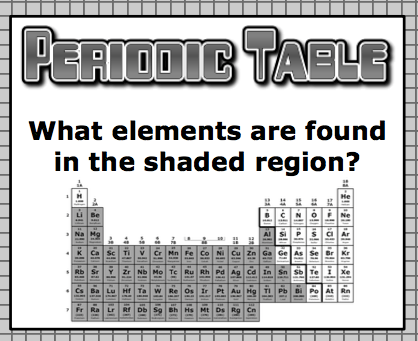
Metals

b)

Nonmetals

c)

Metalloids

19.
a)

Metals

b)

Nonmetals

c)

Metalloids

20.
a)

Metals

b)

Nonmetals

c)

Metalloids

21.
a)
Group 1
b)
Group 17
c)
Group 18
d)
Group 2
22.
a)
Group 1
b)
Group 17
c)
Group 18
d)
Group 2
23.
a)
Group 1
b)
Group 17
c)
Group 2
d)
Group 18
24.
a)
Metals
b)
Nonmetals
c)
Metalloids
25.
a)
Metals
b)
Nonmetals
c)
Metalloids
26.
a)
Metals
b)
Nonmetals
c)
Metalloids
27.
a)
Metals
b)
Nonmetals
c)
Metalloids
28.
a)
Metals
b)
Nonmetals
c)
Metalloids
29.
a)
Metals
b)
Nonmetals
c)
Metalloids
30.
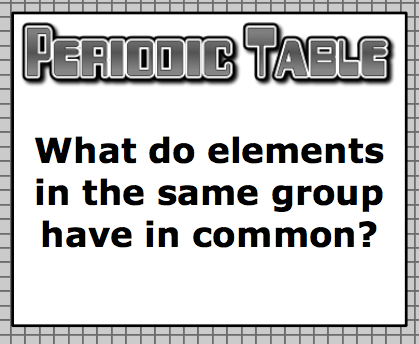
Each column in the periodic table is called a 
a)
period
b)
group
c)
cluster
d)
unit
31.
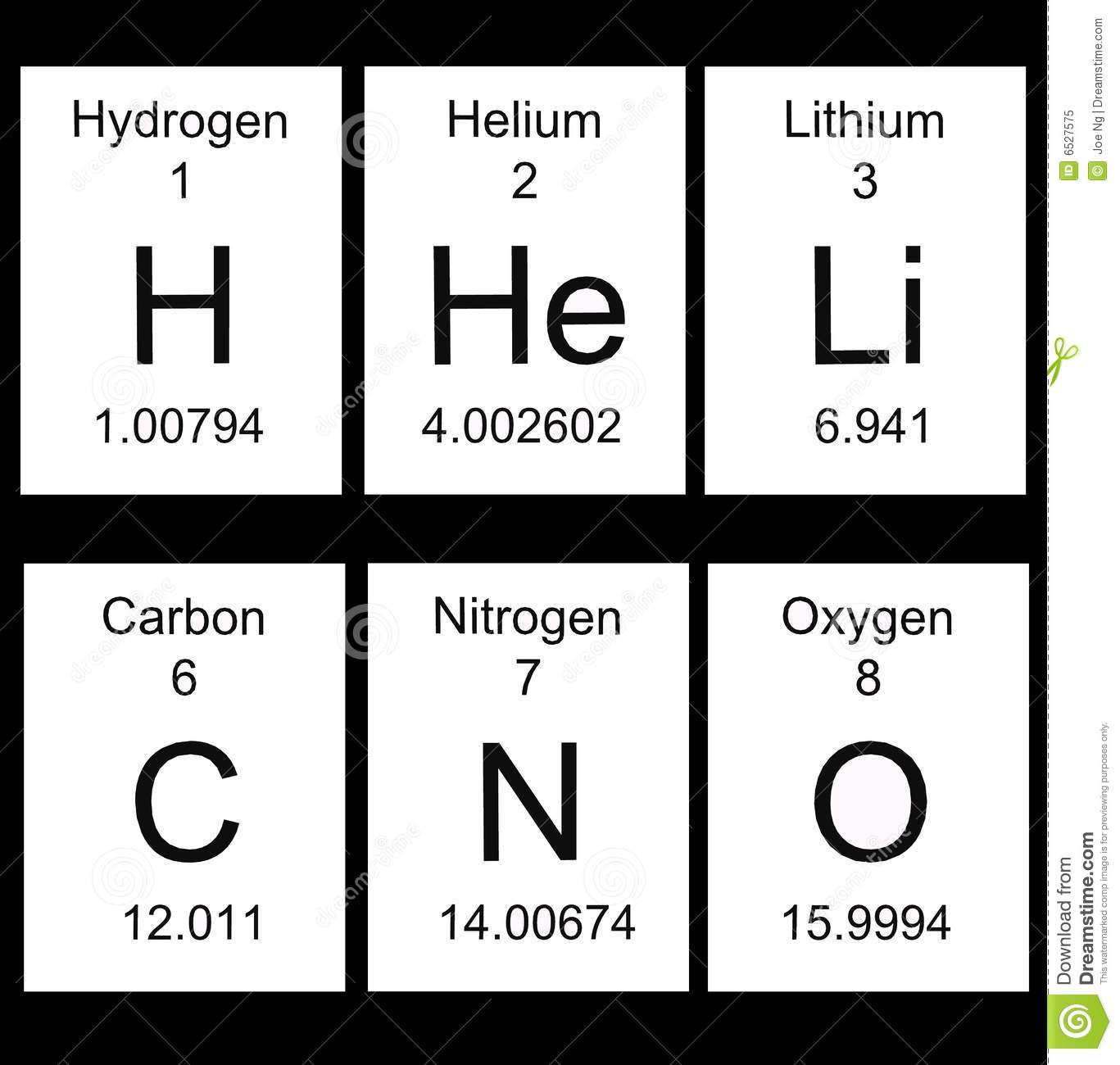
The atomic number tells you what?
a)
number of electrons
b)
number of protons
c)
number of neutrons
d)
both electrons and protons in an atom.
32.

What does the 1.00794 stand for?

a)

Hydrogen

b)

atomic number

c)

atomic mass

d)

atomic explosion

33.

How many protons are in Beryllium?

a)

4

b)

9

c)

5

d)

2

34.
Why is water NOT on the periodic table?
a)
It is naturally occuring
b)
It is a compound, not an element
c)
It exists as a solid, a liquid, and a gas
d)
Its chemical formula doesn't fit
35.
_______ are the ROWS on the periodic table.
a)
Families
b)
Groups
c)
Periods
d)
Elements
36.
What does the atomic mass tell you?
a)
Basically,the number of electrons and protons
b)
The number of neutrons
c)
Basically, the number of protons and neutrons
d)
The number of protons.
37.
What is the chemical symbol for Lithium?
a)
H
b)
He
c)
Li
d)
N
38.
The chemical formula for table sugar (sucrose) is C12H22O11. Name all the elements found in this compound.
a)
Oxygen, carbon, hydrogen
b)
Calcium, helium, iodine
c)
Oxygen, calcium, hydrogen
d)
Helium, carbon, oxygen
39.
What element is represented in this Bohr Model? 
a)
Carbon
b)
Hydrogen
c)
Aluminum
d)
Lithium
40.
Which subatomic particle has no electric charge?
a)
the proton
b)
the neutron
c)
the electron
d)
the photon
41.
Where are valence electrons found in an atom?
a)
first electron shell
b)
second electron shell
c)
third electron shell
d)
outermost electron shell for most atoms
42.
How many valence electrons does this atom have?
a)
2
b)
4
c)
d)
8
43.
Which subatomic particles are found in nucleus?
a)
Proton and electron
b)
Proton and neutron
c)
neutron and electron
d)
neutron, electron and proton
44.
Which is an electron?
a)
A
b)
B
c)
C
45.
Which of the following is a sign that a chemical reaction has occurred?
a)
change in shape
b)
melting
c)
formation of a gas
d)
dissolving
46.
A change in the size, shape, or state of matter.
a)
chemical change
b)
physical change
c)
chemical reaction
d)
electron change
47.
Sugar is burned which causes it to turn black and produce a gas.
a)
Physical Change
b)
Chemical Change
48.
Water is poured into a beaker containing a yellow liquid. The water sinks to the bottom of the beaker.
a)
Physical Change
b)
Chemical Change
49.
The temperature of two solutions increases after they are mixed together.
a)
Physical Change
b)
Chemical Change
50.
A solid substance floats to the top of the liquid it is placed into.
a)
Physical Change
b)
Chemical Change
51.
Water is placed on a hot plate and its temperature increases.
a)
Physical Change
b)
Chemical Change
52.
Two solutions are mixed and a white precipitate is formed.
a)
Physical Change
b)
Chemical Change
53.
what is the definition of chemical change?
a)
any change that results in the formation of new chemical substances. 
b)
changing clothes
c)
matter cannot be created or destroyed, only change form
d)
changes affecting the form of a chemical substance, but not its chemical composition.
54.
Mechanical
a)
Physical
b)
Chemical
55.
Lipases split fat into fatty acids. Amylases split carbohydrates such as starch and sugars into simple sugars such as glucose. Proteases and peptidases split proteins into small amino acids.
a)
Physical
b)
Chemical
c)
Both
d)
Neither
56.
The bacteria in the large intestine can digest some material, creating a gas.
a)
Physical
b)
Chemical
c)
Both
d)
Neither
57.
Hydrochloric acid in the stomach breaking down food is...
a)
physical/mechanical
b)
chemical
58.
Chewing and tearing apart food into smaller pieces is...
a)
physical/mechanical
b)
chemical
59.
The stomach pushing and churning food is...
a)
physical/mechanical
b)
chemical
60.
Enzymes, secretions, and converting into other substances are examples of:
a)
physical/mechanical digestion
b)
chemical digestion
61.
Saliva contains ___ that helps with ______
a)
teeth, mechanical digestion
b)
enzymes, mechanical digestion
c)
enzymes, chemical digestion
d)
teeth, chemical digestion
62.
The teeth chewing food and the stomach grinding and mixing are examples of _____
a)
chemical digestion
b)
elimination
c)
mechanical digestion
d)
ingestion
63.
What law governs the balancing of chemical equations? 
a)
Law of Energy
b)
Law of Conservation of Matter/Mass
c)
Law of Gravity
d)
Law of Matter Movement 
64.
Why is it called the Law of Conservation of Matter/Mass? 
a)
Energy is created and destroyed 
b)
Energy is never created, nor destroyed-- it always moves 
c)
Energy moves between particles
d)
Energy stops moving at the end of the universe 
65.
What is the law of conservation of mass?
a)
Matter changes when reacted or changed.
b)
The mass of all reactants are changed during a physical or chemical change
c)
The mass of the reactants is the same as the mass of the products
d)
The mass of the products is different than the mass of the reactants.
66.
In a reaction A + B ----> C,  reactant A has 5g and product  C has 9g. How many grams does reactant B should have? 
a)
4g
b)
5g
c)
9g
d)
14g
67.
Which  of the following is a balanced equation?
a)
Na   +   Cl2   -->  NaCl
b)
H2  +  O2  --> H2O
c)
Ca   +   Br  -->  CaBr2
d)
Na   +  F  -->  NaF
68.
Is this balanced?...
Al + O2 --> 2Al2O3
a)
Yes!
b)
NO!
69.

How many atoms of aluminum are on each side of the following equation:

4Al + 3O2 --> 2Al2 O3

a)

2

b)

6

c)

1

d)

4

70.

Which problem is balanced?

a)

PbO2 + 2H2

b)

SO2 + H2O --> H2SO4

c)

2Na + 2H2O --> 2NaOH + H2

71.

Is this equation balanced?:

CS2 + 202 --> CO2 +2SO2

a)

Yes

b)

No

72.

Is the equation balanced?:

2H2O + O2 --> 4MgO + 3Fe

a)

Yes

b)

No

73.
(8.5A) Which of the following best describes an electron?
a)
It has no charge and about the same mass as a proton
b)
It has a negative charge and much less mass than a proton
c)
It has a positive charge and much more mass than a neutron
d)
It has a negative charge and about the same mass as a neutron
74.
(8.5A) An atom has 25 protons, 30 neutrons, and 25 electrons. What is the charge of the atom's nucleus?
a)
+25
b)
+30
c)
-25
d)
-30
75.
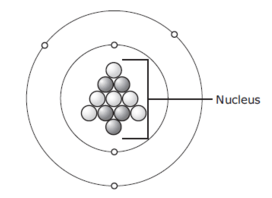
(8.5B) An atom of which element is represented by this model?
a)
Boron (B)
b)
Carbon (C)
c)
Neon (Ne)
d)
Sodium (Na)
76.
(8.5B) When trying to identify an unknown element, a scientist determines what other elements the unknown element reacts with chemically. Which property of the unknown element determines the other elements it reacts with? 
a)
The total number of neutrons in the unknown element.
b)
The total number of particles in the nucleus of the unknown element
c)
The number of protons in the nucleus of the unknown element
d)
The number of valence electrons in the unknown element.
77.
(7.6A) Hay is made up of organic compounds. What are the main elements in many organic compounds?
a)
Helium, carbon, sodium
b)
Sodium, hydrogen, nitrogen
c)
Carbon, hydrogen, oxygen
d)
Radon, oxygen, helium
78.
(6.5C) The chemical equation shown below represents a reaction that produces fuel for certain cars.
CO + H2O ---> CO2 + H2
Which of these represents an element?
a)
CO
b)
H2O
c)
CO2
d)
H2
79.
CaCO3 ---> CaO + CO2
In the chemical reaction shown above, the products are best classified as-- (6.5C)

a)
two elements
b)
one element and one compound
c)
two compounds
d)
two compounds and one element
80.
(6.6B)A balance and a graduated cylinder are used to determine the density of a mineral sample. The sample has a mass of 14.7 g and a volume of 2.2 cm3. What is the density of the mineral sample?
a)
0.15 g/cm3
b)
32 g/cm3
c)
13 g/cm3
d)
6.7 g/cm3