
 Worksheets
Circuits
Total questions: 30
Worksheet time: 36mins
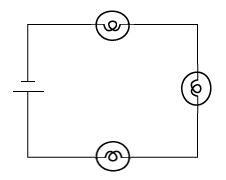
The picture shows an electrical circuit. This circuit is a series circuit because:
It has 3 light bulbs.
The same current flows through all three light bulbs.
It uses a single battery.
The electrical current has more than one path to flow through

How many lightbulbs will work if there is a break in the circuit at POINT A?
1
2
3
NONE

If the current through the battery was 10A in this diagram. What would the current through each identical bulb be?

The equivalent resistance in this circuit is
100 ohms
450 ohms
400 ohms
30 ohms
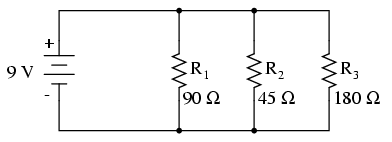
The current going through the 90 ohm resistor is...
(Hint: Know Kirchhoff's Loop Rule and use Ohm's Law)
10 amps
0.1 amps
0.2 amps
9 amps
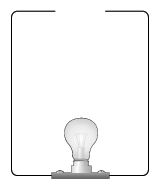
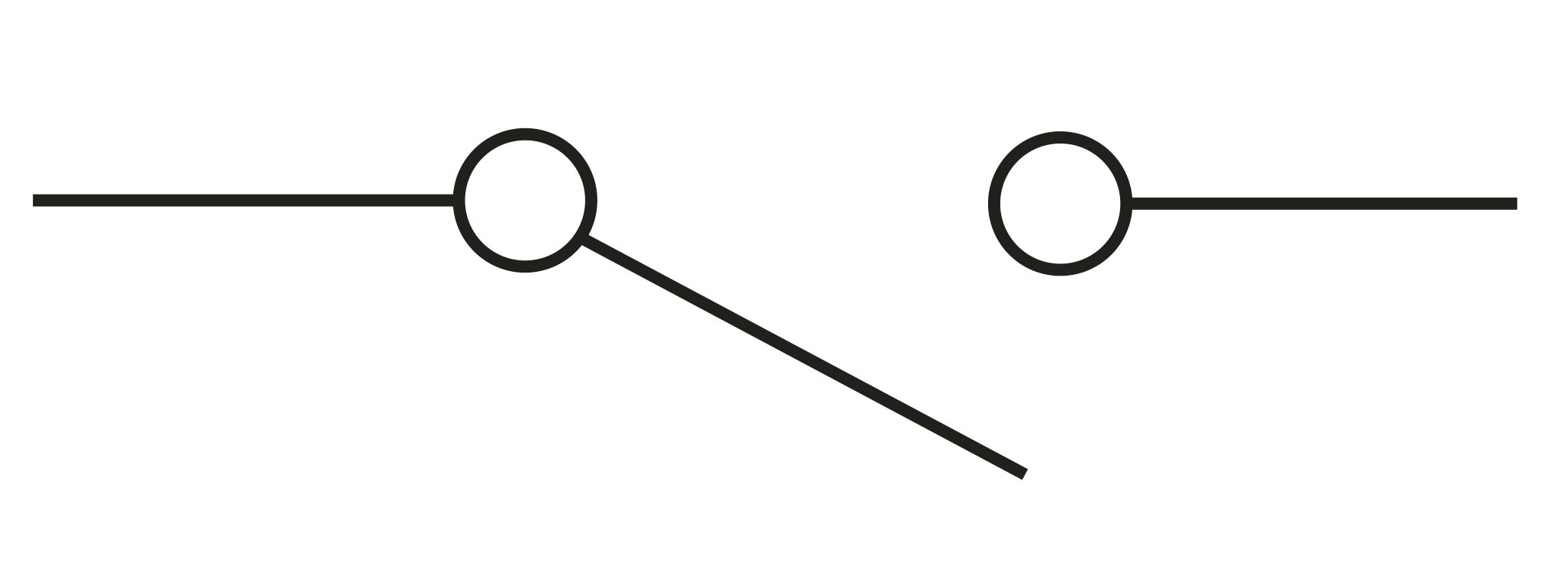
This is the symbol for a _____?
A 2.0-ohm resistor and a 4.0-ohm resistor are connected in series with a 12-volt battery. If the current through the 2.0-ohm resistor is 2.0 amperes, the current through the 4.0-ohm resistor is
1.0 A
2.0 A
3.0 A
4.0 A

Where should an ammeter be located to correctly measure the total current and where should a voltmeter be located to correctly measure the total voltage?
ammeter at 3 and voltmeter at 4
ammeter at 1 and voltmeter at 4
ammeter at 2 and voltmeter at 3
ammeter at 1 and voltmeter at 2
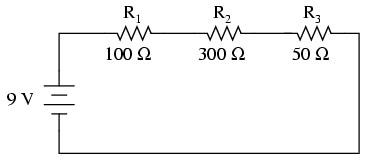
The total current through this circuit is...
(Hint: Find equivalent resistance then use Ohm's Law)
0.02 amps
0.09 amps
50 amps
9 amps

The voltage dropped across the 300 ohm resistor is
(Hint: Find equivalent resistance, use Ohm's Law to solve for total current, then use Ohm's Law to solve for voltage drop at the 300 ohm resistor)
6 V
9 V
2 V
30 V
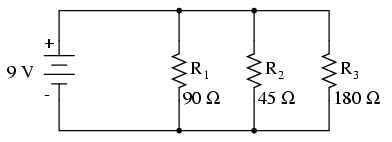
The total resistance (equivalent resistance) of this circuit is
25.7 ohms
315 ohms
324 ohms
90 ohms
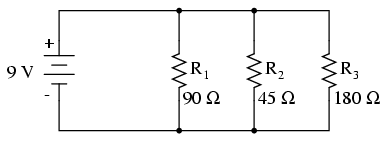
The current going through the 45 ohm resistor is
(Hint: Know Kirchhoff's Loop Rule and use Ohm's Law)

The total current going through the battery of this circuit is (Hint: Find equivalent resistance, then use Ohm's Law to solve for current)
What is the current in a circuit with 6 ohms of resistance and a battery containing 24 Volts?
1/4 A
144 A
4 A
0.4 A

If all of the switches were closed, how many paths can the current take?
4
6
8
10
If switch 3 and 6 were open, which device(s) would turn on?
none
A, B, C
A, C, C, E, F
all of them

What is the current through R1?
(Hint: Know Kirchhoff's Loop Rule and use Ohm's law)
10 A
5 A
7 A
2 A

What is the (hot) resistance of the bulb?
100 ohm
132 ohm
0.01 ohm
0.007 ohm

Based on the graph, which of the following would be true regarding the relationship of voltage and current?
As voltage increases, current decreases.
Voltage will not affect current.
As voltage decreases, current increases.
As voltage increases, current also increases.


What is the voltage of a circuit with 15 amperes of current and toaster with 8 ohms of resistance?
30 volts
60 volts
90 volts
120 volts
Which of the following circuit diagrams would short circuit due to lack of resistance?


What is the difference in finding total resistance (equivalent resistance) in a series circuit vs. in a Parallel circuit?
No Difference
For series use inverse equation, for parallel add resistances up.
For series add up resistances, for parallel add up resistances
For series add up resistances, for parallel use inverse equation
If a series circuit of three bulbs is rearranged into a parallel circuit, what will happen to the brightness of three bulbs
The bulbs will turn off due to an incomplete supply of electricity.
All three bulbs will have the same amount of brightness once rearranged into a parallel circuit but will be dimmer than in parallel.
All three bulbs will have the same amount of brightness once rearranged into a parallel circuit but will be brighter than in parallel.
The bulb next to the battery will be brightest and each bulb will be dimmer than the one before.
Juan and Sam are working on a physics lab together. In their lab, they are to create both a series circuit and a parallel circuit using identical materials. Juan constructs the series circuit while Sam makes the parallel circuit. After observing the two circuits, Sam argues that his circuit contains more resistance than Juan's circuit. Juan says that Sam is wrong, and that his circuit has more resistance. Who is correct?
Sam is correct, the parallel circuit has more paths for the electricity to travel, making the resistance greater.
Sam is correct, the parallel circuit's light(s) are brighter, meaning there is more resistance.
Juan is correct, parallel circuits have LESS resistance because the current is greater.
Juan is correct, parallel circuits have LESS resistance because their resistors add inversely, while the resistors in series circuits add normally.
What will be the current drawn by an electric bulb of 1000 W when it is connected to a source of 220 V?

Remember: V=IR and P=VI

