
 Worksheets
Formation of the Earth
Total questions: 87
Worksheet time: 1hrs 10mins
Name
Class
Date
1.
Which of the following is NOT a cause of an earthquake?
a)
Collapse of Cavern
b)
Eruption of Volcano
c)
Lightning Strikes
d)
Moving Tectonic Plates
2.
What is the shaking of the Earth’s crust caused by a release of energy?
a)
Earthquake
b)
Epicenter
c)
Fault
d)
Plate
3.
What is a break in the lithosphere along which movement in an earthquake has first occurred?
a)
Earthquake
b)
Epicenter
c)
Fault
d)
Focus
4.
Where is the point on the Earth’s surface directly above the focus of an earthquake?
a)
Epicenter
b)
Fault
c)
Hypocenter
d)
Tremor
5.
What is an instrument that detects and records waves produced by earthquakes? (This piece of equipment can measure the magnitude of an earthquake.)
a)
Epicenter
b)
Fault
c)
Seismogram
d)
Seismograph
6.
What is the measure of the amount of energy released in an earthquake?
a)
Earthquake
b)
Epicenter
c)
Magnitude
d)
Seismogram
7.
Which scale measures the intensity of the ground movement?
a)
Mercalli Scale
b)
Richter Scale
c)
Seismogram Scale
d)
Bernoulli Scale
8.
What is the temporary state in which loose soil and rock materials take on the property of a liquid?
a)
Aftershock
b)
Liquefaction
c)
Seismic Gap
d)
Tsunami
9.
What is a smaller earthquake that follows a larger earthquake?
a)
Aftershock
b)
Liquefaction
c)
Seismic Gap
d)
Tsunami
10.
What is a large ocean wave that results from an underwater earthquake, landslide, or volcanic eruption?
a)
Aftershock
b)
Liquefaction
c)
Seismic Gap
d)
Tsunami
11.
What is an area along a seismically active fault where no earthquake activity has occurred over a long period of time?
a)
Aftershock
b)
Liquefaction
c)
Seismic Gap
d)
Tsunami
12.

The outside layer of the earth is called ______________________.
a)
core
b)
crust
c)
mantle
d)
outer core
13.

The huge pieces of the earth's crust are called ____________________________.
a)
crust
b)
plates
c)
directions
d)
seismos
14.
The epicenter of an earthquake is
a)
The point below the surface where rock begins to break and the first motion occurs
b)
The seismic station closest to the earthquake
c)
The place where the greatest damage occurs
d)
The point on the surface directly above the focus
15.

Waves move out through the ground from the ..........
a)
rift
b)
hypocenter
c)
epicenter
d)
fault line
16.
The Richter scale measures:
a)
the amount of radon gas released
b)
the movement of plates
c)
the strength of an earthquake
d)
the weight of tectonic plates
17.
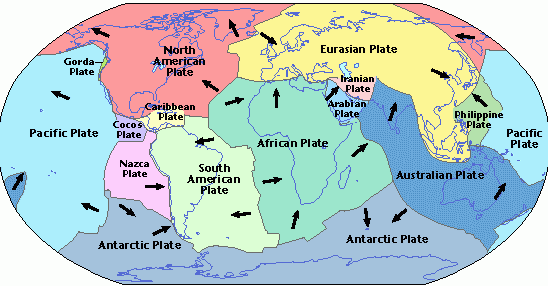
Many earthquakes happen along the borders of...
a)
Countries
b)
Tectonic Plates
c)
Climate Zones
d)
None of the above.
18.
The Richter scale measures:
a)
the amount of radon gas released
b)
the movement of plates
c)
the strength of an earthquake
d)
the weight of tectonic plates
19.
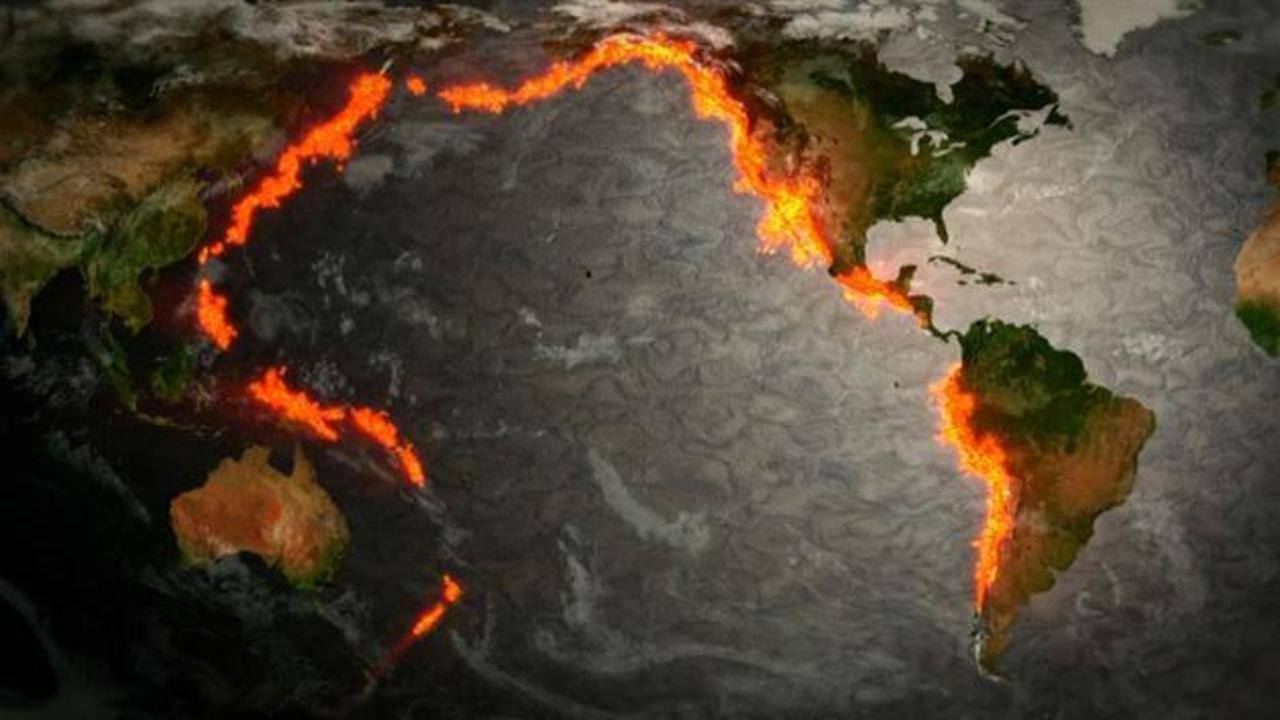
Which ocean in the world is also known as the "Ring of Fire"
a)
Atlantic
b)
Indian
c)
Arctic
d)
Pacific
20.
Liquefaction is when...
a)
the soil behaves like liquid
b)
the ground becomes liquid
c)
magma rises to the surface
d)
buildings are damaged, crumbling like liquid
21.
What is the epicenter of an earthquake
a)
the location along a fault where the first motion of an earthquake occurs
b)
a seismic wave tht travels along the surface of Earth
c)
the point on Earth's surface directly above the earthquake's focus
d)
the last place that motion in an earthquake is detected
22.

What is the outermost layer of the Earth called?
a)
Core
b)
Mantle
c)
Crust
23.
What occurs when two plates move, bump or slide past each other?
a)
An Earthquake
b)
Nothing
c)
Movement
24.
What is the vocabulary word for the line where two tectonic plates move past each other?
a)
Plate Line
b)
Fault Line
c)
Puzzle Line
25.

The place where an earthquake originates inside the Earth's surface is called...
a)
Epicenter
b)
Hypocenter (focus)
c)
Underground
d)
Crust
26.
The tectonic plates float on the
a)
lithosphere
b)
lower mantle
c)
outer core
d)
asthenosphere
27.
The part of the earth that includes the crust and the upper mantle and is split into tectonic plates is the
a)
lithosphere
b)
crust
c)
asthenosphere
d)
mantle
28.
The hottest layer
a)
crust
b)
inner core
c)
mantle
d)
outer core
29.
The coolest layer
a)
crust
b)
inner core
c)
mantle
d)
outer core
30.
The thinest layer
a)
crust
b)
inner core
c)
mantle
d)
outer core
31.
The thickest layer
a)
crust
b)
inner core
c)
mantle
d)
outer core
32.
The least dense layer
a)
crust
b)
inner core
c)
mantle
d)
outer core
33.
The most dense layer
a)
crust
b)
inner core
c)
mantle
d)
outer core
34.
This layer is completely liquid
a)
crust
b)
inner core
c)
mantle
d)
outer core
35.
This layer is a mix between solid and liquid
a)
crust
b)
inner core
c)
mantle
d)
outer core
36.
This layer is completely solid due to the intense pressure it is under
a)
crust
b)
inner core
c)
mantle
d)
outer core
37.
This layer is solid
a)
crust
b)
asthenosphere
c)
mantle
d)
outer core
38.
Supporting Evidence: subduction, earthquakes, volcanoes, Mid-Atlantic Ridge, older theories
a)
Continental Drift
b)
Seafloor Spreading
c)
Plate Tectonics
39.
Supporting Evidence: discovery of Mid-Atlantic Ridge, core rock samples showing older rocks the farther that you get from the mid ocean ridge
a)
Continental Drift
b)
Seafloor Spreading
c)
Plate Tectonics
40.
The name for the actual lithospheric plates
a)
Tectonic Plates
b)
Plate Tectonics
c)
Pangaea
d)
Continental Drift
41.
Ocean trenches always form at subduction zones where dense oceanic crust subducts.
a)
True
b)
False
42.
Volcanoes never form along subduction zones.
a)
True
b)
False
43.
The circular pattern of heating, rising, cooling, sinking of magma in the mantle causing tectonic plates to move.
a)
Plate Tectonics
b)
Convection Currents
c)
Pangaea
d)
Subduction
44.
Volcanoes are most often formed at this boundary.
a)
Divergent
b)
Convergent
c)
Normal
d)
Transform
45.
Continental crust is more dense than oceanic crust.
a)
True
b)
False
46.

Look at the diagram of a cross section of Earth. How does this diagram help to confirm Alfred Wegener"s hypothesis of continental drift?
a)
It shows that Earth's mantle has several concentric layers.
b)
It demonstrates that Earth's crust is the thinnest of layers.
c)
It illustrates how crustal plates float on convection currents in Earth's mantle.
d)
It models how the Earth's core is subdivided into an inner core and an outer core.
47.
What major events cause islands to form in the Pacific Ocean?
a)
tsunamis
b)
severe storms
c)
volcanic eruptions
d)
erosion
48.
Earth is made of different layers that have varying characteristics. Which is the thickest layer?
a)
the mantle
b)
the inner core
c)
the outer core
d)
the crust
49.

Which model best represents the internal structure of Earth?
a)
A
b)
B
c)
C
d)
D
50.
Mount St. Helens was a cone-shaped mountain that formed when molten material reached the surface of Earth and formed layers. Cone-shaped mountains form as a result of which one of these events?
a)
hurricanes
b)
earthquakes
c)
volcanic eruptions
d)
sediment depositions
51.

This illustration shows how most of the recycling of rock from Earth's crust occurs. What is this process called?
a)
subduction
b)
convergence
c)
divergence
d)
faulting
52.
What is the name of the layer that contains the uppermost mantle and crust
a)
Asthenosphere
b)
Mesosphere
c)
Lithosphere
d)
Transosphere
53.

Scientists think that convection currents that move the plates flow in Earth's
a)
Continental crust
b)
oceanic crust
c)
Asthenosphere
d)
Lithosphere
54.
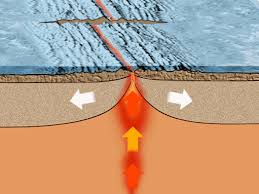
Where does molten material from the mantle rise up during the process of sea-floor spreading?
a)
Along the mid-ocean ridge
b)
At the north and south poles
c)
Along the edges of all the continents near the shoreline and beaches
d)
at the equator
55.
_________ is the thickest layer of the Earth.
a)
Inner Core
b)
Outer Core
c)
Crust
d)
Mantle
56.
What is the driving force to plate tectonics occurring when warm magma rises and cooler magma sinks?
a)
An oceanic current
b)
A conventional current
c)
A convection current
d)
A magnetic current
57.
A break or crack in the Earth's crust is called a...
a)
plate
b)
fault
c)
fold
d)
crack
58.
What was the name given to all the continents when they were joined as one super continent
a)
Supreme Continent
b)
United States
c)
Bill Nye's World
d)
Pangea
59.
Where are most volcanoes found?
a)
Southern Hemisphere
b)
Ring of Fire
c)
Mid-Atlantic Ridge
d)
Hot Spots
60.
Where do volcanoes come from?
a)
Places where plates move apart
b)
Places where plates are moving together
c)
Hot Spots
d)
All of these options
61.
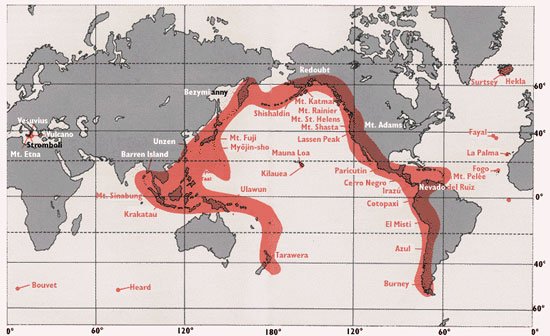
This is the name for the chain of volcanos around the edge of the Pacific Plate.
a)
Circle of Fire
b)
Ring of Lava
c)
Ring of Fire
d)
Circle of Magma
62.

What part of the volcano is at point A?
a)
Pipe
b)
Crater
c)
Lava Flow
d)
Central Vent
63.
Rock underground suddenly breaks along a fault causing tectonic movement, causing what natural hazard?
a)
Volcanic Eruption
b)
Cyclone
c)
Earthquake
d)
Hurricane
64.
What is the difference between a natural hazard and a natural disaster?
a)
They are exactly the same
b)
A hazard is what could happen, a disaster is after it has an impact on humans
c)
I disaster is what could happen, a hazard is after it has an impact on humans
d)
Hurricanes and tsunamis are natural disasters, but earthquakes and volcanoes are hazards
65.
Strange animal behavior, such as toads fleeing an area, could be an indicator that ____________ is about to occur.
a)
a volcanic eruption
b)
a tsunami
c)
a hurricane
d)
an earthquake
66.
A seismograph can be used to measure and study what?
a)
Volcanic eruptions
b)
Earthquakes
c)
Tsunamis
d)
All of the above
67.
Flooding, property damage, fatalities, and fires are all effects of what natural hazard?
a)
Tsunamis and Earthquakes
b)
Volcanoes and Tornados
c)
Hurricanes and Earthquakes
d)
Tsunamis and Hurricanes
68.
Scientists can predict exactly when a volcanic eruption will occur.
a)
True
b)
False
69.
A huge undersea earthquake off the Alaskan coastline could produce what natural hazard?
a)
Tsunami
b)
Cyclone
c)
Hurricane
d)
Drought
70.
Which is not a natural disaster?
a)
tornado
b)
hurricane
c)
tsunami
d)
car accident
71.
Why do floods occur
a)
The plates shift
b)
Too many waves
c)
Earth tilts
d)
When a river banks
72.
A destructive fire that spreads quickly but rejuvenates the soil
a)
Volcanic Eruption
b)
Wildfire
c)
Asteroid Impact
d)
Typhoon
73.

A long high sea wave caused by an underwater Earthquake, landslide or underwater volcanic
a)
Typhoon
b)
Flood
c)
Tornado
d)
Tsunami
74.
Where do hurricanes form?
a)
In a river or stream
b)
Over the ocean
c)
At plate boundaries
d)
Under the Earth
75.
Which catastrophic event will most likely have the effect of returning an ecosystem to primary succession?
a)
A tornado
b)
A volcanic eruption
c)
A flood
d)
A drought
76.

The word tsunami comes from
______
______
a)
Japan
b)
Australia
c)
Africa
d)
Mexico
77.

How tall are the biggest of tsunami's?
a)
50 feet
b)
1000 feet
c)
100 feet
d)
280 feet
78.
Most tsunamis occur here.
a)
Atlantic Ocean
b)
Indian Ocean
c)
Arctic Ocean
d)
Pacific Ocean
79.
The raising and lowering of the sea floor is what causes a tsunami.
a)
True
b)
False
80.
In Japan, residents have to worry about...
a)
active volcanoes
b)
earthquakes
c)
tsunamis
d)
all of these
81.

What is a tsunami?
a)
a large a long, high sea wave
b)
a moving of the earth
c)
magma flowing from inside the earth
d)
a column of rotating air
82.
What is the boundary called where two plates slide next to each other in opposite directions?
a)
Divergent
b)
Convergent
c)
Transform
d)
Ridge
83.
What is the boundary called where two plates collide?
a)
Divergent
b)
Convergent
c)
Transform
d)
Ridge
84.
A collision between two pieces of continental crust at a converging boundary produces a
a)
mid ocean ridge
b)
deep ocean trench
c)
rift valley
d)
mountain range
85.

Name the boundary
a)
convergent boundary
b)
divergent boundary
c)
transform boundary
d)
sergent boundary
86.

Name the boundary
a)
convergent boundary
b)
divergent boundary
c)
transform boundary
d)
sergent boundary
87.

Mass movements of land due to gravity
a)
Earthquakes
b)
Landslides
c)
Volcanoes
d)
Tsunamis
100 %

