
Font size
 Worksheets
ALPHA N3 Benchmark Review
Total questions: 62
Worksheet time: 1hrs 2mins
Select 2 physical properties.
mass
flammablity
reactivity
state of matter
Two or more elements chemically combined is called a(n)
compound
mixture
element
atom
The small group of elements that have properties of both metals and nonmetals are called
compounds
mixtures
metalloids
atoms
Group 18 contains element that do not combine with other elements naturally. These are called the
noble gases
alkali metals
boron group
rare earth elements
Select all signs that indicate a chemical change has occurred.
fizzing
change in color
production of heat
change in odor
The atomic number tells us
how many protons plus neutrons an element has.
how many protons or neutrons an element has.
how many protons an element has.
how many protons, neutrons, and electrons an element has.

What is happening when ice cream changes from a solid to a liquid?
freezing, heat is being removed
melting, heat is being added
melting, heat is being removed
freezing, heat is being added
Particles of a liquid
are tightly packed together and stay in a fixed position.
have no viscosity.
decrease in volume with increasing temperature.
are free to move around one another but still touch.

Nonmetals are located in what section of this periodic table?
Blue
Yellow
Pink
In the gas laws, which of the following shares an inverse relationship with pressure?
volume
temperature
number of particles
average kinetic energy

The relationship shown on the graph is
direct
inverse
opposite
synchronous

What is the net force?
40 N left
0 N Balalnced
400 N right
40 N right

Which is/are moving up?
a & b
b
b & c
d

What element is illustrated?
Carbon
Hydrogen
Aluminum
Lithium
A change in speed, direction, or a change in both speed and direction
speed
velocity
acceleration
force
The equation for finding average acceleration is
(final velocity - initial velocity)
÷ time
(initial velocity - final velocity)
∞ time
initial velocity + final velocity + time
initial velocity + final velocity - time

Peter runs east on a straight road. The velocity vs. time graph of his motion shows a line with a negative slope. What does that tell you about his speed?
He is going slower, then faster.
He is slowing down.
He is speeding up.
He is maintaining a constant speed.
Which Newton's law states an object at rest stays at rest, and an object in motion stays in motion?
1st
2nd
3rd
None
When air rushes out of a balloon, it moves upward. This is an example of which Law of Motion?
Newton's First Law
Newton's Second Law
Newton's Third Law
A soccer ball accelerates more than a bowling ball when thrown with the same force. This describes ___.
Newton's First Law
Newton's Second Law
Newton's Third Law
None of these

Pedals, handle bars, and handbrakes on a bicycle are all which type of simple machine?
wedges
pulleys
incline planes
levers

How could I reduce the effort force needed to lift the load?
move the fulcrum away from the load
move the fulcrum closer to the load
place the fulcrum in the middle
Which of the following is an example of work being done?
holding a heavy piece of wood at a construction site
trying to push a car that doesn't move out of deep snow
pulling a wagon down a sidewalk
holding a door shut on a windy day so it doesn't blow open
_______ are corrosive substances characterized as having a strong smell, a sour taste, and a _______.
Which of the following will dissolve most rapidly?
sugar cubes in cold water
sugar cubes in hot water
powdered sugar in cold water
powdered sugar in hot water
The solubility of gases in liquids
increases with increasing pressure
cannot reach equilibrium
does not depend on pressure
decreases with increasing pressure
Two atoms of the same element but with different mass numbers are called________
ions
isotopes
variables
electron cloud
How many electrons are in an atom that has an atomic number of 34, an atomic mass of 74 and a charge of -2?
34
36
2
40
Waves in which the medium moves at right angles to the direction of the wave are called...
transverse waves
longitudinal waves
compressional waves
surface waves
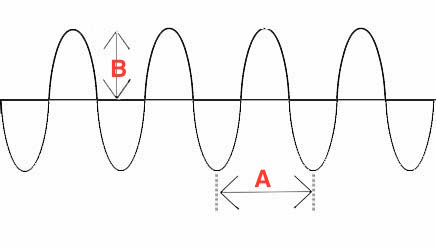
What property of this wave is represented by the letter "A"
amplitude
frequency
trough
wavelength
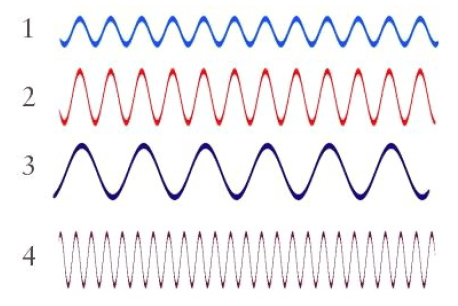
Which wave in the diagram has the greatest frequency?
1
2
3
4

Does the scarf reflect or absorb yellow?
Reflect
Absorb
What do we call it when a wave bends as it enters a new medium at an angle? (example: pencil in a glass of water)
medium
refraction
reflection
interference
When two or more waves overlap and the waves ADD to each other.
Constructive Interference
Destructive Interference
Reflection
Absorption
Law of Reflection states:
Angles are always opposite
Angel of incidence equals angle of reflection
All waves have right angles
Angles are never equal

What kind of energy is represented in this picture?
Thermal
Potential
Nuclear
Mechanical
A battery converts...
sound to kinetic
electromagnetic to thermal
mechanical to electrical
chemical to electrical
Microwaves, x-rays, ultraviolet rays, infrared waves, light waves are all examples of
electrical energy
electromagnetic energy
chemical energy
nuclear energy
An atom of carbon-14 isotope has more protons than an atom of carbon-12 isotope.
True
False
Gamma rays require _____ to be stopped.
paper
glass
aluminum
lead
In nuclear fission the nucleus is divided into two or more fragments, releasing
protons and energy.
neutrons and energy.
ions and energy.
electrons and energy.
On a hot summer day, a student dropped an ice cube onto a park bench. Within minutes, the ice cube melted. Which best describes the process the student observed?
radiation
combustion
conduction
convection

Heat transfers from an area of ____temperature to an area of ___ temperature.
high to low
low to high
high to high

As a pendulum swings from its highest to lowest position, what happens to its kinetic and potential energy?
Both the potential energy and kinetic energy decrease
The potential energy decreases while the kinetic energy increases
The kinetic energy decreases while the potential energy increases
Bothe the potential energy and kinetic energy increase
Gravitational potential energy depends on the ________ and ________ of the object.
Height and mass
Friction and movement
Mass and Movement
Height and Friction
Which of the following is not a compound?
HCl
O2
NaCl
CO2
What is the formula for Calcium Phosphide?
Ca2P3
Ca3P2
CaP
What is the name of K2S?
Potassium Sulfide
Potassium (II) sulfide
Potassium (I) sulfide
Dipotassium Monosulfide
What is the correct name for P2O5 ?
phosphorus oxide
phosphorus (II) oxide
diphosphorus pentoxide
phosphorus pentoxide
Is barium sulfide is ionic or covalent?
Ionic because it is a metal and a nonmetal
Covalent because it is a metal and a nonmetal
Ionic because it is two nonmetals
Covalent because it is two nonmetals
What is the correct term for "atom with more electrons than protons"?
positive ion (cation)
negative ion (anion)
neutral atom
stable atom
After an energy conversion, you end up with the same total amount of energy as the original amount of potential energy. This is called?
energy efficiency
Law of conservation of energy
Law of potential energy
energy resources
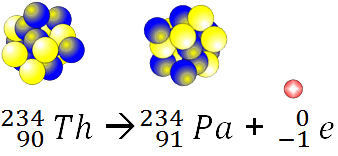

What is it?
Pure Substance, element
Mixture, Homogeneous
Pure Substance, Compound
Mixture, Heterogeneous

What is it?
Pure Substance,Element
Mixture, Homogeneous
Pure Substance, Compound
Mixture, Heterogeneous
Where does fusion occur naturally?
Underwater
In rocks
In the radioactive waste
In the stars
How many different elements are in this chemical formula: Ca2H2CK3
3
4
5
6

