
 Worksheets
Unit 5 Test
Total questions: 26
Worksheet time: 25mins
Name
Class
Date
1.
The type of plate boundary where two plates come together is a .....
a)
Convergent Boundary
b)
Divergent Boundary
c)
Transform Boundary
d)
Plate Boundary
2.
Which of the following causes Earth's tectonic plates to move?
a)
Energy from the Sun
b)
Magnetic Pole Reversal
c)
Convection currents in the mantle
d)
Faults in Mountain Ranges
3.
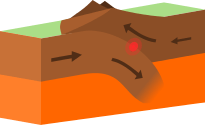
What type of plate boundary is this?
a)
Plate
b)
Divergent
c)
Convergent
d)
Transform
4.

What type of event will occur at this boundary?
a)
Earthquake
b)
Volcano Eruption
c)
Tornado
d)
Mountain Building
5.
A divergent boundary occurs when plates ....
a)
Pull apart
b)
Come together
c)
Slide past each other
d)
subducting
6.
Which of the following is the name of the ancient supercontinent formed 28 Million Years ago.
a)
Pangea
b)
Gondwanda
c)
Laurasia
d)
Neverland
7.
Which of the following is NOT evidence to support the theory of plate tectonics?
a)
Fossils
b)
Mountains
c)
Glaciers
d)
Sand Erosion
8.
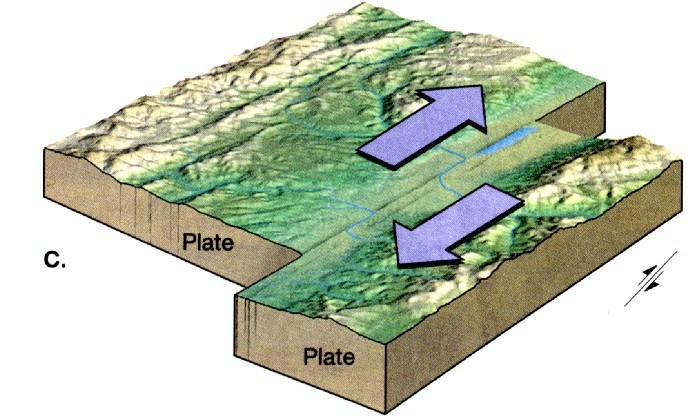
What type of plate boundary is this?
a)
Transform
b)
Convergent
c)
Divergent
d)
Plate
9.
The theory that says Earth's continents once made up an ancient supercontinent, and have been drifting apart ever since, is called the theory of...
a)
Pangea
b)
Plate Tectonics
c)
Natural Selection
d)
Gravity
10.
Islands can from from magma which is pushed up at a __________ plate boundary
a)
Divergent
b)
Convergent
c)
Transform
11.
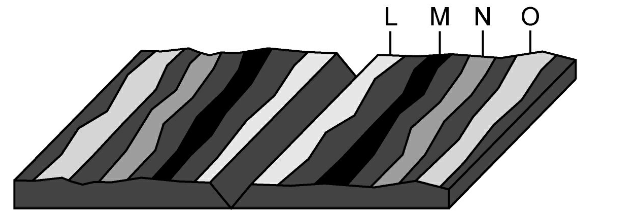
Where would the oldest rock be found?
a)
L
b)
M
c)
N
d)
O
12.
What are the deepest places on Earth formed by pushing oceanic crust under continental crust?
a)
mid-ocean ridges
b)
rift valleys
c)
trenches
d)
mountain ranges
13.
What forms when two oceanic plates diverge?
a)
moutains
b)
rift valley
c)
mid-ocean ridge
d)
deep-ocean trench
14.

What is the highest elevation on this map?
a)
Over 320 meters
b)
Over 450 meters
c)
Over 220 meters
d)
Over 380 meters
15.

What is the elevation of point B?
a)
800 ft
b)
850 ft
c)
900 ft
d)
1000 ft
16.

What is the elevation of A?
a)
10 meters
b)
20 meters
c)
40 meters
d)
120 meters
17.

What feature is formed at B?
a)
river
b)
rift valley
c)
sink hole
d)
mountain
18.
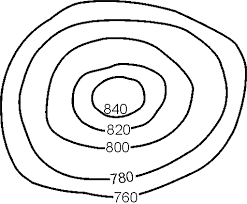
Determine the contour interval:
a)
5 m
b)
10 m
c)
15 m
d)
20 m
19.

Deltas are built up by -
a)
deposition
b)
leaching
c)
abrasion
d)
erosion
20.

What kind of weathering causes the mineral composition of rocks to change?
a)
mechanical weathering
b)
permeable weathering
c)
chemical weathering
d)
physical weathering
21.

A rock containing iron becomes soft and crumbly and reddish-brown in color. It probably has been chemically weathered by -
a)
abrasion
b)
carbon dioxide
c)
oxygen
d)
acid rain
22.

What moon phase is this picture?
a)
This is the full moon phase.
b)
This is the waxing gibbous moon phase.
c)
This is the waning gibbous moon phase.
d)
This is the first quarter moon phase.
23.

What moon phase is this picture?
a)
This is the waning crescent phase.
b)
This is the waxing gibbous phase.
c)
This is the waning gibbous phase.
d)
This is the new moon phase.
24.

What is this moon phase?
a)
This is the waxing crescent phase.
b)
This is the full moon phase.
c)
This is the waxing gibbous phase.
d)
This is the last quarter moon.
25.

What is this moon phase?
a)
This is the waxing gibbous moon phase.
b)
This is the last quarter moon phase.
c)
This is the first quarter moon phase.
d)
This is the new moon phase.
26.

What moon phase is this picture?
a)
This is the full moon phase.
b)
This is the waxing crescent moon phase.
c)
This is the waning gibbous moon phase.
d)
This is the waning crescent moon phase.
100 %

