wayground logo

Free Printable Worksheets

Font size

S
M
L
XL
Worksheets

7th Grade Review

Total questions: 110

Worksheet time: 2hrs 28mins

Name
Class
Date
1.
Which number illustrates Condensation?
a)
1
b)
2
c)
3
d)
4
2.
What does this symbol on a weather map indicate? 
a)
High pressure system
b)
Low pressure system
c)
Cold front
d)
Warm front
3.
What does this symbol indicate on a weather map? 
a)
High pressure system
b)
Low pressure system
c)
Cold front
d)
Warm front
4.
Which weather tool measures air pressure?
a)
thermometer
b)
barometer
c)
anemometer
d)
psychrometer
5.
This weather tool measures wind speed and direction
a)
thermometer
b)
barometer
c)
anemometer
d)
psychrometer
6.
Which weather tool measures temperature?
a)
thermometer
b)
barometer
c)
psychrometer
d)
anememeter
7.
The boundary  between two air masses is known as:
a)
front
b)
storm
c)
climate
d)
flood
8.
Which type of cloud is most often observed during a thunderstorm?
a)
cirrus
b)
stratus
c)
cumulus
d)
cumulonimbus
9.
Hot air (RISES / FALLS) __________.
a)
RISES
b)
FALLS
10.
Cold air (RISES/ FALLS)  _________.
a)
RISES
b)
FALLS
11.
name this front
a)
warm front
b)
cold front
c)
stationary front
d)
occluded front
12.
A _____ is a large, swirling, low-pressure system that forms over the Atlantic Ocean.
a)
blizzard
b)
cold front
c)
tornado 
d)
hurricane
13.
A violently rotating column of air called a _____ when it comes in contact with the ground.
a)
hurrican
b)
tornado
c)
trade wind
d)
local wind
14.
Rain, snow, sleet, and hail are all forms of _____.
a)
precipitation
b)
condensation
c)
evaporation
d)
climate
15.
If plants are exposed to sunlight, then they will grow taller.
What part of the scientific method is this an example of?
a)
Procedure
b)
Hypothesis
c)
Question
d)
Results
16.
What step does every scientific experiment begin with?
a)
hypothesis
b)
question/problem
c)
procedures
d)
conclusion
17.
The independent variable is the ONE thing you _____.
a)
change on purpose
b)
control or keep constant
c)
measure
18.
What is a constant/control in an experiment?
a)
Things that do not change inana experiment.  It's the variable that stays the same.  You can have many variables stay the same.
b)
It's the variables that the scientist changes in the experiment
c)
It's the variables that are being measured in an experiment
19.
What is a PUSH or PULL of an object?
a)
Motion
b)
Force
c)
Friction
d)
Gravity
20.
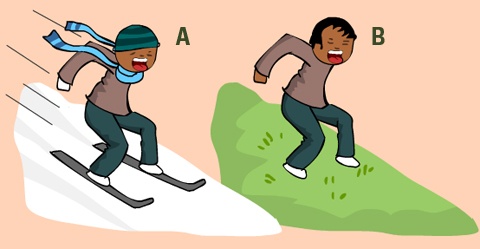
Why is it harder for the boy in Image B to get down the hill?
a)
Motion
b)
Friction
c)
Work
d)
Displacement
21.
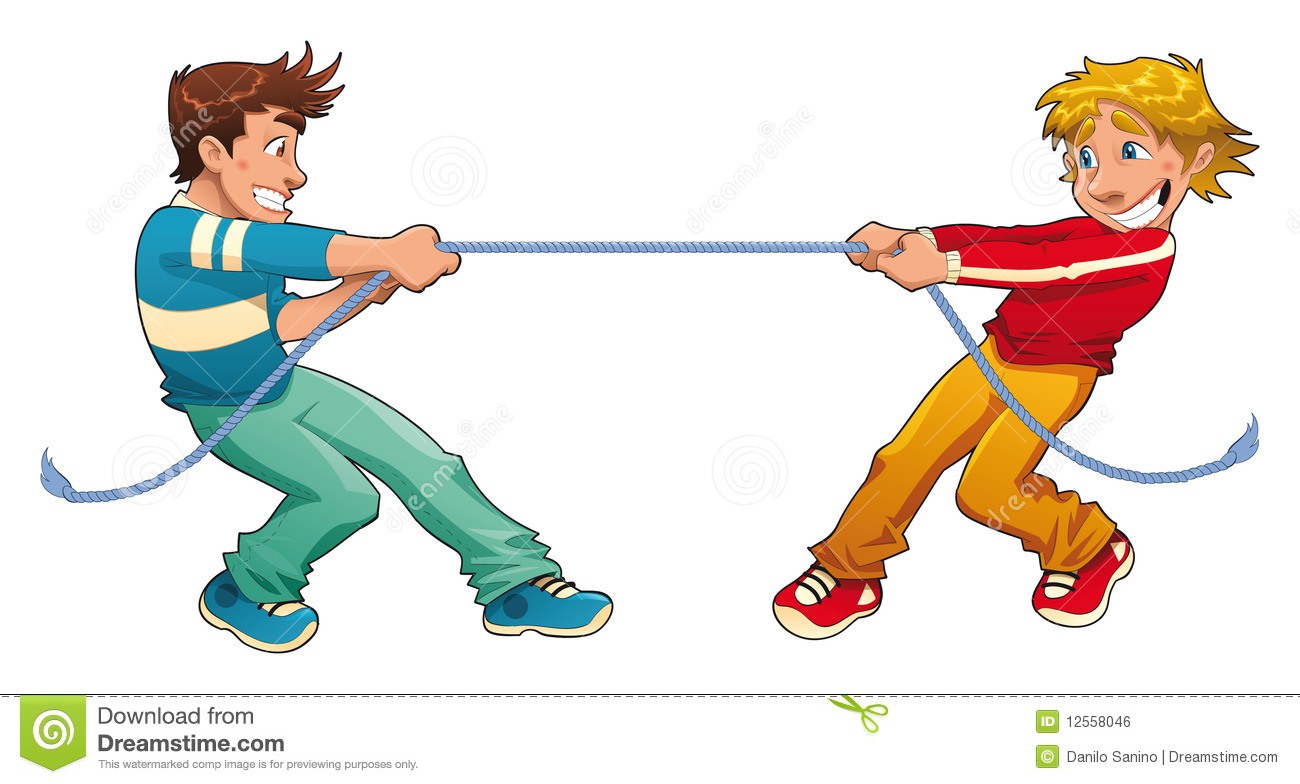
If these boys are pulling with the same amount of force.  What will happen?
a)
The boy in blue will win.
b)
They will not move at all.
c)
The boy in red will win.
d)
Both will fall down.
22.
_______________ is how fast an object changes over time. 
a)
speed
b)
velocity
c)
momentum
d)
acceleration
23.
What is the formula for force?
a)
F=M/A
b)
F=A/M
c)
F=M*A
d)
F=M*F
24.
What happens when two forces act in the same direction?
a)
They cancel each other out.
b)
The stronger one prevails.
c)
Their strengths are added.
d)
Their sum divided by the two is the total force.
25.
Speed is different from velocity because
a)
Velocity has a direction
b)
Speed uses Distance /Time
c)
Velocity doesn't include time
d)
Velocity doesn't include distance
26.
Which organelle is found in plant cells only?
a)
Cell Membrane
b)
Cell Wall
c)
Many Small Vacuoles
d)
Cytoplasm
27.
Which organelle is found in animal cells only?
a)
Cell Membrane
b)
Large Central Vacuole
c)
Many Small Vacuoles
d)
Cytoplasm
28.
To control what enters or leaves the cell is a function of _________.
a)
Cell Wall
b)
Cell Membrane
c)
Nucleus
d)
Mitochondria
29.
To identify the cell as part of an organism is a function of _________.
a)
Cell Wall
b)
Chloroplast
c)
Cell membrane
d)
Mitochondria
30.
To identify the cell as part of an organism is a function of _________.
a)
Cell Wall
b)
Chloroplast
c)
Cell membrane
d)
Mitochondria
31.
To control the processes of the cell through the use of DNA and RNA is a function of _________.
a)
Cell Wall
b)
Cytoplasm
c)
Nucleus
d)
Mitochondria
32.
To provide protection and form for the plant cell is a function of _________.
a)
Cell Wall
b)
Cytoplasm
c)
Nucleus
d)
Mitochondria
33.
A/an__________ is made of genetic material and a protien coat. 
a)
bacteria
b)
virus
c)
protist
d)
archaea
34.
________is when one cell reproduces by dividing in half to become two cells. 
a)
sexual reproduction
b)
prophase
c)
mieosis
d)
binary fission
35.
A virus needs a/an___________to reproduce.
a)
organism
b)
dead cells
c)
host
d)
partner
36.
How can people kill harmful bacteria that live in foods? 
a)
Keeping the food cold.
b)
Using chemicals
c)
Heating the food
d)
Using UV light
37.
The part of Earth where organisms can live.
a)
biotic factors
b)
biosphere
c)
ecology
d)
biology
38.
A system made up of organisms interacting with one another
a)
biology
b)
abiotic
c)
biotic
d)
ecosystem
39.
Nonliving things found in an ecosystem.
a)
factories
b)
factor trees
c)
biotic factors
d)
abiotic factors
40.
A group of the same type of organisms living in the same place at the same time.
a)
threatened species
b)
populations
c)
community
d)
limiting factor
41.
A species that is in danger of becoming extinct.
a)
Threatened species
b)
out of luck
c)
do do birds
d)
endangered species
42.
Which is a biotic factor?
a)
sunlight
b)
air 
c)
bacteria
d)
all of the above
43.
Deserts, mountains, and rivers are all examples of ________.
a)
vacation spots
b)
tundra
c)
ecosystems
d)
wetlands
44.
Decomposers get their food by __________.
a)
making it themselves
b)
eating live organisms
c)
using dead organisms
d)
eating themselves
45.
In an ecosystem, producers and consumers are both __________.
a)
biotic factors
b)
very nice
c)
cranky
d)
abiotic factors
46.
A squirrel in a forest is a member of ___________.
a)
an ecosystem
b)
the squirrel scouts
c)
the Mr. Vilela fan club
d)
illuminati
47.
A homozygous dominant dog with brown fur is crossed with a heterozygous dog with brown fur. What are the percentages of the possible genotypes?
a)
100% BB
b)
75% BB and 25%Bb
c)
50 % BB and 50% Bb
d)
50% Bb and 50% bb
48.
The man who studied genetics and came up with genetics is
a)
Watson
b)
Crick
c)
Mendel
d)
Darwin
49.
What law states that in Tt the person will only show the dominant allele
a)
law of segregation
b)
law of independent assortment
c)
law of dominance
d)
law of punnett squares
50.
Genotype refers to the ...
a)
physical expression of the genes
b)
the possible combination of alleles in a gene
c)
whether an allele is dominant or recessive
d)
how an organism will appear
51.

Squidward has light blue skin, and his genotype for this trait is Bb. Which of the following would describe Squidward?

a)

Purebred

b)

Hybrid

c)

Homozygous

d)

Sex-linked

52.
An offspring will receive how many alleles from each parent to determine a specific trait?
a)
one
b)
two
c)
three
d)
five
53.
Which of the following is a phenotype?
a)
BB
b)
Bb
c)
bb
d)
Blue eyes
54.
What is a phenotype
a)
The genetic make up (code)
b)
The physical trait
55.
the passing of genetic traits from parent to offspring.
a)
heredity
b)
trait
c)
gene
d)
allele
56.
having two of the same genes for the trait (sometimes called purebred).
a)
homozygous
b)
hetrozygous
c)
protein
d)
chromosome
57.
having two different genes for a trait (sometimes called hybrid).
a)
protein
b)
homozygous
c)
heterozygous
d)
genotype
58.
Magda is a tall, 11 year old drummer. She has a scar on her right cheek. She is good at swimming. Which of her traits did Magda most likely inherit?
a)
height
b)
the scar
c)
ability to swim
d)
ability to play drums
59.
Two brown eyed parents (Bb) have a baby. What is the chance the baby is blue eyed?
a)
0 %
b)
25%
c)
50%
d)
75%
60.
G = green, g = yellow
The genotype for a yellow plant is...
a)
GG
b)
Gg
c)
gg
d)
all of the choices result in yellow
61.
An allele whose trait only shows up when no dominant allele is present.
a)
hidden allele
b)
dominant allele
c)
recessive allele
d)
present allele
62.
Two heterozygous (Tt) tall pea plants are crossed. Which describes their offspring?
a)
50% tall and 50% short
b)
75%tall and 25% short
c)
100%short
63.
W=white hair
w= non-white hair
If you cross a horse with WW and a horse with ww what fraction of the offspring would be expected to have white hair?
a)
none
b)
3/4
c)
1/2
d)
all
64.

What is recombinant DNA

a)

DNA from 2 different organisms combined

b)

DNA from 2 different ribosomes

c)

DNA that is separated out from a vector

65.

Which of the following could be used as a vector for a human gene?

a)

Bacterial Plasmid

b)

Bacteria

c)

A mitochondria

d)

mRNA

66.

"transgenic" refers to an animal that:

a)

Has DNA from another organism spliced into its genome

b)

Has undergone DNA modification

c)

Has unique genes for its species

67.

Gel electrophoresis sorts DNA based on:

a)

fragment length

b)

fragement sequence

68.

Humans with genetic diseases can have a gene inserted into their body using a virus. This is called:

a)

Gene therapy

b)

Cloning

c)

DNA fingerprinting

69.
The layer of gases surrounding the Earth
a)
Hydrosphere
b)
Cryosphere
c)
Oxyosphere
d)
Atmosphere
70.
Earth’s entire solid or rocky body
a)
Hydrosphere
b)
Asthenosphere
c)
Geosphere
d)
Mesosphere
71.
The liquid water on Earth
a)
hydrosphere
b)
cryosphere
c)
thermosphere
d)
aquasphere
72.
All of the living things on the Earth
a)
Biosphere
b)
Atmosphere
c)
The continents
d)
Hydrosphere
73.
When layers of the Earth formed, the least dense layer..
a)
sank to the bottom.
b)
mixed with the other layers.
c)
floated to the top.
74.
Which layer of the Earth is the most dense?
a)
Crust
b)
Inner core
c)
Mantle
d)
Outer core
75.
Which layer of the Earth is the least dense?
a)
Crust
b)
Inner core
c)
Mantle
d)
Outer core
76.
Which portion of the crust is thicker?
a)
Continental
b)
Oceanic
77.
The ??? is the plastic (slowly flowing) layer made of solid rock in the mantle
a)
Asthenosphere
b)
Lithosphere
c)
Cryosphere
d)
Mesosphere
78.
The bottom layer of the mantle is the
a)
asthenosphere.
b)
biosphere.
c)
mesosphere.
d)
lithosphere.
79.
The pieces of the lithosphere that move around on top of the asthenosphere are called
a)
continents.
b)
mesospheres. 
c)
crust
d)
tectonic plates.
80.
??? give a lot of information about Earth’s interior by the waves they create. 
a)
Volcanoes
b)
Tsunamis
c)
Earthquakes
d)
Cannonballs 
81.
The layer of rock between the Earth's core and crust.
a)
outer core
b)
crust
c)
inner core
d)
mantle
82.
Liquid metal layer that surrounds the Earth's inner core.
a)
inner core
b)
crust
c)
outer core
d)
mantle
83.
Solid metal layer at the center of the Earth.
a)
mantle
b)
outer core
c)
inner core
d)
crust
84.
The crust that makes up the continents- the land
a)
tectonic plates
b)
atmosphere
c)
continental crust
d)
oceanic crust
85.
The plates that make up the Earth's crust that are responsible for continental drift.
a)
continental crust
b)
oceanic crust
c)
geologist
d)
tectonic plates
86.
Tectonic plates are still moving, causing continents to drift.
a)
True
b)
False
87.
What is the name of the Super-Continent that existed long ago?
a)
Wegener
b)
Pangaea
c)
Geocontinent
88.
What does the prefix -hydro mean?
a)
air, vapor
b)
rock and stone
c)
water
89.
Why does the moon appear bright?
a)
because it has an electric power source
b)
because it is radioactive
c)
because it is a star
d)
because it reflects the Sun's light
90.
When an object orbits another object, it _________.
a)
explodes
b)
revolves
c)
vibrates
d)
rotates
91.
Earth rotates once every 24 hours.  What does this mean?
a)
Earth completes a full spin on its axis once every 24 hours.
b)
Earth changes its orbit from clockwise to counterclockwise every 24 hours.
c)
Earth makes one full trip around the Sun every 24 hours.
d)
Earth makes one full trip around the Moon every 24 hours.
92.
Day and night is caused by the _____________ of earth on its axis.
a)
revolution
b)
orbit
c)
rotation
d)
apparent motion
93.
About how long does it take the Earth to make one REVOLUTION around the Sun?
a)
12 hours
b)
24 hours
c)
365 days
d)
29.5 days
94.
What degree is the earth tilted?
a)
23
b)
25
c)
23.5
d)
25.5
95.
You are getting ready for school.  On the other side of the world, students are getting ready for _______.
a)
school
b)
bed
c)
breakfast
d)
lunch
96.
What causes the sun to look like it is rising in the east and setting in the west?
a)
moon's orbit
b)
sun's rotation
c)
Earth's revolution
d)
Earth's rotation
97.
When is the winter solstice?
a)
December
b)
June
c)
March
d)
September
98.
When are the equinoxes?
a)
June & December
b)
July & January
c)
April & October
d)
March & September
99.
When the Northern Hemisphere of Earth is Leaning away from the Sun, What season is the Southern Hemisphere experiencing?
a)
Summer
b)
Winter
c)
Spring
d)
Fall
100.
The reasons we have seasons is because the Earth is _______
a)
pie
b)
tilted
c)
melting
d)
water
101.
This is the largest planet in the solar system.
a)
Saturn
b)
Jupiter
c)
Uranus
d)
Venus
102.
Scientists think that the universe will _____________________________.
a)
end someday
b)
expand forever
c)
eventually shrink
d)
expand and shrink on a regular basis
103.
What does a star's color indicate?
a)
size
b)
age
c)
temperature
d)
shape
104.
According to the big bang theory, the universe is about ______________________.
a)
470 billion years old
b)
500 billion years old
c)
4.7 billion years old
d)
13.7 billion years old
105.
Scientists think that the Milky Way is probably _______________________.
a)
an irregular galaxy
b)
an elliptical galaxy
c)
a spiral galaxy
d)
a nebula
106.
What is one way scientists use to calculate the age of the universe?
a)
measure the distance from Earth to nearby stars
b)
measure the distance from Earth to various galaxies
c)
measure the distance from Earth to the sun
d)
measure the size of various galaxies
107.
The universe is organized according to __________.
a)
a random pattern
b)
a loosely arranged structure
c)
a rigid and complex pattern
d)
no pattern or structure
108.
What are the three major types of galaxies identified by Edwin Hubble?
a)
spiral, triangular, irregular
b)
spiral, elliptical, irregular
c)
spiral, elliptical, triangular
d)
triangular, elliptical, irregular
109.
What is the study of the origin, structure, and future of the universe?
a)
cosmology
b)
black hole
c)
quasar
d)
light-year
110.
What is the distance that light travels in one year; about 9.5 trillion kilometers?
a)
cosmology
b)
black hole
c)
quasar
d)
light-year