
 Worksheets
Test Practice
Total questions: 30
Worksheet time: 2hrs 39mins
Name
Class
Date
1.
Draw a tree diagram in your math workbook. Then answer this question. A girls' choir is choosing a uniform for their concert. They can pick red, green, or purple sweaters, and they can pick tan, white, or black skirts. The shoes they need come in gold and black. Assuming all the colors go together, how many different combinations can the choir pick?
a)
3 combinations
b)
8 combinations
c)
12 combinations
d)
18 combinations
2.
Draw a tree diagram in your math workbook. Then answer this question. Max is ordering a salad for lunch. He can choose one of chicken, tofu, hard-boiled eggs, or turkey to have on the salad. He can also pick one vegetable topping. The vegetable choices are sprouts, tomatoes, or olives. How many different combinations can Max create?
a)
7 combinations
b)
12 combinations
c)
3 combinations
d)
4 combinations
3.

Which of the following situations is represented by this tree diagram?
a)
3 shirt options, 6 pants options, and 12 shoe options
b)
3 shirt options, 2 pants options, and 2 shoe options
c)
2 shirt options, 3 pants options, and 1 shoe option
d)
8 shirt options, 4 pants options, and 2 shoe options
4.
How many ways can a club select a president, vice president, and a secretary from a group of 5 people?
a)
12
b)
60
c)
15
d)
24
5.
A menu has 6 different sandwiches, with 3 choices of potato chips, 3 types of salad and 5 different beverages. How many different lunch combinations consisting of a sandwich, chips, salad, and beverage can be ordered?
a)
30
b)
17
c)
90
d)
270
6.

Find the theoretical probability of NOT landing on yellow if you spin the spinner.
a)
1/8
b)
7/8
c)
1
d)
7
7.
An event M has m possible outcomes and event N has n possible outcomes. The total number of outcomes of event M followed by event N is .
a)
outcomes
b)
Fundamental Counting Principle
c)
independent events
d)
experimental probability
8.
The ratio of the number of favorable outcomes to the number of possible outcomes when all possible outcomes are equally likely
a)
experiment
b)
Fundamental Counting Principle
c)
experimental probability
d)
theoretical probability
9.
Two events such that the occurrence of one event does not affect the likelihood that the other event(s) will occur
a)
dependent events
b)
independent events
c)
experiment
d)
event
10.
Probability that is based on repeated trials of an experiment
a)
Fundamental Counting Principle
b)
theoretical probability
c)
experimental probability
d)
experiment
11.
Two events such that the occurrence of one event affects the likelihood that the other event(s) will occur
a)
event
b)
compound event
c)
dependent events
d)
independent events
12.
A box contains 5 purple marbles, 3 green marbles and 2 orange marbles. Draws are made without replacement. P(orange,green)
a)
1/15
b)
2/15
c)
3/31
d)
1/5
13.
A jar contains 4 white chips, 5 purple chips, and 1 black chip. Chips are selected randomly one at a time, and are not replaced. P(purple then black)
a)
1/18
b)
2/5
c)
3/7
d)
4/9
14.
A basket contains four apples and six peaches. You randomly select one piece of fruit and eat it. Then you randomly select another piece of fruit. Both pieces of fruit are apples. P(apple, apple)
a)
2/15
b)
3/17
c)
1/19
d)
6/21
15.
Find the probability of selecting a black checker from a bag of 6 black and 4 red checkers, replacing it and selecting another black.
a)
9/25
b)
1/4
c)
2/23
d)
3/41
16.
Jim picks a diamond out of a deck of cards, replaces it and gets a diamond again. What is the probability this happened. (There are 13 diamonds, and 52 cards in a deck)
a)
1/16
b)
2/13
c)
4/17
d)
1/21
17.
Jim picks a diamond out of a deck of cards, replaces it and gets a diamond again. What is the probability this happened. (There are 13 diamonds, and 52 cards in a deck)
a)
1/16
b)
2/13
c)
4/17
d)
1/21
18.
You roll a pair of number cubes (dice). Which equation represents how to find the probability of rolling a 2 and an odd number?
P(2, then odd)
P(2, then odd)
a)
⅙ x ½ = 1/12
b)
⅙ + ½ = 2/8
c)
½ x ½ = 1/4
d)
⅓ + ½ = 5/6
19.

The spinner is spun two times. Determine the probability of landing on red the first spin and on green the second spin .
a)
1/9
b)
1/10
c)
0
d)
1/12
20.
In a box there are 3 red pens, 2 green pens, and 1 blue pen. What is the probability of picking a red pen, not replacing it, and then picking a blue pen?
a)
1/2
b)
4/11
c)
1/10
d)
2/3
21.
Which of the following situations is represented by this tree diagram?
a)
3 shirt options, 6 pants options, and 12 shoe options
b)
3 shirt options, 2 pants options, and 2 shoe options
c)
2 shirt options, 3 pants options, and 1 shoe option
22.
How many styles of sneakers are possible if Jared can choose from high-top or low-top, shoelaces or velcro, and the colors black, white, and red?
a)
12
b)
7
c)
223
d)
64
23.

P(cereal or steak)
a)
9/40
b)
1/40
c)
8/40
d)
1/2
24.
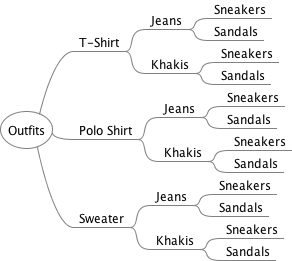
How many total outfit options are represented?
a)
12
b)
22
c)
3
25.

Shannon has a bag of jelly beans. She removed one jelly bean, recording the color, and then replaced it. She repeated the process several times and record her results in the table. What is the experimental probability of her selecting a red jelly bean?
a)
11/33
b)
1/3
c)
1/4
d)
18/26
26.

What is the experimental probability of landing on orange or red?
a)
2/5
b)
3/8
c)
3
d)
10 times
27.
An experiment consists of rolling a fair number cube. Find the theoretical probability of rolling a 3.
a)
1/6
b)
3/6
c)
1
d)
1/2
28.
What is the total number of outcomes for picking a cat or dog and choosing the colors black, brown or spotted?
a)
2
b)
4
c)
6
d)
8
29.
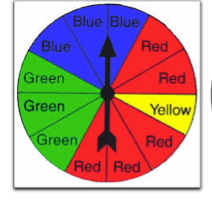
What is the probability of spinning green?
a)
0
b)
1/4
c)
1/2
d)
3/4
30.

What is the probability of getting an odd number when rolling a single 6 sided die?
a)
1/6
b)
2/6
c)
3/5
d)
3/6
100 %

