
Font size
 Worksheets
Tectonic Plates
Total questions: 27
Worksheet time: 27mins
The type of plate boundary where two plates come together is a .....
Convergent Boundary
Divergent Boundary
Transform Boundary
Plate Boundary
Which of the following causes Earth's tectonic plates to move?
Energy from the Sun
Magnetic Pole Reversal
Convection currents in the mantle
Faults in Mountain Ranges
A divergent boundary occurs when plates ....
Pull apart
Come together
Slide past each other
subducting
Which of the following is NOT evidence to support the theory of plate tectonics?
Fossils
Rock types
Glacier movement
Sand Erosion
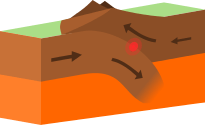
What type of plate boundary is this?
Plate
Divergent
Convergent
Transform
Which layer has convection currents?
Inner Core
Outer Core
Mantle
Crust
Earthquakes and volcanoes are most likely found in which locations?
At plate boundaries
in oceans
in the middle of continents
in the middle of plates
Which of the following are evidence for continental drift?
coastlines fitting together
volcanoes
earthquakes
fossils
ancient coral reefs
Mountains are created when....
Two continental plates collide
Two oceanic plates pull apart
An Oceanic plate subducts under a Continental Plate
Two continental plates pull apart
During sea floor spreading, magma rises up from the mantle...
along the continents
at the mid ocean ridges
deep ocean trenches
at north and south poles
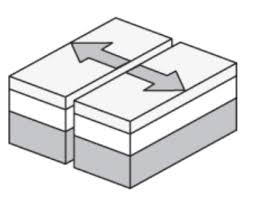
Name the boundary
convergent boundary
divergent boundary
transform boundary
sergent boundary
Which ocean is expanding due to a mid-ocean ridge (divergent boundary)?
Indian Ocean
Pacific Ocean
Atlantic Ocean
Arctic Ocean
Which of the following occurs because of convection currents?
Tectonic plates on the crust move.
The mantle increases in size.
Pressure in the crust increases.
Pressure in the crust decreases.
The epicenter of an earthquake is the below the Earth's surface.
False
True
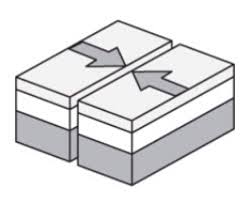
Name the boundary
convergent boundary
divergent boundary
transform boundary
sergent boundary
The place where an earthquake originates (begins) is called the _____________.
tsunami
focus
epicenter
fault line

What type of volcano is this?
Composite Volcano
Shield Volcano
The volcanoes on the Hawaiian Islands form due to which of the following?
Divergent Boundary
Hot Spot
Subduction Boundary
Convergent Boundary

One large landmass of all continents together...
North America
Pangaea
South America
PanAmerica
To create seafloor spreading, ____ is pushed up from the mantle.
Lava
Iron
Magma
Nickel

Which was NOT evidence of Wegener?
Seafloor spreading
fossils
rock types
glacier movement

The _________ is the thinnest layer of Earth.
outer core
inner core
mantle
crust

Plates move apart at _________ boundaries.
volcanic
divergent
convergent
transform
When earthquakes occur, they produce..
Temperature
Seismic waves
Pressure
Lithosphere
True or False: Volcanoes are found at divergent boundaries.
True
False
How is a hot spot for volcanoes created?
An earthquake happened.
A dormant volcano is near by.
A thinner area of crust allows magma to push through.
Why does heat rise?
The molecules are lighter.
The molecules are heavier.
The molecules are moving faster.
The molecules are moving slower.

