
 Worksheets
Primary Checkpoint Science - Cambridge - Part I
Total questions: 96
Worksheet time: 1hrs 9mins
Name
Class
Date
1.
What are the functions of the petals?
a)
Brightly colored
b)
Able to attract insects
c)
Protect the inside of the flower
d)
All of the above
2.
The Stamen, Anther, and Filaments are all female parts of a flower.
a)
True
b)
False
3.
Where are seeds made?
a)
Sepal
b)
Pistil
c)
Ovary
d)
Stigma
4.
Which part of the flower holds the pollen?
a)
Filament
b)
Anther
c)
Stigma
d)
Petals
5.
What is the correct order of a typical plant's life cycle?
a)
seed, germinate, mature, flowers, fruit
b)
seed, mature, germinate, fruit, flower
c)
fruit, germinate, seed, flower, mature
d)
fruit, seed, germinate, flower, mature
6.
The main function of a leaf is to...
a)
release oxygen
b)
release CO2
c)
absorb sunlight
d)
absorb water
7.
A flower will eventually turn into...
a)
a fruit
b)
a leaf
c)
a root
d)
a stem
8.
When a plant germinates...
a)
it starts to grow
b)
it starts to die
9.
Where is food made in a plant?
a)
leaves
b)
roots
c)
stem
d)
fruit
10.

What is #1 pointing to?
a)
ovary
b)
petal
c)
stigma
d)
stamen
11.

What is #8 pointing to?
a)
petal
b)
stamen
c)
pistil
d)
ovary
12.
The male part of the flower is known as the _____.
a)
stamen
b)
pistil
c)
ovary
d)
petal
13.
The female part of the flower is known as the ____.
a)
stamen
b)
anther
c)
filament
d)
pistil
14.
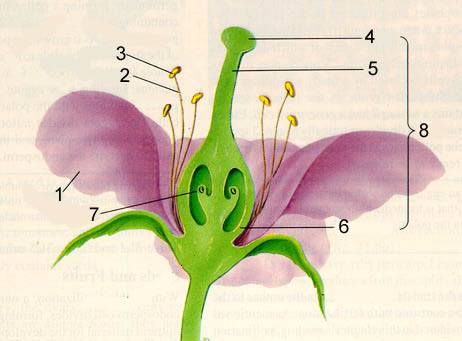
What is #2 pointing to?
a)
anther
b)
filament
c)
ovary
d)
style
15.

What is #3 pointing to?
a)
stigma
b)
filament
c)
ovary
d)
anther
16.
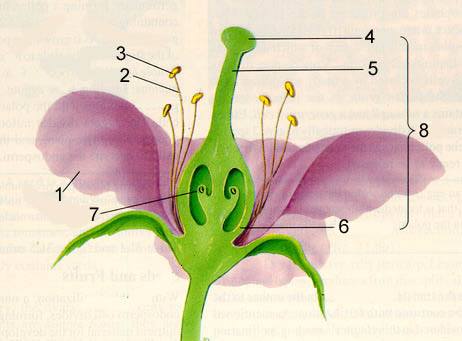
What is #4 pointing to?
a)
anther
b)
style
c)
stigma
d)
ovary
17.

What is #5 pointing to?
a)
anther
b)
filament
c)
stigma
d)
style
18.

What is #6 pointing to?
a)
stigma
b)
style
c)
ovary
d)
petal
19.

What is #7 pointing to?
a)
anther
b)
ovary
c)
ovule
d)
petal
20.
In what part of the flower does fertilization take place?
a)
anther
b)
stigma
c)
ovary
d)
filament
21.
Where is pollen made?
a)
ovary
b)
petal
c)
pistil
d)
anther
22.
What is the sticky part of the flower that catches pollen?
a)
style
b)
stigma
c)
ovary
d)
petal
23.
What part of the flower will turn into a fruit?
a)
petal
b)
ovary
c)
ovule
d)
stamen
24.
What part of the flower will turn into a seed?
a)
ovary
b)
anther
c)
ovule
d)
filament
25.

Which of these are both male reproductive structures?
a)
Stigma and Style
b)
Anther and Filament
c)
Style and Ovary
d)
Stigma and Anther
26.
What part of a flower produces female reproductive cells (OVULES)?
a)
anther
b)
ovary
c)
sepal
d)
filament
27.
What are the small leaves called that protect the bud?
a)
sepal
b)
petal
c)
leaves
d)
seed
28.
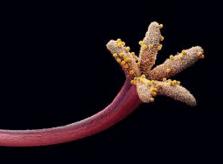
The part of the flower on which the pollen grains land.
a)
pistil
b)
stamen
c)
sepals
d)
stigma
29.
Why are flowers very colorful (and why do they produce odor?)
a)
So people buy them
b)
To make gardens look good
c)
To attract pollinators
d)
To attract sunlight
30.
What part of the flower will turn into a seed if fertilized by a pollen grain?
a)
ovary
b)
anther
c)
ovule
d)
filament
31.
The filament___________
a)
holds up the anther
b)
protects the petal
c)
is the male part of the flower
d)
catches pollen
32.

A
a)
Stigma
b)
Ovary
c)
Ovule
d)
Style
33.

B
a)
Stigma
b)
Ovule
c)
Ovary
d)
Sty
34.

C
a)
Ovary
b)
Ovule
c)
Style
d)
Filament
35.

D
a)
Filament
b)
Anther
c)
Stigma
d)
Style
36.

E
a)
pistil
b)
stigma
c)
filament
d)
anther
37.

F
a)
Ovary
b)
Filament
c)
Anther
d)
Pistil
38.

G
a)
Stamen
b)
Anther
c)
Filament
d)
Ovule
39.

H
a)
filament
b)
anther
c)
stamen
d)
pistil
40.

I
a)
stigma
b)
stamen
c)
sepal
d)
petal
41.
This type of plant comes from seeds and reproduce using flowers.
a)
Flowering Plant
b)
Non-Flowering Plant
c)
Mature Plant
d)
Seed
42.
This type of plant comes from seeds; however, produces their seeds from cones.
a)
Flowering Plants
b)
Non-Flowering Plants
c)
Seeds
d)
Mature Plants
43.
The stage in which seeds are formed.
a)
Pollination
b)
Fertilization
c)
Germination
d)
Mature Plant
44.
The stage in which pollen is spread from flower to flower by insects and/or wind.
a)
Pollination
b)
Fertilization
c)
Germination
d)
Mature Plant
45.
The stage in which a seedling grows.
a)
Pollination
b)
Germination
c)
Fertilization
d)
Mature Plant
46.
At this stage, a seed is considered a full grown plant.
a)
Pollination
b)
Fertilization
c)
Germination
d)
Mature Plant
47.
Which part of the plant takes in water and nutrients from under the ground?
a)
Roots
b)
Stem
c)
Leaves
d)
Flowers
48.
Which part of the plant moves and stores water and nutrients through the rest of the plant?
a)
Roots
b)
Stem
c)
Leaves
d)
Flowers
49.
What is a habitat?
a)
a group of the same animal living together
b)
specific place where an animal lives
c)
how an animal behaves
d)
animal traits
50.
There are lots of different habitats in the world specific for different animals. Match the correct animal to its habitat.
a)
dolphin - fresh water lake
b)
walrus - desert
c)
polar bear - arctic
d)
frog - savannah
51.
In which habitat do the sloth and red eyed tree frog live?
a)
tropical rainforest
b)
savannah
c)
woodland/forest
d)
desert
52.
What habitat is the largest?
a)
ocean
b)
tundra (arctic)
c)
forest
d)
desert
53.
The desert is often looked at as a wasteland, dead, void of life. However, there is the wealth of life and possibilities which exist behind its dry, rock-ridden mask. Which two organisms are able to survive in the hot dry environment?
a)
cactus and horses
b)
cactus and lizards
c)
pine trees and snakes
d)
polar bears and water lilies
54.
Which three animals can be found in the grasslands?
a)
red eyed tree frog, sloth, lion
b)
kangaroos, zebras, lions
c)
elephants, walruses, penguins
d)
gorillas, lions, dolphins
55.
This habitat is home to hawks, zebras and bison where summers are warm and winters are cold.
a)
grasslands
b)
rivers
c)
deserts
d)
wetlands
56.

What sense tells me the leaves are green?
a)
see
b)
hear
c)
taste
d)
smell
57.

What sense do you use to listen to music?
a)
hear
b)
taste
c)
see
d)
smell
58.
1. How many senses do we have?
a)
1
b)
3
c)
5
d)
10
59.
Which of the following is considered a fruit by scientists?
a)
carrot
b)
potato
c)
cucumber
d)
broccoli
60.
The main purpose of a fruit plant is?
a)
To provide healthy food for humans
b)
To help plants and animals grow
c)
To look pretty and attract insects
d)
To protect seeds and help in seed dispersal
61.
What part of a flower makes pollen?
a)
stamen
b)
ovary
c)
pistil
d)
petal
62.
Seeds are NOT dispersed by which of the following?
a)
animals
b)
water
c)
electronics
d)
wind
63.
Which of the following, in order, shows the steps in the life cycle of a seed?
a)
germination, pollination, seed dispersal, flowering
b)
germination, growth, maturity, seed formation
c)
seed formation, growth, germination, maturity
64.
Which of the following is an inherited trait?
a)
The amount of sunlight
b)
Shape and size of the leaves
c)
Amount of water
d)
Type of soil
65.
Which of the following, in order, shows the steps in the life cycle of a seed?
a)
germination, pollination, seed dispersal, flowering
b)
germination, growth, maturity, seed formation
c)
seed formation, growth, germination, maturity
66.
Which of the following, in order, shows the steps in the life cycle of a seed?
a)
germination, pollination, seed dispersal, flowering
b)
germination, growth, maturity, seed formation
c)
seed formation, growth, germination, maturity
67.
This type of plant comes from seeds and reproduce using flowers.
a)
Flowering Plant
b)
Non-Flowering Plant
c)
Mature Plant
d)
Seed
68.
The stage in which seeds are formed.
a)
Pollination
b)
Fertilization
c)
Germination
d)
Mature Plant
69.
The stage in which pollen is spread from flower to flower by insects and/or wind.
a)
Pollination
b)
Fertilization
c)
Germination
d)
Mature Plant
70.
The stage in which a seedling grows.
a)
Pollination
b)
Germination
c)
Fertilization
d)
Mature Plant
71.
At this stage, a seed is considered a full grown plant.
a)
Pollination
b)
Fertilization
c)
Germination
d)
Mature Plant
72.
Which part of the plant takes in water and nutrients from under the ground?
a)
Roots
b)
Stem
c)
Leaves
d)
Flowers
73.
Which part of the plant moves and stores water and nutrients through the rest of the plant?
a)
Roots
b)
Stem
c)
Leaves
d)
Flowers
74.
Which part of the plant attracts animals of all sizes?
a)
Roots
b)
Stem
c)
Leaves
d)
Flowers/Fruit
75.

Which best describes what a food chain shows you?
a)
Energy flow through an ecosystem
b)
Food flowing through an ecosystem
c)
Consumers going into other consumers
d)
Who eats who
76.

What are plants called in a food chain?
a)
Producers
b)
Consumers
c)
Decomposers
d)
Scavengers
77.

What are animals called in a food chain?
a)
Producers
b)
Consumers
c)
Decomposers
d)
Plants
78.

What are the organisms that break down dead stuff?
a)
Producers
b)
Consumers
c)
Decomposers
d)
Organisms
79.

Where does the energy start in this food chain?
a)
Plant
b)
Sun
c)
Deer
d)
Wolf
80.

What is the role of a producer?
a)
Use sunlight to make food
b)
Gain energy from eating other organisms
c)
Keep other species from overpopulating
d)
Breaking down dead stuff
81.

What's the role of consumers in a food chain?
a)
Use sunlight to make food
b)
Eat other species and keep them from overpopulating
c)
Break down dead stuff
d)
Add nutrients to the soil
82.

What is the role of decomposers in a food chain?
a)
Use sunlight to make food
b)
Eat other organisms to gain energy
c)
Make the food for the whole food chain
d)
Break down dead organisms and add nutrients to the soil
83.

Which of these organisms would receive energy from the snake?
a)
Plant
b)
Rabbit
c)
Mouse
d)
Hawk
84.
Which of these organisms would receive energy from the snake?
a)
Plant
b)
Rabbit
c)
Mouse
d)
Hawk
85.

Which type of consumer eats plants only?
a)
Herbivores
b)
Omnivores
c)
Carnivores
d)
Scavengers
86.

Which type of consumer eats meat only?
a)
Producers
b)
Herbivores
c)
Carnivores
d)
Omnivores
87.

Which type of consumer eats meat and plants?
a)
Herbivores
b)
Carnivores
c)
Omnivores
d)
Plants
88.

Which type of consumer is always a first consumer?
a)
Herbivore
b)
Omnivore
c)
Carnivore
d)
Producer
89.

Which type of consumer could be a first or second consumer?
a)
Herbivore
b)
Omnivore
c)
Carnivore
d)
Producer
90.

Which of the following is a producer?
a)
Maple tree
b)
Sunfish
c)
Bunny
d)
Bear
91.

Which of these is true about this food web?
a)
The Owl gets its energy from the producer.
b)
The Lion gets its energy only from a wild cat.
c)
The Kite gets its energy from the goat.
d)
The Mouse is most likely to die, several ways.
92.
What are the basic needs of plants?
a)
air, water, nutrients, sun, temperature and space.
b)
air, water, nutrients, sun, roots, food, shelter.
c)
air, water, sun, shelter, nutrients, and space.
93.
What is the job of the roots?
a)
Roots hold the plant up.
b)
They capture energy from the sun for photosynthesis.
c)
Collect water from the ground and transfer it to the plant.
94.
What part of the plant produces the seeds?
a)
Flower
b)
Roots
c)
Stem
d)
Seed
95.
What part of the plant produces the seeds?
a)
Flower
b)
Roots
c)
Stem
d)
Seed
96.
A feature of a living thing that makes it better suited to its environment.
a)
Flower
b)
Chlorophyll
c)
Adaptation
d)
Deciduous
100 %

