
NEW
Font size
S
M
L
XL
 Worksheets
COT
Total questions: 30
Worksheet time: 28mins
Name
Class
Date
1.
What is it called when all the organisms of a species die out?
a)
Extinction
b)
Mutation
c)
Natural Selection
d)
Fossilization
2.
When organisms are better adapted to their environment they will survive and reproduce more successfully than organisms less adapted. This process is called-
a)
Evolution
b)
Cloning
c)
Natural selection
d)
Selective breeding
3.
Who proposed the theory that evolution happens as a result of natural selection?
a)
James Watson
b)
Charles Darwin
c)
Matthias Schleiden
d)
Robert Hooke
4.
A characteristic that helps an organism survive and reproduce in its environment is called-
a)
an adaptation
b)
a mutation
c)
natural selection
d)
a homologous structure
5.
By studying fossils, scientists have developed a timeline of life on earth. What is the timeline called?
a)
The fossil record
b)
The history of primates
c)
Natural selection
d)
The theory of evolution
6.
Darwin concluded that organisms on the Galápagos Islands
a)
had changed over time.
b)
had remained the same.
c)
were the result of selective breeding.
d)
had no variations.
7.
What did Darwin observe about finches in the Galápagos Islands?
a)
Their feathers were adapted to match their environment.
b)
Their beaks were adaptations related to the foods the finches ate.
c)
They had homologous body structures with other flying vertebrates.
d)
They were unrelated to mainland bird species.
8.
Differences between members of the same species are called
a)
predators.
b)
selections.
c)
traits.
d)
variations.
9.
What was the name of Darwin's ship?
a)
HMS Beagle
b)
HMS Lab
c)
HMS English Bulldog
d)
HMS Husky
10.
What might account for the differences in beaks on the Galapagos Islands?
a)
food sources available
b)
types of nests they build
c)
predators
d)
the original finches
11.
The red fox will vomit before feeling from a predator in order to help it run faster. This is an example of -
a)
behavior that allows it to survive
b)
an inheritable mutation
c)
reason why the species will become extinct
d)
genetic variation that leads to diveresity
12.

Take your time and read carefully! Timer is 3 minutes!
---------
An illustration and a dichotomous key are given. What is the correct classification for this organism?
---------
An illustration and a dichotomous key are given. What is the correct classification for this organism?
a)
Class Insecta
b)
Order Amblygygi
c)
Order Araneae
d)
Order Scorpiones
13.

Take your time and read carefully! Timer is 3 minutes!
---------
A student discovers an arachnid with a segmented abdomen, long legs, and a tail with no stinger. The student uses the dichotomous key below to identify it. Which arachnid has the student found?
---------
A student discovers an arachnid with a segmented abdomen, long legs, and a tail with no stinger. The student uses the dichotomous key below to identify it. Which arachnid has the student found?
a)
Whip Scorpion
b)
Wind Scorpion
c)
Tick
d)
Scorpion
14.
Tool used by a taxonomist to identify an unknown organism is a:
a)
dichotomous key
b)
binomial nomenclature
c)
scientific name
d)
binomial key
15.
A botanist discovers a new plant in the jungle. Which of the
following observations of the plant’s characteristics would be useful in determining its identity with a dichotomous key?
following observations of the plant’s characteristics would be useful in determining its identity with a dichotomous key?
a)
It was discovered in the summertime
b)
It is wet from a recent rain storm.
c)
Its leaves curl up on the edges.
d)
It is eaten by native jungle ants.
16.
Which of the following characteristics will most likely be helpful in identifying a butterfly using a dichotomous key?
a)
Migrates north every spring
b)
hangs on branches
c)
flutters wings fast on hot days
d)
Wings have long extensions
17.
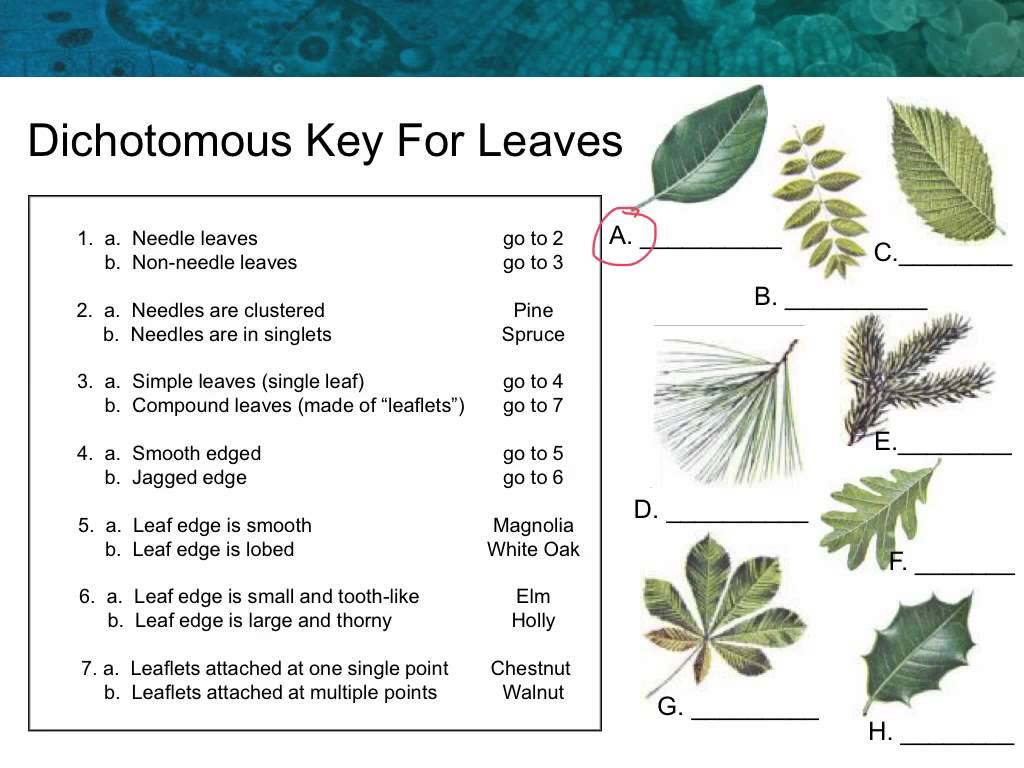
Identify leaf A
a)
Elm
b)
Chestnut
c)
Walnut
d)
Magnolia
18.
When animals travel to a warm place to find food and stay warm.
a)
migration
b)
instincts
c)
adaptation
19.
When animals go into a deep sleep during the winter months.
a)
hibernation
b)
migration
c)
instinct
20.
How do adaptations help animals?
a)
To hide from predators
b)
to hunt for food
c)
to survive in their habitats
d)
All of these are correct
21.
An animal's color or pattern that helps it blend into its surroundings
a)
Environment
b)
Mimicry
c)
Camouflage
d)
Habitat
22.

A dichotomous key for trees is provided. Hikers found a tree that has large brown cones and single sharp needles. What species of tree have the hikers found?
a)
Juniper
b)
Pine
c)
Spruce
d)
Fir
23.
Migration is a behavioral adaptation?
a)
True
b)
False
24.
A cactus lives in the desert because it is adapted to its environment. What adaptations does the cactus have?
a)
It can store water and protect itself with spines
b)
It is a plant
c)
It eats mice
d)
It likes to be covered with ice and snow
25.
Which of the following adaptations would most help an animal that lived near a pond?
a)
a thick coat of fur
b)
webbed feet
c)
large body
d)
deep roar
26.
Which of the following adaptations would most help an animal that is nocturnal?
a)
a strong jaw
b)
excellent night vision
c)
webbed feet
d)
thumbs
27.
Which of these BEST describes how some birds survive when the weather gets cold?
a)
a. They store twigs and sticks in their nest
b)
b. They migrate to a warmer climate
c)
c. They grow more feathers to stay warm in the winter
d)
d. They hide in bushes and wait for warm weather
28.
Dark colored Peppered Moths had a better chance of surviving when the Industrial Revolution began because they blended in with the darkened tree bark. This is an example of,
a)
selective breeding
b)
homologous structures
c)
natural selection
29.

Who is this?
a)
Nikola Tesla
b)
Charles Darwin
c)
An old scientist
d)
Mrs. Whitaker's grandfather
30.
Where did Darwin study?
a)
Galapagos Islands
b)
Caribbean Islands
c)
Hawaiian Islands
d)
Mexican Islands
Reset

