
 Worksheets
Ch. 22 The Great Depression
Total questions: 40
Worksheet time: 25mins
Name
Class
Date
1.
This natural disaster served to worsen the effects of the Great Depression on Farmers in the Midwest
a)
Tornados
b)
Dust Bowl
c)
Black Tuesday
d)
Hurricanes
2.
The President who was mostly blamed for worsening the Great Depression
a)
Roosevelt
b)
Eisenhower
c)
Hoover
d)
Jefferson
3.
The collection of markets and exchange where the issuing and trading of equities, bonds and other sorts of securities takes place.
a)
Margin
b)
New Deal
c)
Deficit Spending
d)
Stock Market
4.
On October 29, 1929 share prices on the New York Stock Exchange completely collapsed and partially caused the Great Depression.
a)
Black Thursday
b)
Black Tuesday
c)
Black Friday
d)
Black Sunday
5.
A time in America following the roaring 20's where America experience rising unemployment that did not end until the onset of World War II.
a)
New Deal
b)
Roaring 20's
c)
Great Depression
d)
Cold War
6.
The Great Depression that began in 1929 hit farmers especially hard. Farmers had not been doing well in the 1920s and several years of severe drought turned the land into a "dust bowl." What was an immediate result of this?
a)
Many farmers decided to grow crops that did not use as much water.
b)
The government built large dams in the West for irrigation.
c)
Many farmers and their families lost their farms and moved west.
d)
The government helped farmers by buying their land and equipment.
7.
In 1929, the United States entered an economic slowdown called the Great Depression. One of the early events was the stock market crash. What was a major cause of the stock market crash?
a)
Stock prices went up so fast that investors could not keep up with the changes.
b)
Stock prices fell, investors panicked and sold their stocks, which led to more panic.
c)
The government decided to close the stock market in New York.
d)
People decided to invest their money in stock markets in Europe.
8.
Because of the Dust Bowl, many farmers moved to California
a)
True
b)
False
9.
Homes that were in parks and built out of cardboard boxes were called Hoovervilles.
a)
True
b)
False
10.
This natural disaster served to worsen the effects of the Great Depression on Farmers in the Midwest
a)
Tornados
b)
Dust Bowl
c)
Black Tuesday
d)
Hurricanes
11.
In the 1930's, people would line up at ____________ to get food. These were normally run by charities.
a)
churches
b)
businesses
c)
soup kitchens
d)
work
12.
During the Great Depression, many people were unemployed. This means that they lost their ____________.
a)
jobs
b)
homes
c)
families
d)
friends
13.
After the Stock Market Crash, many people lost their life savings because _______________.
a)
banks closed
b)
banks gave away their money
c)
they couldn't remember where they put it
d)
someone stole it
14.
To make things worse during the Great Depression, there was a severe drought in the midwest. Because the soil was so dry, wind caused dust storms that covered people's homes, and all of their belongings. This was called the _______________
a)
Dust Bowl
b)
Dry Bowl
c)
Dirt Bowl
d)
Depression Bowl
15.
Towns of cardboard houses popped up during the depression that werecalled_______________.
a)
Franklynvilles
b)
Hoovervilles
c)
Obama towns
d)
Washington Heights
16.

During the 1930s, the conditions shown in this photograph occurred mainly
a)
on the Atlantic Coast
b)
on the Great Plains
c)
in the Rocky Mountains
d)
in the Pacific Northwest
17.
The collection of markets and exchange where the issuing and trading of equities, bonds and other sorts of securities takes place.
a)
Margin
b)
New Deal
c)
Deficit Spending
d)
Stock Market
18.
What caused of The Great Depression?
a)
Unemployment
b)
Bank Failure
c)
Stock Market Crash
d)
All of the Above
19.
What did President Hoover do to limit the effects of the Great Depression?
a)
Provided Relief and Recovery for those in need
b)
Created the New Deal
c)
He created Public Works projects and believed the economy would eventually fix itself
d)
Created the FDIC to put trust back in the banks
20.
What does buying stock on margin mean?
a)
purchasing the stock outside the regular stock exchange
b)
buying the stock for someone else
c)
paying less than the market price of the stock
d)
borrowing money to help pay for the stock
21.
Hoovervilles were
a)
a great place to live
b)
shacks and tents made from anything people could find
c)
a wealthy neighborhood of SOHO
d)
cities with a lot of unemployment
22.
During the Great Depression, many people did lose their homes because they couldn't pay for them. They either had to live with family members or in makeshift "houses" made out of cardboard or whatever they could find. These were called "Hoovervilles" or ________________.
a)
shanty towns
b)
neighborhoods
c)
Hoover Wagons
d)
clubs
23.

What is a good title for this list?
a)
Culture of the 1920s
b)
The Great Migration
c)
Impact of the Great Depression
d)
Features of the New Deal
24.
Which of the following was a major cause of the Great Depression?
a)
overproduction and underconsumption
b)
a decrease in the supply of consumer goods
c)
an increase in demand for imported products
d)
an increase in the price of wheat on the world market
25.
Who was the President of the United States when the Stock Market crashed?
a)
Franklin D. Roosevelt
b)
Herbert Hoover
c)
Woodrow Wilson
d)
Theodore Roosevelt
26.
How did "bank runs" impact the American people during the Great Depression?
a)
Banks eventually ran out of money to loan, and people's life savings were gone.
b)
Banks made loans throughout the Great Depression, helping people pays bills until they could find work.
c)
Banks were able to people's deposits safe, but they could not loan out any more money.
d)
Banks were not at all involved in the Great Depression because people did not use them.
27.
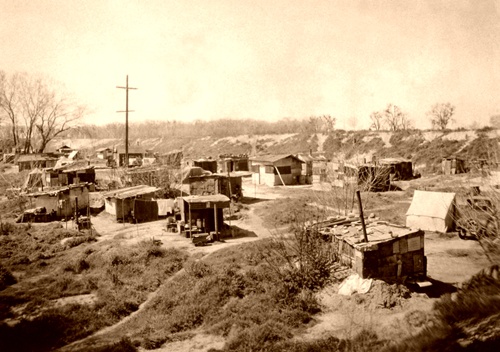
What was the main reason for the emergence of “Hoovervilles” like the one shown in the photograph?
a)
Many Americans had lost jobs during the Great Depression.
b)
Thousands of homes had been destroyed by the effects of the Dust Bowl.
c)
Housing projects could not keep up with the demand for homes needed by the poor.
d)
Preparations for World War I had created a shortage of building materials.
28.
During the early 1930s, the main goal of the Bonus Army was to pressure the Hoover administration to
a)
strengthen the nation’s defenses
b)
end the military draft
c)
bring American troops home from overseas
d)
support the early payment of money promised to veterans
29.
During the 1930s, poor land management and severe drought conditions across parts of the Midwest resulted in the
a)
formation of the United States Department of Agriculture
b)
creation of wheat surpluses
c)
growth of the Populist movement
d)
development of Dust Bowl conditions on the Great Plains
30.
Paying a small % of a stock's price & borrowing the rest is known as what?
a)
buying on margin
b)
speculation
c)
fiat money
d)
price supports
31.
Buying stock without knowing the risks, assuming it will just go up is known as ________.
a)
speculation
b)
buying on margin
c)
market capitalization
d)
hammering the market
32.

Who are these people?
a)
hoboes
b)
immigrants
c)
tourists
d)
carpet baggers
33.
The Bonus Army incident in 1932 best illustrates the idea that
a)
F.D.R.'
s relief programs were unsuccessful.
s relief programs were unsuccessful.
b)
many felt that Herbert Hoover was not handling the Depression well.
c)
protests by veterans during the Depression were effective.
d)
the U.S. Army had increased in size and power during the Depression.
34.
Which of the following was NOT an effect of the Great Depression?
a)
homelessness
b)
bank failures
c)
high tariffs
d)
struggling farmers
35.
Hoovervilles were nicknames for what?
a)
Nickelodeons
b)
The White House during the Depression
c)
Shantytowns
d)
Stock Exchange
36.
Which of the following was NOT a cause of the Great Depression?
a)
uneven distribution of wealth
b)
stock market crash
c)
weak banking system
d)
strong economy
37.
In 1932, this group marched on Washington demanding a promised payment for fighting in World War I.
a)
the Payment Army
b)
the Bonus Army
c)
the RFC
d)
the Hoovervilles
38.
To escape the horrible poverty and dust, many Dust Bowl residents moved to what state?
a)
Oregon
b)
New York
c)
California
d)
Oklahoma
39.
failure to pay back loans
a)
default
b)
on margin
c)
stock exchange
40.
What did people do to try and escape the reality of the Depression?
a)
play sports
b)
go to the movies
c)
work
d)
sleep
100 %

