
 Worksheets
Plate Tectonics
Total questions: 50
Worksheet time: 30mins
The layer of the Earth that contains the plates is called
outer core
inner core
asthenosphere
lithosphere
What type of boundary is the Mid-Atlantic Ridge a result of?
divergent
convergent
strike-slip
transform
Which of the following is NOT caused by the movement of plates?
tsunamis
earthquakes
hurricanes
mountain-building
The name given to the "Supercontinent" is
Gondwanaland
Pangea
Eurasia
Pennsylvania
Which of the following is/are correct about the formation of the Andes Mountains? (Click all that are TRUE)
The Andes Mountains are a result of a convergent boundary.
The Andes Mountains are a result of a divergent boundary.
The Andes Mountains are a result of subduction and uplift.
The Andes Mountains are a result of continental-continental convergence.
Which statement is most accurate?
Under the soil, Earth's outer layer is made of water.
Underneath both the soil and ocean, Earth's outer layer is made of hard, solid rock.
Underneath both the soil and the ocean, Earth's outer layer is made of sand and water.
Underneath the soil, Earth's outer layer is made of hard, solid rock. Underneath the ocean, Earth's outer layer is made of sand.
The slow pulling apart of land, caused by plate movement is
rifting
folding
subduction
uplift
The layer of Earth where convection currents occur is called
lithosphere
crust
asthenosphere
plates
The scientist who stated the theory of Continental Drift
Harry Hess
Henry Hess
Andrew Wegner
Alfred Wegner
Which of the following statements is TRUE concerning convection?
When matter heats up, it expands and becomes more dense.
When matter heats up, it contracts and becomes more dense.
When matter heats up, it expands and becomes less dense.
When matter heats up, it contracts and becomes less dense.
Which of the following is NOT a priority in building an earthquake-resistant building?
Reinforce concrete with steel
Secure the foundation to solid rock deep in the ground
Use beams and columns to secure the roof and floor to the walls
Build with light yet flexible materials so falling debris does not cause much damage
Which of the following is true about subduction of plates? Choose the one best answer.
Oceanic plates are denser and thinner than continental plates; oceanic plates are subducted under continental plates.
Oceanic plates are thicker and more dense than continental plates and therefore subduct under continental plates.
Continental plates are more dense than oceanic plates and therefore subduct under oceanic plates.
Oceanic plates are less dense than continental plates; therefore oceanic plates subduct under continental plates.
A fracture or crack in Earth's outer layer is called a
energy
tension
epicenter
fault
The San Andreas fault is located in
Alaska
California
Indonesia
New Zealand
When two plates diverge, what happens?
A new plate from underneath fills in the gap.
Sand and dirt fill in the gap.
Soft solid rock rises, hardens and joins at the edge of the plates.
Water fills in the gap.
Which of the following is NOT evidence for the theory of Continental Drift?
Same or similar fossils have been found on different continents.
Continents fit together like puzzle pieces.
Same types of rocks have been found on different continents where continents were likely once connected.
Evidence of glaciers has been found in warmer climates.
Storms have gotten more severe over the past 150 years, which is likely linked to plate motion.
Which of the following is NOT true about seafloor spreading?
New rock is formed at the seafloor, which has caused the Earth to continue to expand.
New rock is formed at the seafloor, which becomes part of oceanic plates at a mid-ocean ridge.
Youngest rocks are found at the mid-ocean ridge; oldest rocks are found farthest from the ridge.
Rock from the mid-ocean ridges will likely be subducted eventually.
Hot liquid rock below Earth's surface
lava
magma
True or False? Earthquakes is what causes plates to move.
true
false
What causes plates to move?
energy from the sun
convection currents in the asthenosphere
gravity and friction
natural disasters such as volcanic eruptions and tsunamis
Which of the following locations is NOT along the Ring of Fire?
Indonesia
Alaska
England
Chile
The process by which the ocean floor sinks beneath a deep-ocean trench and back into the mantle is known as
uplift
convection
seafloor spreading
subduction
Which of the following terms describes a boundary formed when two plates MOVE AWAY FROM EACH OTHER or SEPARATE?
divergent
convergent
transform
strike-slip
Which of the following is NOT TRUE concerning the theory of seafloor spreading?
Mid ocean ridges form where the seafloor spreads.
It happens at a DIVERGENT plate boundary.
The rocks closest to the area where the seafloor spreads are OLDER than the rocks farther away.
Europe and North America are moving APART as a result of it.
Which statement best describes the process that takes place at the boundary between two converging oceanic plates?
The mantle expands and forces the plates apart.
The plates contract as one plate is lifted abruptly atop the other.
One plate subducts beneath the other and forms a deep trench.
The plates buckle as they are compressed from either side.
About 90% of the world’s earthquakes and 75% of the world’s volcanoes take place in the “Ring of Fire”. Why is this the case?
It is a place where there is large amount of plate movement.
It is very warm in this region of the world which allows for high levels of convection.
It is the region of the world which is most affected by the weather phenomenon “El Niño”.
It is the location of the largest ridge system, the Mid-Atlantic Ridge.
The youngest part of the ocean floor is found ____
along deep sea trenches
at the edge of continents
where Earth's magnetic field changes polarity
near ocean ridges
A scientist was climbing Mt Everest, the tallest mountain in the world. At the top of the mountain she found a fossil of an organism that once lived in the ocean. How is this possible?
OPTION #1: The surface of the Earth has been changing for billions of years. Due to the forces of plate tectonics, a seafloor from long ago may someday become a mountain top.
OPTION #2: Converging continental and oceanic plates could make mountains out of seafloor.
Neither OPTION #1 nor OPTION #2 is correct.
Both OPTION #1 and OPTION #2 are correct.
Which of the following TWO statements are beliefs of scientists about the Hawaiian Islands?
They were formed from a hot spot
They are the result of plates moving over unusually hot mantle
They were created by seafloor spreading in the Pacific Ocean
They formed at a plate boundary.
a valley formed along a divergent boundary
rift valley
trench
canyon
subduction zone
the amount of energy released at the center of an earthquake
Richter scale
epicenter
magnitude
temperature


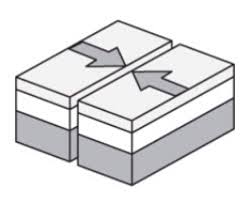
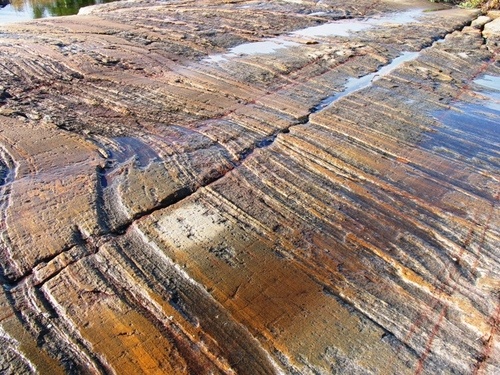

How is it possible for new crust to be formed without increasing the surface area of the Earth?
Crust is recycled in subduction zones at the same time it is created at mid-ocean ridges
New crust is underwater where it sinks
New crust breaks more easily than old crust
The oldest crust just breaks apart as the plates move
Place the following events in sequence: A) A tsunami occurs; B) A segment of the ocean floor is pushed upward; C) Pressure begins building in a subductive zone
A, B, C
C, B, A
A, C, B
B, C, A
What 3 kinds of evidence were used to prove that the seafloor spread?
Rock formations, age of rocks, WWII shipwrecks
Age of rocks, magnetic seafloor stripes, WWII ship logs
Rock formations, magnetic seafloor stripes, age of rocks
This scientist was the first to propose seafloor spreading
William Watts
Harry Hess
Alfred Wegener
Tenzing Norgay

Which statement about Iceland is FALSE?
It is located at a convergent plate boundary.
It is growing in size, as it is located at a divergent plate boundary.
It is made up of two tectonic plates.
It is part of the Mid-Atlantic Ridge

