
 Worksheets
The Atmosphere
Total questions: 42
Worksheet time: 35mins
Name
Class
Date
1.
Condition of Earth's atmosphere at a particular time & place
a)
climate
b)
biogeography
c)
precipitation
d)
weather
2.
Place energy comes from for weather on Earth
a)
the Earth's core
b)
volcanoes
c)
geothermal vents
d)
the Sun
3.
Earth's atmosphere is held down by
a)
radiation
b)
gravity
c)
magnetism
d)
conduction
4.
Two gases that make up 99% of Earth's atmosphere
a)
carbon dioxide & oxygen
b)
nitrogen & carbon dioxide
c)
nitrogen & oxygen
d)
nitrogen & water vapor
5.
Element that forms ozone
a)
nitrogen
b)
oxygen
c)
hydrogen
d)
carbon
6.
Water in the form of gas is called
a)
ice
b)
graupel
c)
sleet
d)
water vapor
7.
Percentage of Earth's atmosphere that carbon dioxide makes up
a)
less than 1%
b)
5%
c)
20%
d)
80%
8.
Layer of Earth's atmosphere where most of the water vapor and carbon dioxide is found
a)
thermosphere
b)
mesosphere
c)
stratosphere
d)
troposphere
9.
Layer of Earth's atmosphere where weather occurs
a)
thermosphere
b)
mesosphere
c)
stratosphere
d)
troposphere
10.
Earth's ozone layer is important because it absorbs
a)
visible light
b)
ultraviolet radiation
c)
x-rays
d)
radio waves
11.
Layer of Earth's atmosphere that contains most of the ozone
a)
thermosphere
b)
mesosphere
c)
stratosphere
d)
troposphere
12.
Warm air rises and creates
a)
low pressure
b)
medium pressure
c)
high pressure
d)
uneven pressure
13.
Cold air sinks and creates
a)
low pressure
b)
medium pressure
c)
high pressure
d)
uneven pressure
14.
The higher one is in the atmosphere the ________________ oxygen(air) there is available to breathe.
a)
More
b)
Less
15.
What is the energy source for the water cycle?
a)
the sun
b)
the earth
c)
water
d)
the moon
16.
The coldest layer.
a)
troposphere
b)
thermosphere
c)
exosphere
d)
mesosphere
17.
The hottest layer.
a)
troposphere
b)
thermosphere
c)
exosphere
d)
mesosphere
18.
What does the earth's atmosphere do?
a)
help to regulate the temperature on Earth
b)
Help UV rays to reach the Earth's surface
c)
Creates meteors in the sky
d)
Keep ocean waters cold
19.
What happens to the air pressure the higher up in space you go?
a)
the air pressure increases
b)
the air pressure decreases
c)
the air pressure stays the same
d)
there is no air pressure
20.
Which statement is true?
a)
The troposphere has the highest temperature because of the distance from the Sun
b)
The troposphere has the highest pressure because gravity keeps the air down.
c)
The exosphere has the highest temperature because of the distance from the Sun
d)
The exosphere has the highest pressure because gravity keeps the air down.
21.
As you go higher in the troposphere, the temperature _______________.
a)
decreases
b)
increases
c)
stays the same
22.
As you go higher in the stratosphere, the temperature _______________.
a)
decreases
b)
increases
c)
stays the same
23.
As you go higher in the thermosphere, the temperature _______________.
a)
decreases
b)
increases
c)
stays the same
24.
Which of these layers is farthest from Earth?
a)
thermosphere
b)
stratosphere
c)
mesosphere
d)
exosphere
25.
Why are some layers warmer than others?
a)
they get hotter the higher up you go
b)
some layers contain gases that can absorb the sun's energy
c)
some layers closer to the sun are hotter
d)
there is no wind in the upper atmosphere
26.
What is the greenhouse effect?
a)
The warming of a planet due to trapped radiation.
b)
The cooling of Earth due to air pollution.
c)
The heating of a solid, such as a rock.
27.
What gas from the list below is a cause for global warming?
a)
Urethane
b)
Oxygen
c)
Carbon Dioxide
28.
Without the Greenhouse Effect the Earth would be
a)
warm
b)
cold
c)
dead
29.
Which of the following is the correct order of the atmosphere layers from Earth to space?
a)
troposphere, stratosphere, mesosphere, thermosphere, exosphere
b)
troposphere, mesosphere, thermosphere, exosphere, stratosphere
c)
thermosphere, stratosphere, mesosphere, troposphere, exosphere
d)
troposphere, stratosphere, mesosphere, exosphere, thermosphere
30.
This layer is where satellites are found.
a)
thermosphere
b)
exosphere
c)
stratosphere
d)
mesosphere
31.
Planes fly in this layer to get out of the weather.
a)
stratosphere
b)
mesosphere
c)
exosphere
d)
thermosphere
32.
Where are the Aurora Borealis located?
a)
Troposphere
b)
Mesosphere
c)
Thermosphere
d)
Stratosphere
33.
Which statement correctly describes a difference between the mesosphere and the stratosphere?
a)
The mesosphere has more active weather than the stratosphere.
b)
The mesosphere contains fewer oxygen molecules than the stratosphere.
c)
Air pressure is lower in the stratosphere than in the mesosphere.
d)
Temperatures decrease with altitude only in the stratosphere.
34.
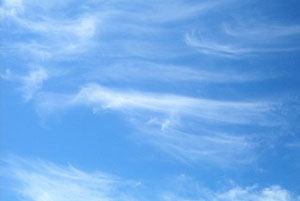
This type of cloud is thin, wispy, and made of ice crystals
a)
cumulus cloud
b)
stratus cloud
c)
cirrus cloud
d)
cumulonimbus cloud
35.
The temperature at which water vapor condenses is the
a)
relative humidity
b)
humidity
c)
freezing point
d)
dew point
36.
This type of cloud is thick and puffy on top, and generally flat on the bottom. It has well-defined edges and can change shape rapidly.
a)
cumulus cloud
b)
stratus cloud
c)
cirrus cloud
d)
cloud 9
37.
Nimbostratus and cumulonimbus clouds can signal what type of upcoming weather?
a)
fair skies
b)
hot, sunny weather
c)
windy weather
d)
rainy weather
38.
Cumulus and cirrus clouds can signal what type of upcoming weather?
a)
fair skies
b)
hot, sunny weather
c)
windy weather
d)
rainy weather
39.
Clouds are made up of tiny drops of ______ or ice. The moisture in the cloud affects the weather.
a)
dust
b)
water
c)
cloud particles
d)
precipitation
40.

what type of cloud is shown?
a)
cumulus
b)
cirrus
c)
stratus
41.
During which part of the water cycle does a cloud form?
a)
Evaporation
b)
Precipitation
c)
condensation
d)
Run off
42.

Clouds form when...
a)
liquid water is heated and evaporates to become water vapor in the atmosphere.
b)
water vapor in the atmosphere cools and condenses becoming water droplets in the atmosphere
c)
water droplets float upwards and gather together in the atmosphere to form a cloud.
100 %

