wayground logo

Free Printable Worksheets

NEW

Font size

S
M
L
XL
Worksheets

Physical Science

Total questions: 60

Worksheet time: 53mins

Name
Class
Date
1.
What is a White Dwarf Star?
a)
A faint star of enormous density.
b)
A very small star.
c)
A region of space resulting from the collapse of a star.
d)
A very tiny star.
2.
The main elements in a star's composition are _______ and ________.
a)
hydrogen, helium
b)
carbon, helium
c)
hydrogen, iron
d)
helium, dark matter
3.
What is the main element in a stars composition? 
a)
Hydrogen 
b)
Helium 
c)
Lithium 
d)
Heavy Elements 
4.
Super nova leads to the formation of elements heavier than Iron (Fe) due to the intense _________ and ______________.
a)
Magnitude and Velocity
b)
heat and pressure
c)
beauty and explosive force.
5.
A diatomic molecule like O2 is always_______ because electrons are shared ________.
a)
nonpolar; equally
b)
polar; equally
c)
nonpolar; unequally
d)
nonpolar; unequally
6.
The polarity of a bond between two elements can be best determined by
a)
The difference in electronegativity between the elements
b)
The difference in first ionization energy between the elements
c)
The number of electrons shared in the bond
d)
The difference in atomic radius between the elements
7.
what causes  a partial charge on the ends of the bond (dipoles)
a)
unequal sharing of electrons
b)
an electronegativity difference between 0.3 and <1.7
c)
electron spends more time around one of the atom
d)
all of the above 
8.
What is the heaviest element that is fused within a high mass star? 
a)
Gold
b)
Silver
c)
Iron
d)
Carbon
9.
Process in which lighter elements (hydrogen) combine to form heavier elements (helium).
a)
Luminosity
b)
Nuclear Fusion
c)
Supernova
d)
Star
10.
Hot sphere of gas and dust composed primarily of hydrogen and helium that produces energy from nuclear fusion
a)
Luminosity
b)
Nuclear Fusion
c)
Supernova
d)
Star
11.
According to VSEPR, molecules adjust their shapes to keep which of the following as far away as possible?
a)
Pairs of valence electrons
b)
Inner shell electrons
c)
Mobile Electrons
d)
Electrons closest to the nucleus
12.

Use VSEPR theory to predict the shape of the water molecule, H₂O.

a)

tetrahedral

b)

linear

c)

bent

d)

octahedral

13.
What group of elements satisfies the octet rule without forming compounds?
a)
halogen
b)
noble gas
c)
alkali metal
d)
alkaline-earth metal
14.
When chlorine reacts it wants to ______________ electron.
a)
gain 1
b)
lose 1
c)
gain 2
d)
lose 2
15.
Which of the following has a full valence shell?
a)
Oxygen
b)
Neon
c)
Barium
d)
Carbon
16.
How many total valence electrons are available in a OF2 molecule?
a)
13
b)
19
c)
20
d)
26
17.
How many lone pairs of electrons in a molecule of isocyanic acid; pictured above?
a)
2
b)
3
c)
6
d)
8
18.
Which of these is not an intermolecular force?
a)
covalent bonding
b)
hydrogen bonding
c)
London dispersion forces
d)
dipole-dipole forces
19.
Which are the strongest intermolecular forces?
a)
hydrogen bonds
b)
dipole-dipole forces
c)
London dispersion forces
d)
molecule-ion attractions
20.
What type of intermolecular force is present in all substances, regardless of polarity?
a)
London dispersion forces
b)
dipole-dipole forces
c)
ion-dipole forces
d)
hydrogen bonding
21.
What is a dipole?
a)
A polar molecule
b)
A nonpolar molecule
c)
A diatomic element
22.
Hydrogen bonding occurs when hydrogen is bonded to N, O, or F. Which of the following would have hydrogen bonding with water molecules?
a)
CBr4
b)
NO2
c)
H2S
d)
NH3
23.
Electronegativity is...
a)
how good an atom in a bond is at attracting electrons
b)
the ability of an atom to lose electrons
c)
the energy required to remove an electron from a specific atom
d)
how easy it is to make friends. 
24.
Choose the correct shape for this molecule:
a)
linear
b)
Trigonal pyramidal
c)
Bent
d)
Tetrahedral
25.
Choose the correct shape for this molecule:
a)
Tetrahedral
b)
Trigonal pyramidal
c)
Bent
d)
Trigonal planar
26.

Calculating the difference in EN can help determine_________?

a)

valence electrons

b)

polarity

c)

type of bond

d)

geometry

27.
According to the octet rule most elements need _______ valence electrons.
a)
2
b)
8
c)
6
d)
18
28.
This model added on to previous models by showing electrons existed at certain "energy levels". However it does not accurately show what those levels look like.
a)
The "Bohr Model" of the atom
b)
The "Rutherford Model" of the atom
c)
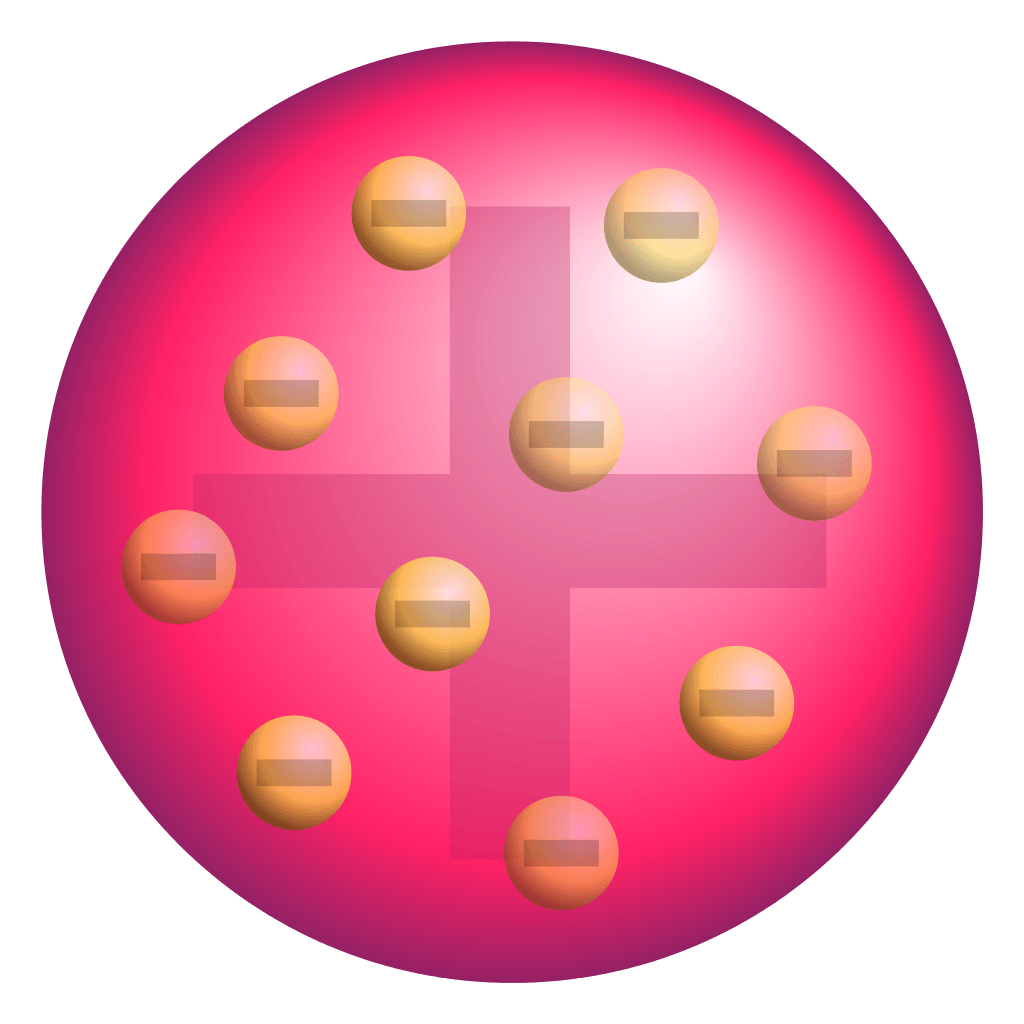
The "Plumb Pudding Model" of the atom
d)
The "Quantum Mechanical Model" of the atom
29.
This model was developed after J.J. Thompson discovered electrons, a particle smaller than an atom. Is shows electrons floating freely in a positive space.
a)
The "Plum Pudding Model" of the atom
b)
The "Rutherford Model" of the atom
c)
Democritus's model of the atom
d)
The "Quantum Mechanical Model" of the atom
30.
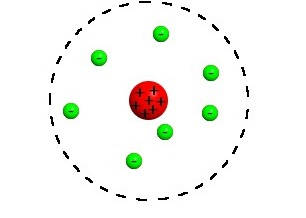
Who came up with this model?
a)
Dalton
b)
Thomson
c)
Rutherford
d)
Bohr
31.
Discovered the nucleus
a)
Democritus
b)
Robert Millikan
c)
James Chadwick
d)
Ernest Rutherford
32.
What contribution did John Dalton make to atomic theory? 
a)
He discovered that every atom was positively charged. 
b)
He discovered that every element consisted of one type of atom.  
c)
He discovered that atoms had nuclei. 
d)
He discovered that atoms could be divided into smaller parts. 
33.
Ernest Rutherford discovered which part of the atom through the use of gold foil?
a)
Proton
b)
Neutron
c)
Electron
d)
Orbitals
34.
Who proposed that matter was formed of small indivisible particles?
a)
Dalton
b)
Thomson
c)
Democritus
d)
Chadwick
35.
Which atomic theory model is the most modern?
a)
Bohr
b)
Shrodinger
c)
Rutherford
d)
Quantum 
36.
Which scientist used his love of playing cards to create the periodic table?
a)
Demitri Mendeleev
b)
John Dalton
c)
JJ Thomson
d)
Schrodinger
37.
How did Rutherford discover the proton?
a)
Cathode tube ray experiment
b)
Gold Foil Experiment
c)
Planetary Model
d)
Plum Pudding Model
38.
Earth, Air, Fire, and Water were the fundamental elements propose by ___.
a)
Aristotle
b)
Democritus
c)
Plato
d)
Galileo
39.

Which is the correct sequence of the scientists who made major changes in the model of the atom?

1-JJ Thomson

2-Erwin Schrodinger

3-John Dalton

4-Niels Bohr

5-Ernest Rutherford

a)

2, 1, 4, 3, 5

b)

3, 1, 5, 4, 2

c)

5, 3, 2, 1, 4

d)

4, 3, 2, 1, 5

40.
Which biomolecule is made of nucleotides and contain you DNA?
a)
Carbohydrate
b)
Lipids
c)
Protein
d)
Nucleic Acid
41.

Which biomolecule helps form muscles?

a)

Nucleic Acid

b)

Carbohydrate

c)

Protein

d)

Lipids

42.
Which biomolecule is responsible for insulation and energy storage?
a)
Protein
b)
Nucleic Acid
c)
Lipid
d)
Carbohydrate
43.
Which biomolecule has sugars and starches?
a)
Lipids
b)
Proteins
c)
Carbohydrates
d)
Nucleic Acid
44.
A monomer is ...
a)
a single atom
b)
a building block for polymers
c)
a single element
d)
is an inorganic molecule
45.
AB + CD →AD + CB
a)
Double Replacement
b)
Single Replacement
c)
Synthesis
d)
Decomposition
46.
Identify this type of reaction,
Cl2 + 2KI -->  I2 + 2KCl
a)
Synthesis
b)
Single displacement
c)
Double displacement
d)
Decomposition
47.
2 C5H5 + Fe --> Fe(C5H5)2 
a)
single displacement
b)
double displacement
c)
decomposition
d)
synthesis
48.
Which chemical reaction breaks down into 2 substances?
a)
Double displacement
b)
Single displacement
c)
Synthesis
d)
Decomposition
49.
A battery converts what type of energy to another?
a)
sound to kinetic
b)
light to heat
c)
mechanical to electrical
d)
chemical to electrical
50.
Wind turbines and windmills convert what energy to another?
a)
Kinetic to electric
b)
Gravitational potential to electric
c)
Mechanical to potential
d)
Thermal to sound
51.
What are the two realms that the Ancient Greeks believed that the cosmos or the universe was divided to?
a)
celestial and terrestrial
b)
aerial and aqua
c)
celestial and aerial
d)
aerial and terrestial
52.
The motion of the objects in this realm was perfect and circular.
a)
terrestrial
b)
aerial
c)
celestial
d)
burial
53.
The motion in this realm was unstable and imperfect, and there should be a cause for motion.
a)
Celestial
b)
Terrestrial
c)
Water realm
d)
Aerial
54.
What are the three types of motion according to Aristotle?
a)
natural motion, voluntary motion, and involuntary motion.
b)
primary motion, secondary motion, and tertiary
c)
diurnal motion, annual motion, and precession motion
d)
diurnal motion, primary motion, and voluntary motion
55.

This scientist (90AD to 168AD) thought like the ancient Greeks that Earth was the center of the universe - geocentric model

a)

Newton

b)

Ptolemy

c)

Copernicus

d)

Brahe

56.

This scientist (1473-1543) Further developed Aristarchus heliocentric model by making a model of how the planets move around the sun

a)

Ptolemy

b)

Copernicus

c)

Brahe

d)

Kepler

57.
A ______ telescope uses a mirror to focus light onto a small area.
a)
reflecting
b)
refracting
c)
radio
d)
spectrum
58.
Another name for light bending is ....
a)
Reflaction
b)
Absorbing
c)
Refraction
d)
mirror
59.
Kepler's first law states that the orbits of the planets around the sun are 
a)
Circles
b)
Ellipses
c)
Spheres
d)
irregular shapes
60.

Kepler's "equal area in equal time" law states that the closer a planet is to the sun the ________ it travels.

a)

Faster

b)

Slower

c)

Higher

d)

Lower