
NEW
Font size
 Worksheets
Knowledge Check (Bonding Basics)
Total questions: 56
Worksheet time: 56mins

When an atom loses an electron, it becomes a:
positive ion
negative ion
neutral ion
neutral atom

When an atom gains an electron, it becomes a:
positive ion
negative ion
neutral ion
neutral atom
Ionic bonds form between a
two metals
nonmetal and nonmetal
metal and nonmetal
two metalloids
Covalent bonds form between a
nonmetal and nonmetal
metal and nonmetal
two metals
two metalloids
According the "Octet rule", how many valence electrons does an atom need to have a stable electron configuration?
1
5
8
10
Which group in the periodic table has elements with a stable electron structure? (Full outer shell)
Group 1
Group 2
Group 14
Group 18 (Noble Gases)
H and He are exceptions to the Octet Rule. How many electrons can they have in their outer shell?
1
2
8
10

How does Lithium become an ion?
Lose 1 electron
Gain 7 electrons
Lose 3 electrons
Gain 1 electron

How does Fluorine become an ion?
Gain 1 electron
Lose 1 electron
Lose 7 electrons
Lose 2 electrons
When a bond is formed, energy is _____________.
absorbed
released
When a bond is broken, energy is _____________.
absorbed
released
All chemical bonds involve
valence electrons
protons
neutrons
In an Ionic bond, electrons _______________ between atoms.
are shared
are transferred
flow freely
In Covalent bond, electrons _______________ between atoms.
are shared
are transferred
flow freely
Chemical reactivity is determined by
the atomic number.
the total number of electrons.
the neutrons.
the valence electrons.
Which of the below is an ionic compounds?
Ni
MgCl2
H2O
CH4
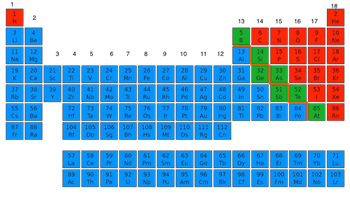
How many valence electrons does Boron (B) have?
5
13
3
11


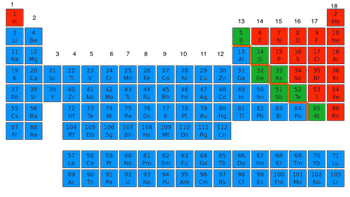

CaCl2
Ionic Compound
Covalent Compound

CO2
Ionic Compound
Covalent Compound
The overall charge of an ionic compound is always _______.
positive (+)
neutral (0)
negative (-)

When Calcium (Ca) loses 2 electrons, what charge does it have?
+2
+1
0
-1

When Oxygen (O) gains 2 electrons, what charge does it have?
+2
+1
-1
-2
1 covalent bond = ________________
1 shared electron
2 shared electrons
3 shared electrons
4 shared electrons

How many bonds are there in the compound CH3Cl?
3
4
6
7
Predict the bond that will form between Cl and Cl.
Ionic
Covalent
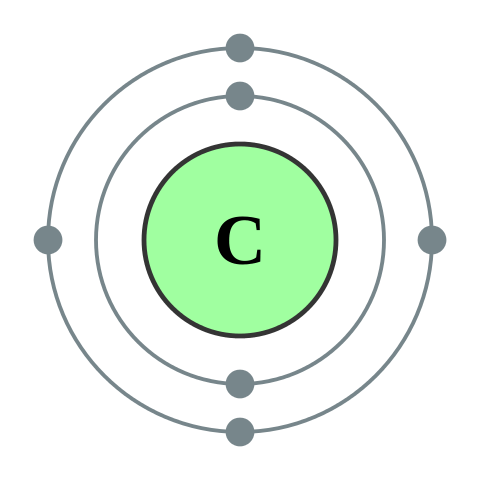
How many valence electrons does carbon have?
4
5
6
7

Which type of bond is best represented in the picture
Covalent
Polar Covalent
Ionic
Metallic

Which type of bond is best represented in the picture
Covalent
Polar Covalent
Ionic
Metallic
Electronegativity increases...
To the right across a period and down a group
To the right across a period and up a group
To the left across a period and down a group
To the left across a period and up a group

This could be the dot diagram of
Mg
Cl
C
O
What is the goal of the Lewis Dot Structure?
To determine the electron position.
To show the element's valence electrons & bonding capabilities.
To find the atomic mass of an element.
To search for the number of electrons in an individual atom.

This is a correct dot diagram for nitrogen (N)
true
false

This is a correct dot diagram for neon (Ne)
true
false
How would you draw a Lewis dot diagram for Magnesium?


Metals make _____ ions.
positive
negative
neutral
Nonmetals will make _____ions.
positive
negative
neutral
How many valence electrons should Oxygen have in its Lewis dot model?
5
6
7
8

This is a correct dot diagram for carbon (C)
true
false


Which Lewis Dot Diagram would represent Chlorine?


What element does this Lewis Dot Digram represent?
Li
Al
C
Be
This could be the dot diagram of
Si
Br
B
S
How many valence electrons does Arsenic (As) have?
5
3
7
6

