wayground logo

Free Printable Worksheets

NEW

Font size

S
M
L
XL
Worksheets

Chemistry Semester Final Exam

Total questions: 60

Worksheet time: 2hrs 11mins

Name
Class
Date
1.
In covalent bonds, atoms...
a)
share a pair of electrons
b)
share an electron
c)
transfer electrons
d)
have an electron sea
2.
Which type of atoms tend to form ionic bonds with each other?
a)
Metals only
b)
Metals and nonmetals
c)
Nonmetals only
d)
Noble Gases only
3.

Using a periodic table, how many protons does Copper have?

a)

29

b)

63

c)

64

d)

35

4.

Using a periodic table, how many neutrons are in Iron?

a)

26

b)

56

c)

30

d)

86

5.

Using a periodic table, how many electrons are in Sulfur

a)

16

b)

32

c)

32.066

d)

48

6.

What is the correct equation for Density

a)

Density equals volume divided by mass

b)

Density equals mass divided by volume

c)

Volume is equal to mass multiplied by density

d)

Volume is equal to density multiplied by mass

7.

Calculate the density in g/mL of 30 mL of solution that weighs 120 grams

a)

4 g/ml

b)

4 ml/g

c)

.25 g/ml

d)

.25 ml/g

8.

Which of the following is a chemical change

a)

cut banana turn brown

b)

freezing water

c)

melting butter

d)

tear paper

9.

Which is a physical change

a)

Cutting a potato

b)

Acid reacting with metal

c)

Burning food

d)

food turning into energy

10.

Which of the following is a heterogeneous mixture

a)

Salad

b)

Tea

c)

Chocolate milk

d)

All answers are Homogeneous

11.

This type of mixture is homogeneous

a)

Salad

b)

Sand

c)

Tea

d)

Stir Fry at the Chinese restaurant

12.

This is a positive charged particle inside an atom

a)

Proton

b)

Neutron

c)

Electron

d)

Nucleus

13.

Electrons have this type of charge

a)

negative

b)

postive

c)

neutral

d)

no charge

14.

This is the largest category on the Periodic Table

a)

Metals

b)

Non Metals

c)

Metaloids

d)

Semi Metals

15.

The first group or family on the periodic table is known as Alkali Metals

a)

True

b)

False

c)

I have no idea because we were not taught this

d)

Could be, but maybe not. I am not sure one way or the other. But I know that this is not the correct answer.

16.

What determines the identity of an atom?

a)

number of protons

b)

number of electrons

c)

number of neutrons

d)

number of valence electrons

17.
What charge will an atom have if it loses 2 electrons?
a)
+2
b)
-2
c)
0
d)
+1
18.

Which element is in period 1, group 8?

a)

Helium

b)

Hydrogen

c)

Neon

d)

Lanthanum

19.

Which element is in period 3, group 4?

a)

Silicon

b)

Gallium

c)

Carbon

d)

Germanium

20.
What charge will magnesium have once it reaches an octet?
a)
+2
b)
-2
c)
+12
21.

What type of bond forms between nonmetals only?

a)

covalent

b)

ionic

c)

metallic

d)

metalloid

22.

Which of the following is a nonmetal?

a)

Na

b)

Pb

c)

S

d)

Al

23.

What type of bond forms between H and Br?

a)

metallic

b)

ionic

c)

covalent

d)

metalloid

24.

What type of bond forms between Na and O?

a)

ionic

b)

covalent

c)

metallic

d)

metalloid

25.

Rank the elements Mn, Ne, O, Si, and Sr from lowest to highest electronegativity.

a)

(low) Ne < Sr < Mn < Si < O (high)

b)

(low) Sr < Mn < Si < O < Ne (high)

c)

(low) O < Si < Mn < Sr < Ne (high)

d)

(low) Ne < O < Si < Mn < Sr (high)

26.

How many significant figures does the following measurement have: 0.002040 m?

a)

6

b)

4

c)

3

d)

2

27.

Gold is best described as...

a)

Element

b)

Compound

c)

Homogeneous Mixture

d)

Heterogeneous Mixture

28.
Is burning wood a chemical or physical change?
a)
chemical
b)
physical
29.
When you put peroxide on a cut, it bubbles up. This is an example of a ______.
a)
chemical reaction
b)
physical change
30.
What is the mass number?
a)
the number of protons
b)
the number of protons and neutrons
c)
the number of neutrons
d)
the number of protons and electrons
31.

How many atomic orbitals exist in a d orbtial?

a)

1

b)

7

c)

3

d)

5

32.

An atomic orbital can at most hold how many electrons, according to the Pauli Exclusion Principle?

a)

1 electron

b)

2 electrons

c)

3 electrons

d)

4 electrons

33.

What element has the electron configuration 1s2 2s2?

a)

Li

b)

Be

c)

He

d)

Mg

34.

Valence electrons are defined a the ...........

a)

Electrons farthest away from the nucleus

b)

Electrons closest to the nucleus

c)

Electrons that just come and go - they don't stay with the atom

35.
Each column in the periodic table is called a 
a)
period
b)
group
c)
cluster
d)
unit
36.
Which group of the periodic table is composed of inert (not reactive)  gases?
a)
alkali metals
b)
alkaline earth metals
c)
halogens
d)
noble gases
37.
A horizontal row of elements in the periodic table.
a)
column
b)
group
c)
period
38.
In the modern periodic table elements are arranged by:
a)
atomic mass
b)
atomic number
c)
valence electrons
d)
number of isotopes
39.
As you move left to right across a period, the atomic radius will ....
a)
decrease
b)
increase
c)
stay the same
40.
As you move from Aluminum to Gallium, the atomic radius will ....
a)
decrease
b)
increase
c)
stay the same
41.
As atoms of elements in group 16 are considered in order from top to bottom, the electronegativity of each successive element....
a)
decreases
b)
increases
c)
remains the same
d)
none of the above
42.
As you move down the periodic table atoms get bigger.  This is because ____________.
a)
The atoms have more mass.
b)
The atoms have more protons.
c)
The atoms have more energy levels
d)
The atoms have more nuetrons
43.
Cations are...
a)
Positive
b)
Negative
c)
Neutral
d)
Purring
44.
Anions are...
a)
Positive
b)
Negative
c)
Neutral
d)
Crying
45.
An atom becomes _________ when it gains electrons.
a)
Positive
b)
Negative
c)
Neutral
d)
Invinsible
46.
What is a Rubidium ion's symbol?
a)
Rb-
b)
Rb+
c)
Rb-2
d)
Rb+2
47.
What is the charge on a Hydrogen ion?
a)
+1
b)
1
c)
2
48.
What is the formula for magnesium phosphide?
a)
Mg3P2
b)
Mg2P3
c)
Mg2(PO4)3
d)
Mg3(PO4)2
49.

What is the formula for iron(III) chloride?

a)

FeCl

b)

Fe3Cl

c)

FeCl2

d)

FeCl3

50.
What is the VSEPR theory used to predict?
a)
Bond Strength
b)
Polarity
c)
Molecular Shape
d)
Electronegativity
51.
What is the measure of a tetrahedral bond angle?
a)
90 Degrees
b)
109.5 Degrees
c)
120 Degrees
d)
180 Degrees
52.
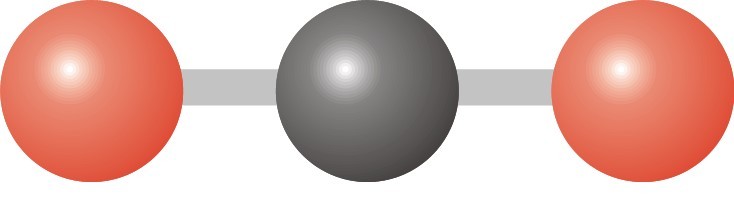
Which molecule would have this shape?
a)
BF3
b)
CH4
c)
PCl5
d)
CO2
53.
What molecule could this be? 
a)
BF3
b)
CH4
c)
H2O
d)
CO2
54.

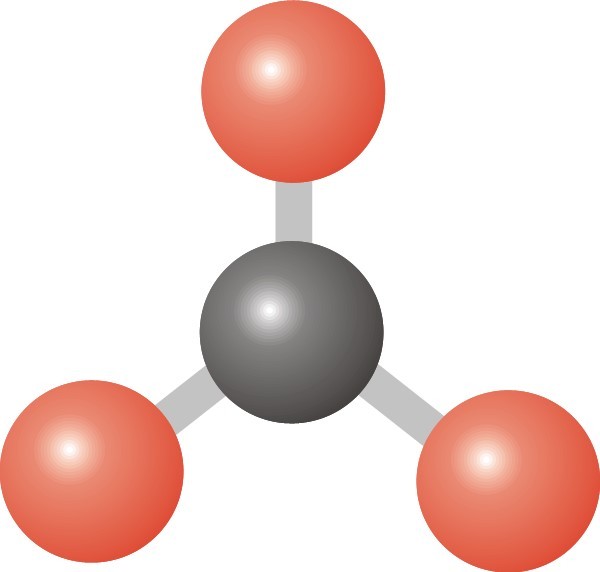
What shape would this have?

a)

Trigonal planar

b)

Pyramidal

c)

Tetrahedral

d)

Bent

55.

Which of the following is a polar molecule?

a)

CH4

b)

Xe

c)

H2S

d)

CO2

56.

How close a measurement is to the accepted value is called..

a)

Accuracy

b)

Precision

c)

Significant

d)

Estimate

57.
4.35% of all X atoms have a mass of 39.946 amu. 83.79% have a mass of 41.941 amu, 9.50% have a mass of 42.941 amu, and 2.36% have a mass of 43.939 amu. What is the average atomic mass of atom X?
a)
41.97 amu
b)
42.19 amu
c)
10.43 amu
d)
40.04 amu
58.
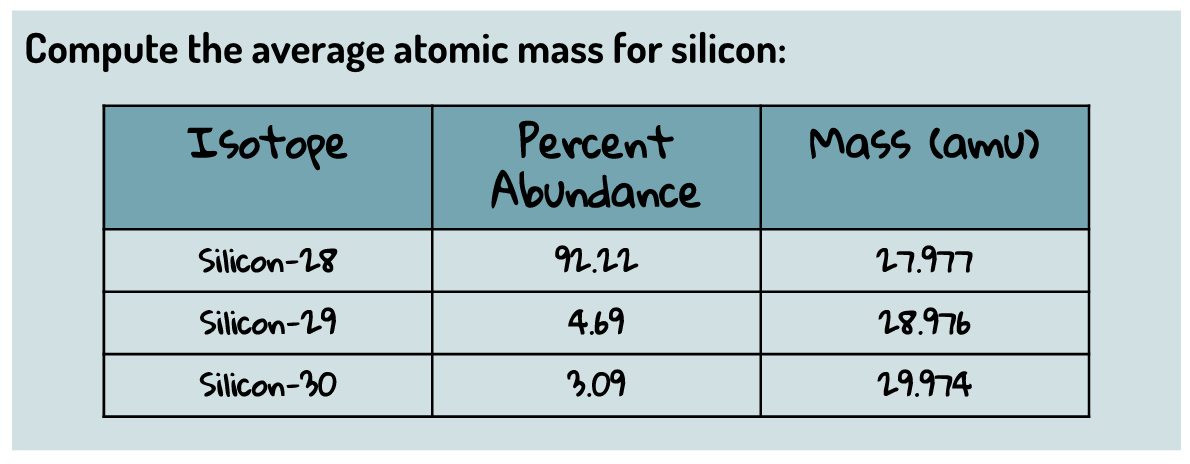
Compute the average atomic mass for silicon:
a)
27.977
b)
28.09
c)
28.976
d)
The average mass cannot be determined from provided information.
59.
How many significant figures: 1000 mL
a)
1
b)
2
c)
3
d)
4
60.
Calculate 1.23 m x 0.89 m and give your answer with the correct number of significant figures.
a)
1.0 m2
b)
1.1 m2
c)
1.0947 m2
d)
1.095 m2