

wayground logo

Free Printable Worksheets

NEW

Font size

S
M
L
XL
Worksheets

Reactivity Series and Displacement Reactions

Total questions: 58

Worksheet time: 49mins

Name
Class
Date
1.
The alkali metals are in group 1, on the far left of the periodic table. Which of these is NOT an alkali metal?
a)
Lithium
b)
Iron
c)
Potassium
d)
Francium
2.
How can you tell that a metal is reacting with water?
a)
Colour change
b)
Bright light
c)
Fizzing
d)
It gets colder
3.
What gas is always produced when a metal reacts with water?
a)
Oxygen
b)
Carbon Dioxide
c)
Hydrogen
d)
Carbon Monoxide
4.
What else is produced when a metal reacts with water? (HINT: Water has the formula H2O)
a)
Metal Oxide
b)
Metal Carbonate
c)
Metal Hydride
d)
Metal Hydroxide
5.
Metals can also react with acids. This produces a gas. What is the name of this gas?
a)
Hydrogen
b)
Carbon Dioxide
c)
Nitrogen
d)
Oxygen
6.
As well as a gas, there is another product made when an acid reacts with a metal. What is the name for this?
a)
Salt
b)
Water
c)
Alkali
d)
Carbon
7.
When sodium reacts with hydrochloric acid, what is the name of the salt formed?
a)
Sodium Hydride
b)
Sodium Chloride
c)
Sodium Hydrochloric
d)
Sodium Chlorine
8.
When potassium reacts with sulphuric acid, what is the name of the salt produced?
a)
Potassium Sulphide
b)
Potassium Sulphur
c)
Potassium Sulphuric
d)
Potassium Sulphate
9.

When a metal salt reacts with a more reactive metal, what sort of reaction occurs?

a)

Displacement

b)

Neutralisation

c)

Combustion

d)

No Reaction

10.
When magnesium reacts with copper sulphate, there are two products. What are they?
a)
Magnesium  and Copper
b)
Magnesium Sulphate and Copper
c)
Magnesium Sulphate and Copper Sulphate
d)
Magnesium and Copper Sulphate
11.
When copper and magnesium sulphate are mixed together, there is no reaction. Why?
a)
Magnesium is more reactive than copper
b)
Copper is more reactive than magnesium
c)
Copper never reacts with metal salts
d)
Magnesium Sulphate never reacts with metals
12.
Metals have many useful properties. For example, they...
a)
...conduct electricity
b)
...are malleable
c)
...are good thermal conductors
d)
All of these
13.
Another useful property of metals is that they are ductile. What does this mean?
a)
The conduct heat well
b)
They can be bent into shape
c)
They have high melting points
d)
They can be stretched into wires
14.

Based on the activity series, will this reaction occur?

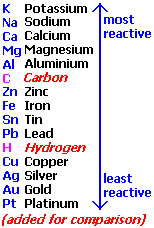
Au (s) + HCl (aq) →

a)

Yes

b)

No

15.

Which metal is more reactive than calcium?

a)

magnesium

b)

potassium

c)

silver

d)

aluminum

16.

What will be the result of the following:

Li + NaF ->

a)

Li will replace F

b)

Na will replace Li

c)

Li will replace Na

d)

no reaction will occur

17.
calcium + zinc nitrate goes to
a)
Calcium + zinc nitrate 
b)
Zinc + calcium nitrate
c)
there will be no reaction
d)
Zinc + calcium chloride
18.

Which one of the following would result in a displacement reaction?

a)

Iron with magnesium chloride

b)

magnesium with iron chloride

c)

Iron with Zinc Sulphate

d)

gold with silver nitrate

19.

Which of the following is MOST reactive?

a)

Magnesium

b)

Lead

c)

Tin

d)

Copper

e)

Zinc

20.

Which metal is more reactive than calcium?

a)

magnesium

b)

potassium

c)

silver

d)

aluminum

21.

Choose the least reactive metal

a)

calcium

b)

magnesium

c)

iron

d)

copper

22.

Choose the most reactive metal

a)

calcium

b)

magnesium

c)

iron

d)

copper

23.
Which of the following indicates a chemical change?
a)
Change in state of matter
b)
Temperature change
c)
Change in size 
d)
Change in shape
24.

What does displacement mean?

a)

A chemical reaction where a less reactive metal takes the place of a more reactive metal in a compound.

b)

A chemical reaction where a more reactive metal takes the place of a less reactive metal in a compound.

c)

A more reactive metal is removed from a compound.

25.

Magnesium chloride + Sodium → ?

a)

Sodium chloride + Magnesium

b)

Magnesium chloride + Sodium (No change)

c)

Sodium magnesium + Chlorine

26.

Zinc sulphate + Magnesium → ?

a)

Magnesium + Sulphur + Hydrogen

b)

Zinc sulphate + Magnesium

c)

Magnesium sulphate + Zinc

27.

Lithium chloride + Iron → ?

a)

Lithium chloride + Iron (No change)

b)

Iron chloride + Lithium

c)

Lithium oxide + hydrogen

28.

Which is least reactive?

a)

gold

b)

Calcium

c)

Magnesium

29.

Which can displace Calcium from calcium sulphate?

a)

Sodium

b)

Copper

30.

Iron nails + copper oxide → ?

a)

Iron nails + copper oxide

b)

Iron oxide + copper oxide

c)

Iron oxide + copper

d)

Magic

31.

What observation would you see if a metal is reacting with water?

a)

Colour change.

b)

A flame occurs.

c)

Bubbles are formed.

d)

It gets colder.

32.

Name the products of the reaction between magnesium and hydrochloric acid?

a)

magnesium chloride and water

b)

magnesium chloride, water, and carbon dioxide

c)

magnesium chloride and oxygen gas

d)

magnesium chloride and hydrogen gas

33.

Which reaction is a metal displacement reaction?

a)

iron with magnesium chloride

b)

magnesium with iron chloride

c)

iron with zinc sulfate

d)

gold with silver nitrate

34.

A displacement reaction will occur when...

a)

a more reactive metal displaces a less reactive metal from its aqueous salt solution.

b)

A less reactive metal displaces a more reactive metal from its aqueous salt solution.

c)

Displacement only occurs when two of the same metals are reacted

d)

Displacement reactions will only occur in metals above iron in the reactivity series

35.
What is the correct equation when potassium reacts with water?
a)
2K (s) + H2O (l) -->  KOH (aq) + H2 (g)
b)
K (s) + 2H2O (l) -->  KOH (aq) + 2H2 (g)
c)
2K (s) + 2H2O (l) -->  2KOH (aq) + H2 (g)
d)
K (s) + H2O (l) -->  KOH (aq) + H2 (g)
36.
Which of the following is arranged according increasing reactivity?
a)
Mg > Li > Na > K
b)
Mg > Na > Li > K
c)
Na > Li > Mg > K
d)
K > Mg > Na > Li
37.
Which of the following does not react with water?
a)
lithium
b)
magnesium
c)
lead
d)
calcium
38.
Which of the following the most reactive in dilute acid
a)
magnesium
b)
calcium
c)
aluminum
d)
zinc
39.
What is made when magnesium reacts with hydrochloric acid?
a)
magnesium nitrate and hydrogen gas
b)
magnesium sulfate and hydrogen gas
c)
magnesium oxide and oxygen gas
d)
magnesium chloride and hydrogen gas
40.
Which of the following is the correct equation when aluminum reacts with sulfuric acid?
a)
2Al (s) + 3H2SO4 (aq) -->  Al2(SO4)3 (aq) + 3H2 (g)
b)
2Al (s) + 3H2SO4 (aq) -->  Al2(SO4)3 (l) + 3H2 (s)
c)
2Al (s) + 3H2SO4 (l) -->  Al2(SO4)3 (l) + 3H2 (g)
d)
2Al (s) + 3H2SO4 (s) -->  Al2(SO4)3 (l) + 3H2 (g)
41.
When a metal reacts with oxygen gas, the product is ...
a)
metal hydroxide
b)
metal oxide
c)
metal oxide and oxygen
d)
metal hydroxide and hydrogen gas
42.
The least reactive in oxygen in the list is 
a)
iron
b)
zinc
c)
copper
d)
lead
43.
Complete the following equation: 
2Cu (s)  +  O2 (g)  -->
a)
2CuO (s)
b)
2CuO (g)
c)
4CuO (s)
d)
2CuO (g)
44.
Complete the following equation: 
4Fe (s)  +  3O2 (g) -->
a)
4Fe2O3 (s)
b)
2FeO (s)
c)
2Fe2O3 (s)
d)
4FeO (s)
45.
Complete the following equation: 
Zn (s)  +  2HNO3 (aq) -->
a)
2ZnNO3 (aq)  +  2H2 (g)
b)
ZnNO3 (aq)  +  H2 (g)
c)
2Zn(NO3)(aq)  +  2H2 (g)
d)
Zn(NO3)(aq)  +  H2 (g)
46.
Which one of the following equations correctly represents the reaction of silver nitrate with copper metal?
a)
CuNO3(aq) + Ag(s) → Cu(s) + AgNO3(aq)
b)
Cu(s) + 2 AgNO3(aq) → Cu(NO3)2(aq) + 2 Ag(s)
c)
Cu(s) + AgNO3(aq) → CuNO3(aq) + Ag(s)
d)
Cu(s) + Ag(NO3)2(aq) → Cu(NO3)2(aq) + Ag(s)
47.
Which one of the following metals reacts most vigorously with cold water?
a)
Sodium
b)
Magnesium
c)
Copper
d)
Zinc
48.
Which one of the following metals could produce zinc metal, if heated with zinc oxide?
a)
Copper
b)
Aluminium
c)
Iron
d)
Silver
49.
When scrap iron is added to blue copper sulphate solution, a pinky-brown deposit is formed and a pale green solution is left above it. The pale green solution is of?
a)
 iron oxide
b)
copper chloride
c)
sulphuric acid
d)
iron sulphate
50.
Which of these reactions is possible? 
a)
Zn (s) + CuO (aq) --> ZnO (aq) + Cu (s)
b)
Cu (s) + FeSO(aq) --> CuSO(aq) + Fe (s)
c)
Pb (s) + ZnCl2 (aq) --> PbCl2 (a) + Zn (s)
d)
Au (s) + 2HCl (aq) --> AuCl(aq) + H(g)
51.
Which of the following metals does not displace H2 gas from dilute HCl or dilute H2SO4?
a)
Mg
b)
Al
c)
Cu
d)
Zn
52.
Which four numbers a, b, c and d are required to balance the equation?
a Fe (s) + b H2SO4 (aq)  -->  c FeSO4(aq)  +  d H2 (g) 
a)
1 1 1 1
b)
2, 3, 2, 2
c)
3, 4, 1, 2
d)
2, 3, 1, 4
53.
Given the equation ... 
2Na(?) + 2H2O(?) --> 2NaOH(X) + H2(?)
Which state symbol should be where (X) is?
a)
(s)
b)
(g)
c)
(l)
d)
(aq)
54.
Which metal is more reactive than calcium?
a)
magnesium
b)
potassium
c)
silver
d)
aluminum
55.
If the metal is more reactive than the metal in the compound it completes with the less reactive metal. Therefore, it can concluded that ...
a)
The less reactive metal repel the more reactive metal from its compound
b)
The more reactive metal bonded with  the less reactive metal from its compound
c)
The less reactive metal pushes out or displaces the more reactive metal from its compound
d)
The more reactive metal pushes out or displaces the less reactive metal from its compound
56.
What will be reaction if less reactive metal is added in a solution with more reactive metal compound?
a)
vigorous reaction
b)
fizzing gas produced
c)
burns moderately
d)
no reaction
57.

Will silver react with magnesium chloride solution?

a)

yes

b)

no

58.
Which of the following will not undergo reaction?
a)
zinc metal  +  zinc oxide 
b)
iron metal  +  copper oxide
c)
zinc metal +  iron oxide
d)
magnesium  +  iron oxide
