
 Worksheets
IGCSE CHEMISTRY: RATE OF REACTION
Total questions: 53
Worksheet time: 44mins
List three factors that affect the rate of a reaction
temperature
concentration
surface area
volume
Why does a higher concentration increase the rate of reaction?
it increases the amount of reactants
it lowers the activation energy
it increases the energy of particle collisions
it increases the frequency of particle collisions
Why does a higher temperature increase the rate of a reaction?
it increases both the frequency and energy of particle collisions
it only increases the frequency of particle collisions
it only increases the energy of particle collisions
it reduces the activation energy of the reaction
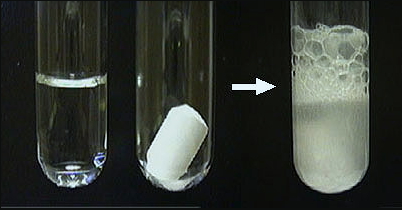
How could we make this reaction happen more quickly?
Decrease the concentration of the acid
crush the chalk to increase the surface area
Put the test tube in an ice bath
Catalyst helps to
increase the amount of product obtained
to lower the activation energy
provide an alternative reaction route
decrease the frequency of collision
Increasing pressure causes the reacting particles
to bond together
to repel from each other
gain more kinetic energy
to move closer together
Increasing the temperature gives particles more __________.
time
energy
space
frequency

Diagram 4 shows the graph of volume of carbon dioxide gas against time when 5 g of marble chips is added to
50 cm3 of 0.2 mol dm-3 hydrochloric acid.
At what time the rate of reaction the highest?
t1
t2
t3
t4

Diagram 7 shows a graph of the volume of gas produced against time for the reaction between zinc granules and hydrochloric acid.
The gradient of the graph decreases with time because
catalyst is not used
volume of mixture decreases
temperature of reaction decreases
concentration of hydrochloric acid decreases
The equation represents the reaction between sodium carbonate and hydrochloric acid.
Na2CO3 + 2 HCl → 2 NaCl + H2O + CO2
The mass of the beaker and its contents is plotted against time.
Which graph represents what happens when sodium carbonate reacts with an excess of dilute hydrochloric acid?


Table 9 shows the experiments carried out to study the rate of reaction between zinc carbonate and nitric acid.
Which of the following graph represents the two experiments?


Magnesium reacts with acid to produce hydrogen gas, H2.Which solution would give the highest initial rate of reaction?
100 cm3 of 1.0 mol dm-3 of nitric acid, HNO3
100 cm3 of 1.0 mol dm-3 of hydrochloric acid, HCl
100 cm3 of 1.0 mol dm-3 of sulphuric acid, H2SO4
100 cm3 of 1.0 mol dm-3 of ethanoic acid, CH3COOH
Which manufacturing of the following is not a characteristic of catalyst?
A catalyst is specific in its reaction.
A catalyst influences the quantity of product of a reaction.
The chemical property of a catalyst remains unchanged at the end of the reaction.
Only a little amount of a catalyst is needed to influence the rate of reaction.

Diagram 12 shows an energy profile diagram. Ea is the activation energy for the decomposition of hydrogen peroxide.
P
Which of the following is the activation energy for the dissociation of hydrogen peroxide when manganese(IV) oxide is added?
P
Q
R
S
Which of the following explains the meaning of effective collision?
The collision where its energy is less than the activation energy
The collision that has a low energy
The collision which takes place before a reaction
The collision that causes a reaction
Which of the following is the meaning of activation energy?
The maximum energy that the particles need to produce effective collision
The amount of energy used by the particles during a collision
The minimum amount of energy that particles must have in order to react
The amount of kinetic energy of molecules during a collision
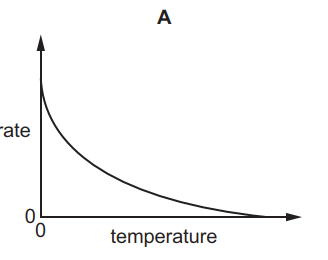
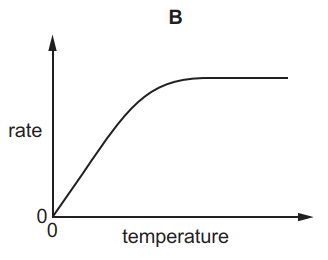
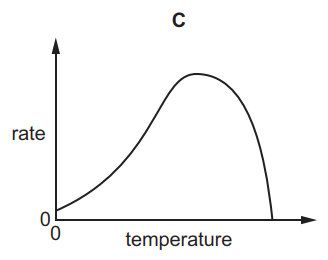
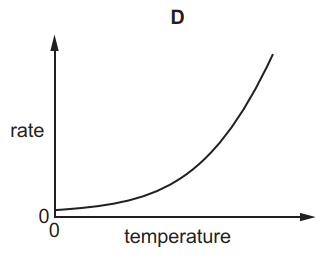
Which graph shows the effect of increasing temperature on the rate of reaction of calcium carbonate with dilute hydrochloric acid?


On the diagram, which letter represents the activation energy for the reaction?
A
B
C

Which of the two reaction profiles shows the catalysed reaction?
A
B

Which of the curves indicates the fastest reaction?
A
B
C

Which of the curves indicates the slowest reaction?
A
B
C
Which of the following will increase the frequency of successful collisions?
Increasing the temperature
Decreasing the pressure
Decreasing the concentration
Which of the following has the smallest suface area to volume ratio?
Powder
Gauze
Lumps
Which of the following would give a steeper curve on a graph of volume of gas against time?
Low temperature
Low concentration
Using a catalyst
Which of the following statements about catalysts is false?
They speed up reactions
They provide an alternative reaction pathway with a lower activation energy
They become chemically changed at the end of the reaction
What piece of apparatus could be used to measure the volume of gas produced in a reaction
Gas syringe
Beaker
Top pan balance
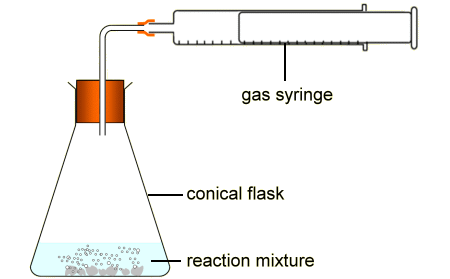
How is this equipment being used to measure the rate of reaction?
The gas syringe measures how much gas is produced in a certain time
The reaction mixture will increase in volume in a certain time
Which factors increase the rate of a reaction?
increasing temperature
increasing concentration
increasing surface area
all of these

Icing sugar has a greater ______ _____ than a solid cube of
sugar.
Surface Area
Catalyst
Temperature
The word for a substance that you react at the start of a chemical reaction...
Reaction
Reactant
Product
The result
The word for a substance created in a chemical reaction...
Reaction
Reactant
Product
Mass
Objects hitting each other
Collision
Catalyst
Explosion
Reaction
The speed at which a chemical reaction occurs
Fast
Slow
Rate
Ratio

The amount of something; how many particles in a volume of a mixture
Rate
Collision
Catalyst
Concentration
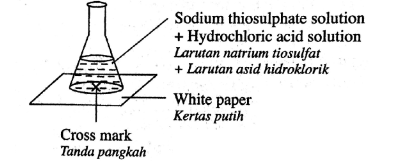
Diagram shows the apparatus set up for an experiment to determine the rate of reaction.
Which of the following techniques is the most suitable to determine the rate of reaction?
Record the time as soon as precipitate is formed
Record the time taken to obtain the maximum temperature
Record the times as soon as the cross mark cannot be seen
Record the times taken for the change of the pH value until a fixed pH value is obtained
How does surface area affect the rate of reaction?
Increasing surface area increases the rate
Increasing concentration decreases the rate
How can rate of reaction be measured in reactions?
Measure mass lost when gas produced.
Measure color change or formation of a solid.
Measure volume of gas produced.
Measure time taken for liquid to disappear.

Look at the graph. At what time does the reaction finish?
4 minutes
6 minutes
5 minutes
7 minutes
The steeper the slope is the ... the reaction.
faster
slower

Identify where the reaction has finished
A
B
C
D
The more collisions between particles of reactants there are in a given time ...
the faster reaction
the slower reaction
Four light sticks are placed in water baths of varying temperatures. At which temperature would the light stick glow the brightest?
0° C
20° C
30° C
40° C

