wayground logo

Free Printable Worksheets

Font size

S
M
L
XL
Worksheets

UNIT 3 Cells & Transport

Total questions: 50

Worksheet time: 48mins

Name
Class
Date
1.
An area with a higher concentration of particles is described as.....
a)
low concentration
b)
high concentration
c)
diffusion
d)
osmosis
2.
Diffusion is the movement of .... 
a)
water from low concentration  to high concentration
b)
particles from low concentration to high concentration
c)
water from an area of high concentration to low concentration
d)
particles from an area of high concentration to low concentration
3.
Which of the following terms means the movement of water from an area of high concentration to an area of low concentration.
a)
diffusion
b)
prokaryotes
c)
osmosis
d)
concentration
4.

Large molecules and ions can easily pass through the cell membrane without any help.

a)

true- they pass right through

b)

false- they need a protein channel or participate in active transport
5.
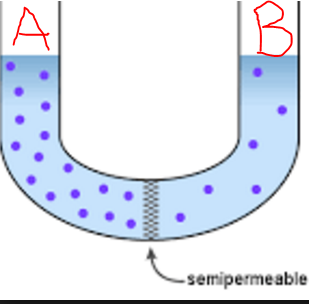
Which way would the molecules move through the semi-permeable membrane?
a)
From the  A side  to the B-side
b)
From the B side to the A side
c)
none of the purple molecules would move
6.
Which transport does not require energy?
a)
Passive
b)
Active 
7.
Which is true about active transport?
a)
It requires energy
b)
it does not require energy
c)
It moves substances down the concentration gradient
d)
it moves material from high to low concentration
8.
Passive transport requires no
a)
concentration gradients
b)
osmosis
c)
motion
d)
energy
9.
Which of the following substances passes through the plasma membrane   through the process of osmosis?
a)
glucose
b)
water
c)
protein
d)
sodium
10.
Which of the following does not have a cell wall?
a)
animal cells
b)
bacteria cells
c)
plant cells
d)
fungi
11.
The movement of atoms, ions, or molecules from an area of high concentration to an area of low concentration.
a)
osmosis
b)
active transport
c)
diffusion
d)
hypertonic
12.
Permeable means
a)
things can pass through
b)
the concentration levels are different
c)
it is permanent
d)
things are stuck
13.

What does it mean that a cell membrane is semi-permeable?

a)

It allows all substances in

b)

It allows some substances in

c)

It allows nothing in

14.
When both inside and outside of a cell have the same amount of water it is said that the cell has reached a state of
a)
Osmosis
b)
Diffusion
c)
Equilibrium
15.
A person's tongue cells after finishing eating a salty French fry would...
a)
get smaller
b)
get bigger
c)
remain the same
16.
A slug passes away when salt is put on it from their cells
a)
expanding
b)
shrinking
17.

If there is 75% water inside a cell and 75% water outside a cell

a)

more water will move inside the cell

b)

more water will move outside the cell

c)

There will be no movement of water molecules

d)

There will be no net movement of water

18.
This cell organelle helps organisms maintain homeostasis by controlling what substances may enter or leave cells.
a)
vacuole
b)
nucleus
c)
cell membrane
d)
cell wall
19.
The movement of molecules against a concentration gradient
a)
simple diffusion
b)
facilitated diffusion
c)
active transport
d)
osmosis
20.
The picture is an example of...
a)
active tranport
b)
passive transport
c)
diffusion
d)
osmosis
21.
The function of the plasma membrane is....
a)
to regulate what enters and leaves the cell.
b)
fight bacteria and viruses that enter the cell.
c)
provide rigid support and protection to the cell.
d)
make sure each cell can move
22.
The _____ in the plasma membrane prevents the fatty acids tails from sticking together. 
a)
carbohydrate chains
b)
cholesterol
c)
proteins
d)
lipids
23.
Hydrophobic region of the cell membrane?
a)
E
b)
B
c)
C
d)
24.
Hydrophilic means...
a)
water-loving
b)
water-fearing
c)
nonpolar
d)
lipid soluble
25.
Hydrophilic means...
a)
water-loving
b)
water-fearing
c)
nonpolar
d)
lipid soluble
26.
Part of the plasma membrane responsible for cell recognition... 
a)
C
b)
E
c)
B
d)
D
27.
Which of the following is responsible for getting large or charged (polar) molecules across the cell membrane?
a)
E
b)
B
c)
C
d)
D
28.
Which of the following is NOT part of the cell membrane?
a)
Lipids
b)
Carbohydrates
c)
Proteins
d)
Nucleic Acids
29.
What forms the channels and pumps in the phospholipid bilayer?
a)
carbohydrates
b)
proteins
c)
hydrophilic heads 
d)
lipids
30.
Most of the cell membrane is made of...
a)
Lipids
b)
Carbohydrates
c)
Proteins
d)
Nucleic acids
31.
What is another term for "selectively permeable"?
a)
porous
b)
completely permeable
c)
permanent
d)
semipermeable
32.
Which of the following is responsible for getting large or charged (polar) molecules across the cell membrane?
a)
E
b)
B
c)
C
d)
D
33.
Part of the plasma membrane responsible for cell recognition... 
a)
C
b)
E
c)
B
d)
D
34.
The _____ in the plasma membrane prevents the fatty acids tails from sticking together. 
a)
carbohydrate chains
b)
cholesterol
c)
proteins
d)
lipids
35.
Protein...
a)
A
b)
B
c)
C
d)
D
36.
Enzymes are
a)
nucleic acids
b)
proteins
c)
lipids
d)
carbohydrates
37.
Which of the following binds to the active site of an enzyme? 
a)
substrate
b)
product
c)
codon
d)
none of the above
38.
Based on the graph, what temperature does this enzyme work best? 
a)
15 C
b)
40 C
c)
30 C
39.
What is the function of an enzyme?
a)
enzymes break themselves into small pieces
b)
they slow down chemical reactions
c)
they speed up chemical reactions
d)
enzymes combine products to form reactants 
40.
What happens when enzymes are heated to a high temperature?
a)
The enzymes die.
b)
The shapes of the enzyme are altered or denatured
c)
The enzymes' amino acid sequence changes.
d)
The enzymes remain the same
41.
Which of the following conclusions can be drawn from this graph?
a)
The optimum pH of the enzyme is 6.6.
b)
The optimum pH of the enzyme is 5.8
c)
The enzyme’s activity increases as pH increases 5.0 to 9.0
d)
The enzyme’s activity is greater around pH of 8.0 .
42.
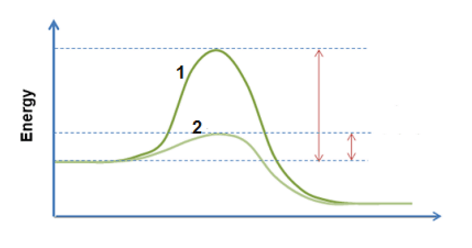
The graph shows how enzymes affect reactions in cells. Which statement best summarizes the information shown in the graph?
a)
Enzymes increase the energy of the reactants.
b)
Enzymes decrease the energy level of the products.
c)
Enzyme decrease the activation energy of the reaction.
d)
Enzymes reverse the direction of the reaction.
43.

Which of the following are true about enzymes? (Choose all that apply)

a)

Enzymes speed up chemical reactions.

b)

Enzymes react best at a specific temperature.

c)

Enzymes only control ONE type of reaction.

d)

Enzymes are made of fatty acids.

44.
Which line represents an enzyme-catalyzed reaction? 
a)
Line 1
b)
Line 2
45.
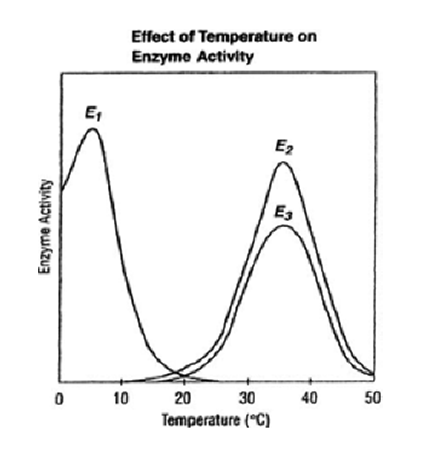
The graph shows the effect of temperature on enzyme action. What characteristic do enzymes E1, E2, and E3 share?
a)
Their activity increases between 20°C and 30°C.
b)
Their activity is greatest between 5°C and 10°C.
c)
Their activity is at a low level between 15°C and 25°C.
d)
Their activity is at a high level between 30°C and 40°C.
46.
What is the function of ATP in living things?
a)
provides energy for cells
b)
stores genetic information
c)
provides structure in the nucleus
47.
Which structures shown in the Figure make up the ADP molecule?
a)
A and B
b)
A, B and C
c)
A, B, C, and D
d)
C and D
48.
What does the "TP" in ATP stand for?
a)
2 phosphates
b)
tri (3) phosphates
c)
Two proteins
d)
tri (3) proteins
49.
Where is the energy stored in ATP molecules
a)
In the Ribose Sugar
b)
In the Adenine group
c)
In the Phosphate bonds
d)
In the Bank
50.
What type of macromolecule is ATP/ADP?
a)
Carbohydrate
b)
Nucleic Acid
c)
Lipid
d)
Protein