
 Worksheets
1.C3.1-3 Heating Curves and Ions Practice
Total questions: 53
Worksheet time: 27mins
Name
Class
Date
1.

Describe the substance between letters A and B.
a)
Solid
b)
Liquid
c)
Melting
d)
Evaporating
2.

Describe the substance between letters B and C.
a)
Solid
b)
Liquid
c)
Melting
d)
Evaporating
3.
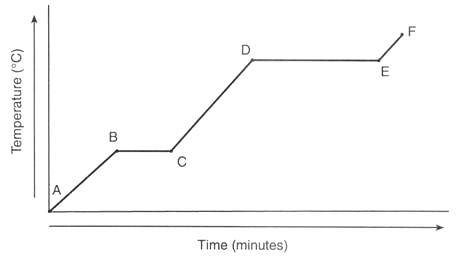
Describe the substance between letters C and D.
a)
Gas
b)
Liquid
c)
Melting
d)
Evaporating
4.

Describe the substance between letters D and E.
a)
Gas
b)
Liquid
c)
Melting
d)
Evaporating
5.

Describe the substance between letters E and F.
a)
Gas
b)
Liquid
c)
Melting
d)
Evaporating
6.

Between which points is the temperature of the substance increasing?
a)
A-B only.
b)
A-B, C-D, E-F
c)
B-C only.
d)
B-C, D-E
7.
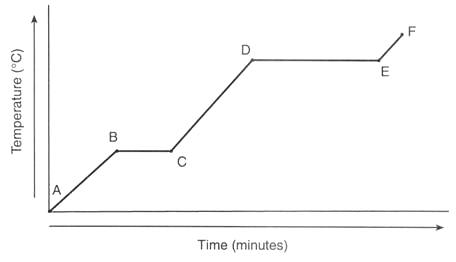
Between which points is the temperature of the substance remaining constant?
a)
A-B only.
b)
A-B, C-D, E-F
c)
B-C only.
d)
B-C, D-E
8.
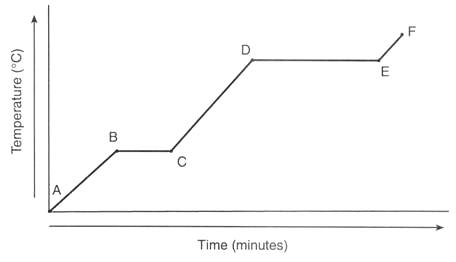
Between which points is the substance changing state?
a)
A-B only.
b)
A-B, C-D, E-F
c)
B-C only.
d)
B-C, D-E
9.

This type of graph is called a:
a)
Phase diagram
b)
Heating curve
c)
State of matter
d)
Temperature chart
10.

Which of the following states of matter has a definite shape AND definite volume?
a)
Solid
b)
Liquid
c)
Gas
d)
Solid and Liquid
11.

Which of the following states of matter has a definite volume but NO definite shape?
a)
Solid
b)
Liquid
c)
Gas
d)
Solid and Liquid
12.

Which of the following states of matter has NO definite volume or shape?
a)
Solid
b)
Liquid
c)
Gas
d)
Solid and Liquid
13.

Elements in which groups on the periodic tend to form positive ions?
a)
Groups 1 - 3
b)
Groups 5 - 7
14.

Elements in which groups on the periodic tend to form negative ions?
a)
Groups 1 - 3
b)
Groups 5 - 7
15.

How many outer electrons do Group 1 elements have?
a)
1
b)
2
c)
6
d)
7
16.

How many outer electrons do Group 2 elements have?
a)
1
b)
2
c)
6
d)
7
17.

How many outer electrons do Group 3 elements have?
a)
2
b)
3
c)
6
d)
7
18.

How many outer electrons do Group 5 elements have?
a)
3
b)
5
c)
6
d)
7
19.

How many outer electrons do Group 6 elements have?
a)
3
b)
5
c)
6
d)
7
20.

How many outer electrons do Group 7 elements have?
a)
3
b)
5
c)
6
d)
7
21.
Which of the following correctly describes the process by which Group 1 elements form ions (charged particles)?
a)
Lose 1 outer electron, +1 charge
b)
Lose 2 outer electrons, +2 charge
c)
Gain 2 outer electrons, -2 charge
d)
Gain 1 outer electron, -1 charge
22.
Which of the following correctly describes the process by which Group 2 elements form ions (charged particles)?
a)
Lose 1 outer electron, +1 charge
b)
Lose 2 outer electrons, +2 charge
c)
Gain 2 outer electrons, -2 charge
d)
Gain 1 outer electron, -1 charge
23.
Which of the following correctly describes the process by which Group 3 elements form ions (charged particles)?
a)
Lose 2 outer electrons, +2 charge
b)
Lose 3 outer electrons, +3 charge
c)
Gain 2 outer electrons, -2 charge
d)
Gain 1 outer electron, -1 charge
24.
Which of the following correctly describes the process by which Group 5 elements form ions (charged particles)?
a)
Lose 2 outer electrons, +2 charge
b)
Lose 3 outer electrons, +3 charge
c)
Gain 3 outer electrons, -3 charge
d)
Gain 2 outer electrons, -2 charge
25.
Which of the following correctly describes the process by which Group 6 elements form ions (charged particles)?
a)
Lose 2 outer electrons, +2 charge
b)
Lose 3 outer electrons, +3 charge
c)
Gain 3 outer electrons, -3 charge
d)
Gain 2 outer electrons, -2 charge
26.
Which of the following correctly describes the process by which Group 7 elements form ions (charged particles)?
a)
Lose 2 outer electrons, +2 charge
b)
Lose 1 outer electron, +1 charge
c)
Gain 3 outer electrons, -3 charge
d)
Gain 1 outer electron, -1 charge
27.

The charge of a lithium ion is:
a)
+1
b)
+2
c)
-2
d)
-1
28.

The charge of a sodium ion is:
a)
+1
b)
+2
c)
-2
d)
-1
29.

The charge of a potassium ion is:
a)
+1
b)
+2
c)
-2
d)
-1
30.

The charge of a rubidium (Rb) ion is:
a)
+1
b)
+2
c)
-2
d)
-1
31.

The charge of a caesium (Cs) ion is:
a)
+1
b)
+2
c)
-2
d)
-1
32.

The charge of a francium (Fr) ion is:
a)
+1
b)
+2
c)
-2
d)
-1
33.

The charge of a beryllium (Be) ion is:
a)
+1
b)
+2
c)
-2
d)
-1
34.

The charge of a magnesium (Mg) ion is:
a)
+1
b)
+2
c)
-2
d)
-1
35.

The charge of a calcium (Ca) ion is:
a)
+1
b)
+2
c)
-2
d)
-1
36.

The charge of a strontium (Sr) ion is:
a)
+1
b)
+2
c)
-2
d)
-1
37.

The charge of a boron (B) ion is:
a)
+2
b)
+3
c)
-3
d)
-2
38.

The charge of a aluminium (Al) ion is:
a)
+2
b)
+3
c)
-3
d)
-2
39.

The charge of a nitride (N) ion is:
a)
+2
b)
+3
c)
-3
d)
-2
40.

The charge of a phosphide (P) ion is:
a)
+2
b)
+3
c)
-3
d)
-2
41.

The charge of an oxide (O) ion is:
a)
+2
b)
+3
c)
-3
d)
-2
42.

The charge of a sulfide (S) ion is:
a)
+2
b)
+3
c)
-3
d)
-2
43.

The charge of a fluoride (F) ion is:
a)
+1
b)
+2
c)
-2
d)
-1
44.

The charge of a chloride (Cl) ion is:
a)
+1
b)
+2
c)
-2
d)
-1
45.

The charge of a bromide (Br) ion is:
a)
+1
b)
+2
c)
-2
d)
-1
46.

The charge of a iodide (I) ion is:
a)
+1
b)
+2
c)
-2
d)
-1
47.
The charge of a helium (He) ion is:
a)
+8
b)
-8
c)
-2
d)
Trick question, noble gases don't tend to form ions.
48.

What compound is shown in the image? (Count the electrons to find the atomic numbers)
a)
Lithium chloride
b)
Lithium fluoride
c)
Sodium chloride
d)
Sodium fluoride
49.

What compound is shown in the image?
a)
Lithium chloride
b)
Magnesium sulfide
c)
Magnesium oxide
d)
Beryllium oxide
50.
If the charge of a potassium ion is +1, and the charge of an oxygen ion is -2, what is the chemical formula for the ionic compound potassium oxide?
a)
K2O
b)
KO
c)
K2O2
d)
KO2
51.
If the charge of a calcium ion is +2, and the charge of a nitrogen ion is -3, what is the chemical formula for the ionic compound calcium nitride?
a)
CaN
b)
CaN2
c)
Ca2N3
d)
Ca3N2
52.
An ionic bond forms when electrons are
a)
shared
b)
transferred
53.

Ionic bonds form between
a)
ions that have opposite charges.
b)
atoms that are sharing electrons.
100 %

