wayground logo

Free Printable Worksheets

Font size

S
M
L
XL
Worksheets

Atomic Structure

Total questions: 51

Worksheet time: 2hrs 44mins

Name
Class
Date
1.

Look at this picture of Argon off the periodic table. Which of the following is true for this element?

a)

18 protons

b)

40 protons

c)

22 protons

d)

21.9 protons

2.

Look at this picture of Argon off the periodic table. Which of the following is true for this element?

a)

18 neutrons

b)

40 neutrons

c)

22 neutrons

d)

21.9 neutrons

3.

Look at this picture of Argon off the periodic table. Which of the following is true for this element when it is neutral?

a)

18 electrons

b)

40 electrons

c)

22 electrons

d)

21.9 electrons

4.

Which part of an atom is used to identify it?

a)

number of protons

b)

number of neutrons

c)

number of electrons

5.

When you two atoms with different masses, Carbon-12 and Carbon-13 for example, what type of atom do you have?

a)

Neutral atom

b)

Ion

c)

Isotope

6.

When you have an ion of an atom, O-2 for example, what has changed in the atomic structure?

a)

Number of protons

b)

Number of neutrons

c)

Number of electrons

7.
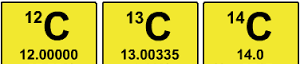
What do these isotopes of carbon all have in common?
a)
neutrons & mass number
b)
atomic number and neutrons
c)
atomic number and electrons
d)
protons, atomic number, and mass number
8.
How many neutrons does the isotope of lithium have?
a)
8
b)
3
c)
4
d)
5
9.
If X is the symbol for an element, which of the following two symbols represent    isotopes of the same element?     I. 7735X  II. 7733X  III. 8137X  IV. 8135 X
a)
I and II
b)
III and IV
c)
I and IV
d)
I and III
10.
Four isotopes of lead include lead-204, lead-206, lead-207, and lead-208.  The average atomic mass of lead is 207.2.  Which isotope of lead is likely to be the most abundant.
a)
204
b)
206
c)
207
d)
208
11.
What atom matches this electron configuration?
1s2s2p3s2
a)
Neon
b)
Magnesium
c)
Aluminum
d)
Potassium
12.
Which is the electron configuration for an oxygen atom?
a)
1s22s22p63s23p64s2
b)
1s22s22p4
c)
1s22s22p6
d)
1s22s22p63s23p6
13.
What is the maximum number of electrons that an orbital can have?
a)
1 electron
b)
2 electrons
c)
3 electrons
d)
4 electrons
14.
How many d orbitals are there in a given sublevel?
a)
1
b)
3
c)
5
d)
7
15.
How many p orbitals are there in a sublevel?
a)
2
b)
1
c)
4
d)
3
16.
How many electrons can the d sublevel hold?
a)
8
b)
10
c)
2
d)
4
17.
What is this element? 
1s22s22p63s23p6
4s23d104p6
a)
Argon
b)
Krypton
c)
Selenium
d)
Bromide
18.
What atom matches this electron configuration?
[Xe] 6s2 4f14 5d9
a)
Mercury
b)
Gold
c)
Platinum
d)
Thallium
19.
What is the shorthand electron configuration for Sulfur atom?
a)
[Ar] 3p4
b)
[He] 3s23p4
c)
[Ne] 3s23p4
d)
[Na] 3s23p3
20.
Identify the element in Period 5 that has 1 valence electron?
a)
Rb
b)
Nb
c)
Ag
d)
Sb
21.
What element in Period 4 has 5 valence electrons?
a)
Zr
b)
As
c)
V
d)
Sb
22.
Electron arrangement that uses arrows
a)
Electron configuration
b)
Shorthand configuration
c)
Lewis dot structure
d)
Orbital diagram
23.
The electron configuration of an atom is 1s22s22p6.  The number of electrons in the atom is 
a)
3
b)
6
c)
8
d)
10
24.

Which electron configuration belongs to Copper (Cu)?

a)

1s2 2s2 2p6 3s2 3p6 4s2 3d8

b)

1s2 2s2 2p6 3s2 3p6 4s2 3d9

c)

1s2 2s2 2p6 3s2 3p6 4s2 3d10

d)

1s2 2s2 2p6 3s2 3p6 4s1 3d10

25.
The _______________ determines the color of visible light. 
a)
wavelength
b)
speed
c)
amplitude
d)
light
26.

What do spectroscopes do?

a)

Collect light to identify elements

b)

Refract light

c)

Absorb light

d)

Transmit light

27.
Emission of light from an atom occurs when an electron
a)
drops from a higher to a lower energy level.
b)
   jumps from a lower to a higher energy level.   
c)
   moves within its atomic orbital.
d)
falls into the nucleus.
28.
Which drawing represents the process by which an absorption line is formed?
a)
A
b)
B
c)
C
d)
D
29.
For an electron to change from ground state to an excited stated it must...
a)
Absorb energy
b)
Release energy
30.
When talking about energy levels in an atom, what is an "excited state"?
a)
The highest energy state of an atom.
b)
Any level higher than the ground state.
c)
The lowest energy state of an atom.
d)
When an atom loses an electron
31.
Why are line emission spectra of elements called "atomic fingerprints"?
a)
They are all the same
b)
They are all unique
c)
They are all similar
d)
They all contain colored light
32.

A line spectrum is produced when an electron moves from one energy level

a)

into the nucleus

b)

to a higher energy level

c)

to another position in the same sublevel

d)

to a lower energy level

33.

Which type of spectrum is this?

a)

Emission Spectrum

b)

Absorption Spectrum

c)

Continuous Spectrum

34.

If the frequency of electromagnetic radiation is high, then the wavelength will be (a)  

35.

A photon is a (a)   of light

36.
The parallel lines represents...
a)
energy levels of the atom
b)
energy levels of the electrons
c)
energy levels of the photons
d)
energy levels of the nucleus
37.

Each element produces its own pattern of emission spectra lines because each element has its own distinct

a)

Speed of light

b)

Electron configuration

c)

Number of neutrons

d)

None of these

38.
Which has the LONGEST wavelength and, therefore, the lowest frequency/energy
a)
Gamma Rays
b)
Radio Waves
c)
Visible Light
d)
Infrared rays
39.
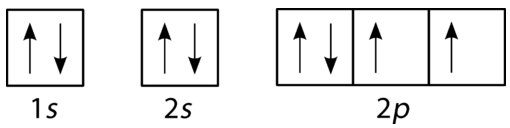
This orbital diagram represents:  
a)
C
b)
B
c)
N
d)
O
40.
This orbital diagram represents:  
a)
C
b)
B
c)
N
d)
O
41.
What is incorrect about this orbital diagram?
a)
Both arrows in the 2p box should be pointing up
b)
There is nothing incorrect with this diagram
c)
In the 2p box there should only be 1 electron in the first 2p box and one in the 2nd 2p box
d)
All the arrows should be pointing up.
42.
Electrons occupy orbitals of lowest energy first is part of what electron configuration rule?
a)
Hund’s Rule
b)
Aufbau Principle
c)
Pauli Exclusion Principle
43.
What is the Pauli Exclusion Principle?
a)
An atomic orbital can only hold a maximum of 2 electrons, each with opposite spins
b)
An atomic orbital can hold a minimum of 6 electrons, each with opposite spins
c)
An atomic orbital can hold a maximum of 6 electrons, each with the same spin
d)
An atomic orbital can hold a minimum of 2 electrons, each with opposite spins
44.
Which orbital shows a violation of Hund's Rule?
a)
A
b)
B
c)
C
d)
D
45.
Which orbital shows a violation of the Aufbau Principle?
a)
A
b)
B
c)
C
d)
D
46.
Which orbital shows a violation of the Pauli Exclusion Principle?
a)
A
b)
B
c)
C
d)
D
47.

What is the short-hand electron configuration for sulfur?

a)

[Ar] 3p4

b)

[He] 3s2 3p4

c)

[Ne] 3s2 3p4

d)

[Na] 3s2 3p4

48.

How many electrons does iron have in the 3rd energy level?

a)

2

b)

6

c)

8

d)

14

49.

A certain photon of light has a wavelength of 4.22x10⁻⁷nm. What is the frequency? (v=c/λ)

a)

7.11x10¹⁴ Hz

b)

7.11Hz

c)

1.41x10⁻¹⁵ Hz

d)

-1.41x10¹⁵ Hz

50.

Certain blue lights have a frequencey of 6.91x10¹⁴Hz. What is the wavelength? (λ=c/v)

a)

4.34x10²¹ m

b)

4.34x10⁻⁹m

c)

4.34x10⁻⁷m

d)

2.07x10²³m

51.

Bohr's idea about the atom is pretty good, however it has limitation. What is this limitation?

a)

It lacks substantial evidence explaining the spectral lines of the Hydrogen atom.

b)

His model is too simple.

c)

His model can no longer explain the behavior of electron based on its spectral lines of atoms with more than one electron.

d)

None of the above