
NEW
Font size
S
M
L
XL
 Worksheets
Evolution
Total questions: 23
Worksheet time: 15mins
Name
Class
Date
1.
Who is the father of evolution?
a)
Darwin
b)
Mendel
c)
Newton
d)
Einstein
2.
What is another name for natural selection?
a)
survival of the smartest
b)
survival of the fastest
c)
survival of the biggest
d)
survival of the fittest
3.
What is a change in an organism that allows for it to survive in its environment?
a)
homologous
b)
vestigial
c)
variation
d)
adaptation
4.
When all of the organisms of a species have died it is called
a)
evolution
b)
extinction
c)
adaptation
d)
natural selection
5.
What is an organism that has similar characteristics and can reproduce?
a)
species
b)
organism
c)
embryology
d)
vestigial
6.

What is this an example of?
a)
diversity of species
b)
variation
c)
vestigial structures
d)
DNA studies
7.
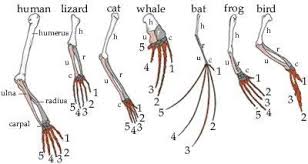
What is this an example of?
a)
vestigial structures
b)
embryology
c)
homologous structures
d)
fossil record
8.
When the DNA of an organism is altered it is referred to as…
a)
Mutation
b)
Gene Flow
c)
Genetic Drift
d)
Sexual Selection
9.
When individuals choose traits possessed by the opposite sex it is called…
a)
Mutation
b)
Gene Flow
c)
Genetic Drift
d)
Sexual Selection
10.
The cause of artificial selection is…
a)
The environment
b)
Humans
c)
Mutation
d)
Gene Flow
11.
Which of the following is NOT an example of natural selection?
a)
People selectively breeding hamsters.
b)
Insect populations developing resistance to certain pesticides.
c)
Bacteria becoming resistant to antibiotics.
d)
Male birds of certain species developing colorful feathers to attract female mates.
12.
Which term refers to the process by which individuals that are better suited to the environment survive and reproduce therefore passing down their genes to their offspring?
a)
Evolution
b)
Variation
c)
Adaptation
d)
Natural Selection
13.

Which species’ DNA is most similar to the DNA of the toothed whale?
a)
Hippopotamus
b)
Baleen Whale
c)
Grazing Mammals
d)
Camels
14.
The environment around Manchester, England, changed during the Industrial Revolution. How did this change affect peppered moths living in the area?
a)
Natural selection favored moths with dark wings because predators could not see them on the soot-colored trees.
b)
Natural selection favored moths with white wings that were easy for predators to see.
c)
Natural selection favored moths with white wings because predators could not see them on the soot-colored trees.
d)
Natural selection caused moths with white wings to become extinct.
15.
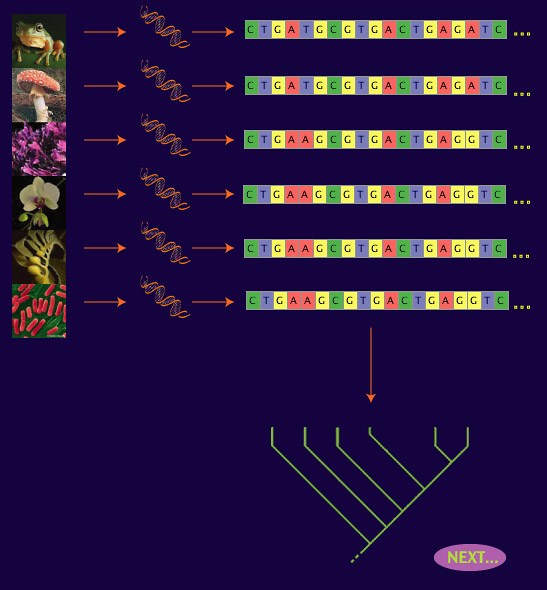
Two organisms that are closely related would have
a)
very similar DNA sequence
b)
exactly the same DNA sequences
c)
no proteins in common
d)
completely different DNA sequence
16.
A remnant or trace of an organism from the past is called a _______.
a)
Ancestor
b)
Skeleton
c)
Fossil
d)
Imprints
17.
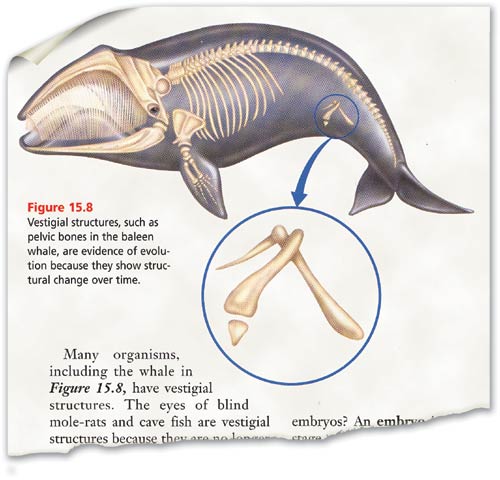
Which of the following is an example of a vestigial structure?
a)
the wings of a red-tailed hawk
b)
the hind limbs of a house cat
c)
the fins of sharks
d)
the tailbone of a human
18.

The diagram shows fossils in different rock layers. Which of these statements about the age of these fossils is most likely correct?
a)
Fossil A and C are the same age
b)
Fossil B is older than fossil C
c)
Fossils A is older than fossil B
d)
Fossil D is older than fossil C
19.
Why are advantageous traits more likely to be passed onto offspring?
a)
Because they are more likely to survive and reproduce.
b)
Because they come from dominant alleles.
c)
Because they come from recessive alleles.
d)
Because the trait is an acquired phenotype.
20.
The ability of an organism to survive and reproduce in its specific environment
a)
diversity.
b)
evolution
c)
adaptation
d)
fitness
21.
In natural selection, the selective agent is the
a)
humans
b)
mutations
c)
breeders
d)
environment
22.
Mutations are important because they bring about
a)
death of the organism in which they develop
b)
genetic variation needed for a population to evolve
c)
benefits for the individual, not for the population
d)
Hardey-Weinberg equilibrium within a population
23.
What is speciation?
a)
combining of tow species to form one with different traits
b)
isolation that affects mating behaviors
c)
timing of mating that prevents normal sexual selection
d)
divergence of two or more species from an existing one
Reset

