
 Worksheets
Backyard Biologist
Total questions: 62
Worksheet time: 35mins
Name
Class
Date
1.
What is the function of a root?
a)
To provide minerals and water for the plant to grow.
b)
Only to anchor the plant.
c)
Photosynthesis
d)
Defense against animals
2.
What is the function of a leaf?
a)
To provide minerals and water for the plant to grow.
b)
Only to anchor the plant.
c)
Photosynthesis
d)
Defense against animals
3.
What is the function of a stem?
a)
To provide minerals and water for the plant to grow.
b)
Only to anchor the plant.
c)
Photosynthesis
d)
Support and transport
4.
What is gravitropism?
a)
Plant's growth response to gravity.
b)
Plant's growth response to light.
c)
Plant’s movement towards or away from touch.
d)
The movement of a plant organ in response to the stimulus of water.
5.
What is phototropism?
a)
Plant's growth response to gravity.
b)
Plant's growth response to light.
c)
Plant’s movement towards or away from touch.
d)
The movement of a plant organ in response to the stimulus of water.
6.
What is hydrotropism?
a)
Plant's growth response to gravity.
b)
Plant's growth response to light.
c)
Plant’s movement towards or away from touch.
d)
The movement of a plant organ in response to the stimulus of water.
7.
What is thigmotropism?
a)
Plant's growth response to gravity.
b)
Plant's growth response to light.
c)
Plant’s movement towards or away from touch.
d)
The movement of a plant organ in response to the stimulus of water.
8.
In the life cycle of seed plants what comes before pollination?
a)
Seeds
b)
Germination
c)
Flowering
d)
Leaves
9.

Identify this picture.
a)
Long leaf pine
b)
Loblolly Pine
10.

Identify this bird
a)
Cardinal
b)
Orange wingworblur
c)
Southern Wrenn
d)
Tufted titmouse
11.

Identify this bird
a)
Carolina Wrenn
b)
Brown-headed nuthatch
c)
Tufted titmouse
d)
Tweety
12.

What is the source of energy for photosynthesis?
a)
carbohydrates-chemical
b)
sunlight-radiant
c)
heat-thermal
d)
television-electrical
13.
What are the reactants (what's needed) for photosynthesis?
a)
glucose and oxygen
b)
light, water, and carbon dioxide
14.
What gas is released by plants during photosynthesis?
a)
sulfur
b)
carbon dioxide
c)
oxygen
d)
hydrogen
15.
What is the purpose of photosynthesis?
a)
make glucose
b)
make ATP
c)
make light
d)
release carbon dioxide
16.
What are the products (what's made) during photosynthesis?
a)
glucose and oxygen
b)
water, light, and carbon dioxide
17.
What type of organism uses photosynthesis?
a)
plants
b)
bacteria
c)
animals
d)
both plants and bacteria
18.
What is the energy conversion during photosynthesis?
a)
chemical --> chemical
b)
thermal --> electrical
c)
chemical --> electrical
d)
radiant --> chemical
19.

In which organelle (part of the cell) does photosynthesis take place?
a)
mitochondria
b)
chloroplast
c)
nucleus
d)
cell membrane
20.
What is the gas we breath out that plants use for photosynthesis?
a)
sulfur
b)
carbon dioxide
c)
oxygen
d)
hydrogen
21.
How can photosynthesis be related to cellular respiration?
a)
What's produced (made) by one is needed (the reactants) for the other
b)
They both produce the same products
c)
They both have the same reactants (need the same things)
d)
These 2 processes have nothing in common
22.

Identify this picture.
a)
Dogwood
b)
Red Oak
c)
Cottonwood
d)
American Beech
23.

Identify this picture.
a)
Cottonwood
b)
Red Bud
c)
Sweet Gum
d)
Dogwood
24.

What anchors the plant to the ground?
a)
roots
b)
stems
c)
leaves
25.

What holds soil in place an prevent erosion?
a)
roots
b)
stems
c)
leaves
26.

What provides support for the plant body?
a)
roots
b)
stems
c)
leaves
27.

What carries nutrients throughout the plant?
a)
roots
b)
stems
c)
leaves
28.

What is a defense system to protect against predators and infection?
a)
roots
b)
stems
c)
leaves
29.

What is the main photosynthetic system?
a)
roots
b)
stems
c)
leaves
30.

What is the site of oxygen release and carbon dioxide intake?
a)
roots
b)
stems
c)
leaves
31.

What is the first stage of the life cycle of a seed plant?
a)
seed
b)
seedling
c)
tree
d)
fruit
32.

What is the second stage in the life cycle of a seed plant?
a)
seed
b)
seed with leaves
c)
seedling
d)
fruit
33.

What is the third stage in the life cycle of a seed plant?
a)
seed
b)
seed with leaves
c)
seedling
d)
small tree
34.

What is the fourth stage in the life cycle of a seed plant?
a)
seedling
b)
small tree
c)
growing tree
d)
mature tree with fruit
35.

What comes after a small tree in the life cycle of seed plants?
a)
seedling
b)
seed
c)
growing tree
d)
mature tree with fruit
36.

What happens before a seed falls to the ground?
a)
seedling
b)
mature tree with fruit
c)
seed with leaves
d)
small tree
37.
What is not true about all birds?
a)
They can fly
b)
They have eggs with hard shells
c)
They have feathers
d)
They are warm-blooded
38.
Birds are animals.
a)
True
b)
False
39.
All birds migrate.
a)
True
b)
False
40.
When a bird migrates, the journey is usually pretty successful.
a)
True
b)
False
41.
Threats to the migration journey include...
a)
buildings
b)
predators
c)
chemicals
d)
all of the above
42.

This bird is mainly pink and white. I am describing its....
a)
habitat
b)
size and shape
c)
field marks
d)
color pattern
43.
This bird has a yellow beak with a black tip and long, dark pink feathers on its hind side. I am describing its....
a)
habitat
b)
size and shape
c)
field marks
d)
color pattern
44.
This bird is as large as a vulture with long skinny legs and a long curved neck. I am describing its....
a)
habitat
b)
size and shape
c)
field marks
d)
color pattern
45.
This bird lives in magrove swamps and salty lakes. I am describing its...
a)
habitat
b)
range
c)
field marks
d)
color pattern
46.
This bird lives in magrove swamps and salty lakes. I am describing its...
a)
habitat
b)
range
c)
field marks
d)
color pattern
47.
Andean flamingos live in the southern part of South America. I am describing its....
a)
habitat
b)
range
c)
field marks
d)
color pattern
48.
If a scientist notices several sick or dying birds, he or she may infer that there is something wrong with the environment.
a)
True
b)
False
49.
A bird is a bioindicator. This means...
a)
it has 2 different forms.
b)
it is a living thing.
c)
it is part of an ecosystem
d)
it can tell us how healthy the environment is.
50.

What is this called?
a)
Field Mark
b)
Size
c)
Silhouette
d)
Dimorphism
51.

These birds are both pheasants. They show an example of ...
a)
Bioindicator
b)
Bimorphism
c)
Dimorphism
d)
Diagnostic
52.
Humans can _________ impact bird populations.
a)
positively
b)
negatively
c)
positively or negatively
d)
not
53.

Does this bird migrate?
a)
yes
b)
no
c)
not enough information
54.

Does this bird migrate?
a)
yes
b)
no
c)
not enough information
55.
Why do birds migrate?
a)
To find food.
b)
To raise their young.
c)
For a warmer climate.
d)
All of the above
56.

What is this bird?
a)
male house sparrow
b)
female house sparrow
c)
male red-winged blackbird
d)
female red-winged blackbird
57.

What is this bird?
a)
male house sparrow
b)
female house sparrow
c)
male red-winged blackbird
d)
female red-winged blackbird
58.

What is this bird?
a)
male house sparrow
b)
female house sparrow
c)
male American goldfinch
d)
female American goldfinch
59.

What sound does this bird make?
a)
peep!peep!peep!
b)
cheep.....cheep.....cheep
c)
caw! caw!
d)
cherrily cherrily! chirp! chirp!
60.

What sound does this bird make?
a)
peep!peep!peep!
b)
cheep.....cheep.....cheep
c)
conk-a-ree! or happy-hall-o-weeeen!
d)
cherrily cherrily! chirp! chirp!
61.

What sound does this bird make?
a)
peep!peep!peep!
b)
cheep.....cheep.....cheep
c)
caw! caw!
d)
cherrily cherrily! chirp! chirp!
62.
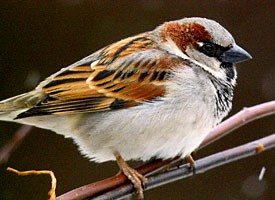
What sound does this bird make?
a)
peep!peep!peep!
b)
cheep.....cheep.....cheep
c)
caw! caw!
d)
cherrily cherrily! chirp! chirp!
100 %

