
 Worksheets
Vehicles in Motion LS 1
Total questions: 59
Worksheet time: 54mins
Name
Class
Date
1.
What is a PUSH or PULL of an object?
a)
Motion
b)
Force
c)
Friction
d)
Gravity
2.
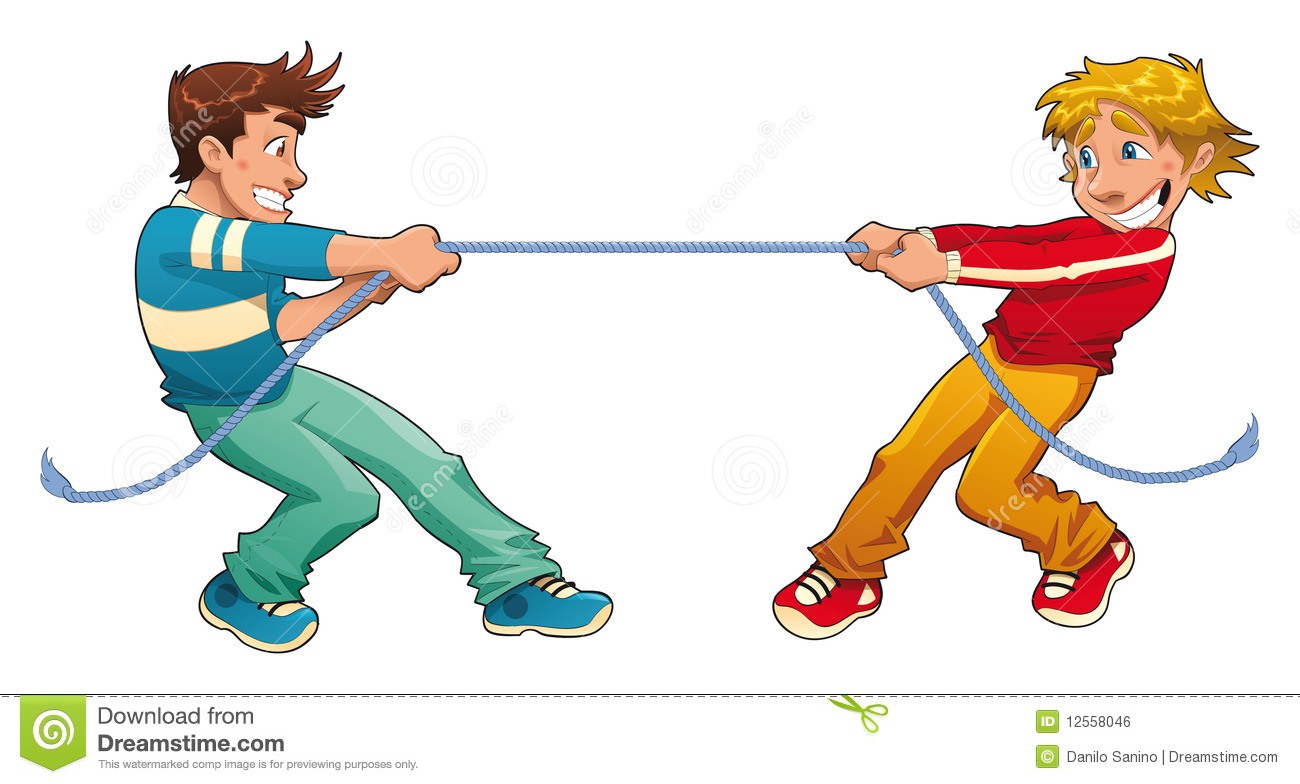
If these boys are pulling with the same amount of force. What will happen?
a)
The boy in blue will win.
b)
They will not move at all.
c)
The boy in red will win.
d)
Both will fall down.
3.
_______________ is how fast an object changes over time.
a)
speed
b)
velocity
c)
momentum
d)
acceleration
4.
What happens when two forces act in the same direction?
a)
They cancel each other out.
b)
The stronger one prevails.
c)
Their strengths are added.
d)
Their sum divided by the two is the total force.
5.
Any time the forces are unbalanced, an object will remain at rest. True or false?
a)
true
b)
false
6.
When you tell the direction and speed of an object, you give its
a)
motion
b)
velocity
c)
acceleration
d)
mass
7.
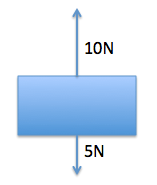
What is the net force on the block? (click on the words to view the picture)
a)
5 Newtons up
b)
5 Newtons down
c)
15 Newtons up
d)
15 Newtons down
8.
Which of the following statements is true?
a)
Balanced forces cause a change in motion.
b)
Unbalanced forces cause a change in motion.
c)
Forces do not effect the change in motion.
9.
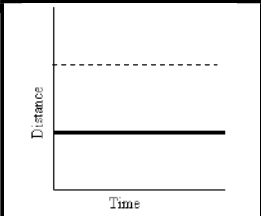
What does this graph represent?
a)
Constant speed
b)
Acceleration
c)
Not moving
10.
Which of the following objects has the least acceleration?
a)
a. an empty shopping cart pushed with a hard force
b)
b. a full shopping cart pushed with a hard force
c)
c. an empty shopping cart pushed with a light force
d)
d. a full shopping cart pushed with a light
force
11.
A baseball is thrown a distance of 50 meters. What is the speed if it takes 2 seconds to cover that distance?
a)
100 m/s2
b)
25 m/s2
c)
52 m/s2
d)
100 seconds
12.
Speed is equal to
a)
Distance/Time
b)
Time/Distance
c)
Time x Distance
d)
Acceleration
13.
Speed is different from velocity because
a)
Velocity has a direction
b)
Speed uses Distance /Time
c)
Velocity doesn't include time
d)
Velocity doesn't include distance
14.

During which interval is the object speeding up?
a)
A to B
b)
B to C
c)
D to E
d)
E to F
15.

What is this graph showing?
a)
Constant Speed
b)
Acceleration (speeding up)
c)
Deceleration (slowing down)
d)
No motion
16.

Which graph represents a students standing at their locker for a period of time.
a)
A
b)
B
c)
C
d)
D
17.

Ms. Pittman was walking at a constant pace to warm up for a run, but then stopped to tie her shoe. After tying her shoe she began running.
What distance/ time graph represents Ms. Pittman.
What distance/ time graph represents Ms. Pittman.
a)
A
b)
B
c)
C
d)
D
18.
What is the Average Speed?
Distance: 10m
Time: 5s
Distance: 10m
Time: 5s
a)
2
b)
1/2
c)
50
d)
100
19.
A ball is moving in a certain direction. What would happen to the ball if a greater force was applied on the ball along its direction of motion?
a)
The speed of the ball would decrease.
b)
The speed of the ball would increase.
c)
The ball will stop instantly.
d)
The ball will change direction.
20.
The candy was sour.
a)
Qualitative data
b)
Quantitative data
21.
The bug was 5 cm long.
a)
Qualitative data
b)
Quantitative data
22.
The flower is red.
a)
Qualitative data
b)
Quantitative data
23.
The mass of the beaker was 122 grams.
a)
Qualitative data
b)
Quantitative data
24.
My fingernail is 2 cm long.
a)
Qualitative data
b)
Quantitative data
25.
The slug was slimy.
a)
Qualitative data
b)
Quantitative data
26.
The laptop is white.
a)
Qualitative data
b)
Quantitative data
27.
He ran 50 miles.
a)
Qualitative data
b)
Quantitative data
28.
The plant is green.
a)
Qualitative data
b)
Quantitative data
29.
It tastes sour.
a)
Qualitative data
b)
Quantitative data
30.
This type of force is an attraction between two objects
a)
contact
b)
gravity
c)
friction
31.
The unit of force is
a)
m/s
b)
m/s^2
c)
newton
d)
kg
32.
What is defined as a push or pull?
a)
force
b)
motion
c)
vector
d)
speed
33.
An _______ force must act on an object for it to CHANGE it's motion
a)
balanced
b)
unbalanced
c)
gravitational
d)
electrical
34.
What two measurements are necessary for calculating speed?
a)
Mass and time
b)
Temperature and mass
c)
Mass and distance
d)
Distance and time
35.
What is the starting point used to describe the position of an object?
a)
Beginning point
b)
Ending point
c)
Reference point
d)
positive
36.
To measure and object's speed, you must know two things, they are:
a)
The size and direction of the object
b)
The starting position and time it took
c)
how far the object traveled and how long it took to go that distance
d)
how to use a timer, how heavy the object is
37.
Change in speed over a given period of time is
a)
velocity
b)
motion
c)
speed
d)
acceleration
38.

The formula:
? = D/T with direction
is used to find
? = D/T with direction
is used to find
a)
Velocity
b)
Speed
c)
Force
d)
Acceleration
39.

What is the magnitude (size) and direction of the net force?
a)
15 N to the left
b)
15 N to the right
c)
1 N to the left
d)
1 N to the right
40.

What is the magnitude (size) and direction of the net force?
a)
14 N Down
b)
14 N Up
c)
6 N Up
d)
6 N Down
41.

The graph shows how the speed of an object changed over time. During which segments of this graph were the forces acting on the object balanced?
a)
R only
b)
Q and S
c)
R and T
d)
R, S and T
42.

What is the net force?
a)
65 N left
b)
65 N right
c)
35 N left
d)
35 N right
43.

What happens when the force of lift is greater than the force of gravity?
a)
The plane moves forward
b)
The plane slows down
c)
The plane increases altitude (takes off.)
d)
The plane decreases altitude (lands.)
44.

How will this object move?
a)
It won't move.
b)
It will move to the right.
c)
It will move to the left.
d)
It will move in both directions.
45.
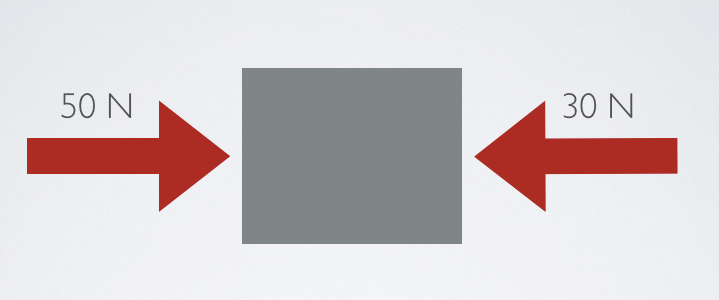
How will this object move?
a)
It won't move.
b)
It will move to the right.
c)
It will move to the left.
d)
It will move up.
46.
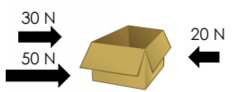
Calculate the Net Force.
a)
60N, Left
b)
40N, Right
c)
0N
d)
60N, Right
47.

Calculate the Net Force.
a)
40N, Left
b)
40N, Right
c)
0N, Balanced
d)
75N, Right
48.
In each of the following cases, determine where the car has no acceleration ?
a)
A car shortly after a stoplight turns green.
b)
A car approaching a red light
c)
A car with the cruise control set at 80 km/h
d)
A car moving down a ramp
49.
Acceleration only takes place when things speed up.
a)
True
b)
False
50.
Why does a car accelerate as it rounds a corner at a constant speed?
a)
Its direction changes
b)
It doesn't
c)
It slows down
d)
Its speeds up
51.

Determine the motion of the car.
a)
at rest
b)
moving at constant speed
c)
speeding up
d)
slowing down
52.
Velocity is both ____ and _____.
a)
speed , direction
b)
direction, mass
c)
volume, density
d)
direction, magnitude
53.
Which statement indicates that motion has occurred?
a)
the reference point has changed
b)
the position of the object has changed
c)
the object being described has changed
54.
What is motion?
a)
change in position over time
b)
Force
c)
Work
d)
Motion
55.
The starting point you choose to describe the location of an object is called the ____. A. reference direction C. reference point D. motion D. east
a)
reference direction
b)
reference point
c)
motion
d)
east
56.
. Which statement indicates that motion has occurred? A. The reference point has changed. B. The position of the object has changed. C. The object being described has changed. D. Directions change.
a)
The reference point has changed.
b)
The position of the object has changed.
c)
The object being described has changed.
d)
Directions change.
57.
Line graphs can show
a)
Medians
b)
Means
c)
Trends
58.
Which of the following is a quantitative observation?
a)
There is one teacher in this room
b)
There are a lot of students in this class
c)
The class is a mix of boys and girls
d)
Everybody in the class is a teenager
59.
Which of the following is a qualitative observation?
a)
The man weighs three hundred pounds
b)
The man eats alot of cheeseburgers
c)
The man ate four cheeseburgers last night
d)
The man lives alone with his two cats, Mr. Cheezit and Mrs. Velveeta
100 %

