
 Worksheets
Chapter 8 & 9
Total questions: 59
Worksheet time: 45mins
Name
Class
Date
1.
The process of restoring an area of land to a more natural, productive state is called ______.
a)
erosion
b)
nutrient depletion
c)
desertification
d)
land reclamation
2.
Using land to grow food crops is an example of ______.
a)
desertification
b)
agriculture
c)
mining
d)
development
3.
Farmers may leave fields unplanted or plant alternate crops to reduce ______.
a)
nutrient depletion
b)
desertification
c)
strip mining
d)
habitat destruction
4.
Which indoor air pollutant is a colorless, odorless gas that forms when wood, coal, oil, or natural gas are incompletely burned?
a)
ozone
b)
photochemical smog
c)
CFC's
d)
carbon monoxide
5.
One group of gases that is responsible for destroying ozone in the ozone layer is ______.
a)
car exhaust fumes
b)
CFC's
c)
nitrogen oxides and sulfur oxides
d)
carbon monoxide and carbon dioxide
6.
Most of Earth's water (about 97%) is ______.
a)
freshwater in lakes and rivers
b)
salt water in the oceans
c)
in the form of snow or ice
d)
in the clouds
7.
The thick, brown haze formed when certain gases in the air react with sunlight is ______.
a)
ozone
b)
photochemical smog
c)
acid rain
d)
sulfur oxide
8.
The bacteria that break down oil after an oil spill in the ocean are ______.
a)
quickly killed by the oil
b)
always present in the ocean, but can only handle small spills
c)
better able to handle large spills than small ones
d)
dangerous to ocean organisms
9.
Which of the following is considered a renewable resource?
a)
iron
b)
sunlight
c)
oil
d)
coal
10.
The study of natural processes in the environment and how humans can affect them is called ______.
a)
resource management
b)
environmental science
c)
preservation
d)
conservation
11.
Predict a way people can reduce the emissions that contribute to smog and the greenhouse effect.
a)
by purchasing products that contain CFC's
b)
by never pouring chemicals down the drain
c)
by taking public transportation or walking instead of driving a car
d)
by finding substitutes for garden chemicals
12.
All of the following factors affect an area's biodiversity EXCEPT ______.
a)
area
b)
number of endangered species
c)
climate
d)
diversity of niches
13.
The water and human wastes that are washed down sinks, showers and toilets are called ______.
a)
the water cycle
b)
sewage
c)
thermal pollution
d)
point pollution sources
14.
Chemicals that kill crop-destroying organisms are called ______.
a)
sediments
b)
oil & gasoline
c)
acid rain
d)
pesticides
15.
Summarize a major cause of permanent habitat destruction.
a)
clearing land to grow food and build businesses and homes
b)
forest fires caused by lightning strikes and accidents
c)
overhunting a species to extinction
d)
polluting the environment by burning fossil fuels
16.
How can many types of food waste and yard trimmings be recycled?
a)
by reusing
b)
by burning
c)
by bagging
d)
by composting
17.
Photochemical smog results from the interaction of pollutants in the presence of ______.
a)
rainfall
b)
oxygen
c)
sunlight
d)
high temperatures
18.
Fertilizers and pesticides are examples of which source of water pollution?
a)
agricultural wastes
b)
industrial wastes
c)
road runoff
d)
human wastes
19.
Which of the following is an effect of global warming/climate change?
a)
increased frequency of drought
b)
falling sea levels
c)
decreased coastal flooding
d)
spreading glaciers
20.
What change in the atmosphere appears to contribute to global warming?
a)
decreased moisture
b)
decreased heat
c)
increased oxygen
d)
increased carbon dioxide
21.
A town is debating over which type of power plant to build. To make the best possible decision, the town council should ______.
a)
find out which type of power plant the mayor prefers
b)
always choose the cheapest power plant
c)
consider the costs and benefits of each type of power plant
d)
look only at the short-term benefits of each type of power plant
22.
Which of the following best describes a renewable resource?
a)
a natural resource that is not replaced as it is used up
b)
a natural resource that is supplied continually
c)
a natural material that can be burned for energy
d)
a natural material that is used by people
23.
Human population growth expanded rapidly in the 1800s and continues to do so today. Many experts credit improved health care as a factor. How did improved health care contribute to population growth?
a)
more infants died at birth
b)
more people immigrated
c)
fewer people died of disease
d)
the death rate has increased
24.
One benefit of the ozone layer in the stratosphere is that ozone absorbs energy from the sun, which warms our atmosphere. Which of the following is another benefit of the ozone layer?
a)
It reflects radio signals back to Earth.
b)
It burns up meteoroids before they strike land.
c)
It shields Earth from harmful ultraviolet radiation.
d)
It relays telephone and television communications.
25.
Water that causes erosion picks up ______.
a)
sediment
b)
sewage
c)
pollutants
d)
algae
26.
A radioactive gas that is naturally formed by certain types of rocks underground is called ______. It is also a source for indoor air pollution
a)
radon
b)
carbon dioxide
c)
methane
d)
carbon monoxide
27.
People may not have enough water during a(n) ______, which is a period when rainfall is below normal.
a)
thunderstorm
b)
hurricane
c)
drought
d)
tornado
28.
______ can damage plants, waterways, metals, and stone.
a)
incineration
b)
acid rain
c)
photochemical smog
d)
recycling
29.
The sea otter is a(n) _______ species that influences the survival of many other species in its ecosystem
a)
keystone
b)
exotic
c)
invasive
30.
______ are the #1 most diverse ecosystems in the world
a)
coral reefs
b)
tropical rainforests
c)
deserts
d)
grasslands
31.
Strip mining exposes soil and causes ______.
a)
population growth
b)
land reclamation
c)
growth of plant life
d)
erosion
32.
The burning of solid waste is called _______.
a)
erosion
b)
incineration
c)
emissions
d)
recycling
33.
The ozone layer is important because it helps to screen out harmful ______ radiation.
a)
ultraviolet
b)
infrared
c)
gamma
d)
beta
34.
Alternative energy is
a)
Generated by natural resources and is renewable
b)
man made
c)
nonrenewable
d)
not helpful to us in Texas
35.
Geothermal energy is energy from
a)
the sun
b)
heat from deep in the earth
c)
wind
d)
inexhaustable
36.
Wind energy is
a)
generated from moving water
b)
starts with moving air and generates electricity
c)
starts with the sun
d)
comes from the earth
37.
Energy from the sun is called
a)
Biofuels
b)
Solar
c)
Geothermal
d)
Hydroelectric
38.
Corn, wheat, and soybeans can be made into a substance called ethanol. In some places, ethanol is part of a mixture used to power cars and trucks. What type of alternative energy resource is ethanol?
a)
Hydroelectric
b)
Geothermal
c)
Biofuels
d)
Solar
39.
All of the following are considered alternative energy sources EXCEPT –
a)
Wind
b)
Coal
c)
Biofuel
d)
Solar
40.

The poster shown below advertises tours of a power plant.
This power plant produces electricity most likely by using-
This power plant produces electricity most likely by using-
a)
fossil fuels
b)
biofuels
c)
solar energy
d)
geothermal energy
41.
Which alternative energy source is generated beneath Earth’s crust and can be used to heat buildings?
a)
Hydroelectric energy
b)
Geothermal energy
c)
Wind energy
d)
Solar energy
42.
Wind Energy is...
a)
Energy that comes from harnessing the movement of the air
b)
Energy that comes from the Sun
c)
A source of renewable energy, such as solar, wind, or geothermal energy
d)
Fuel from plant material
43.
Biofuel is...
a)
Energy that comes from harnessing the movement of the air
b)
Energy that comes from the Sun
c)
A source of renewable energy, such as solar, wind, or geothermal energy
d)
Fuel from plant material
44.
As water flows through a dam, a generator is turned and creates enough electricity for thousands of homes. This describes...
a)
biofuels
b)
hydroelectric energy
c)
geothermal energy
d)
solar power
45.

Which type of alternative energy source is shown in this picture?
a)
Wind
b)
Solar
c)
Hydroelectric
d)
Geothermal
46.
Which of the methods of generating electricity does NOT use alternative energy resources?
a)
Burning coal in a power plant
b)
Turbines spinning in dam
c)
Solar panels taking in light energy
d)
Drilling wells to reach hot rocks deep inside the earth
47.

What fossil fuel is in the image?
a)
Coal
b)
Natural Gas
c)
Petroleum
48.

What fossil fuel is in the image?
a)
Natural Gas
b)
Steam
c)
Coal
d)
Petroleum
49.
Inexhaustible resources are
a)
Air, Sun, Water
b)
Water, Coal, Diamonds
c)
Animals and Plants
d)
Land, Water, Food
50.

A student is preparing a presentation about alternative energy resources. The student has found the following information:
Which alternative energy source does this information describe?
Which alternative energy source does this information describe?
a)
Hydroelectricity
b)
Solar energy
c)
Biofuels
d)
Wind
51.
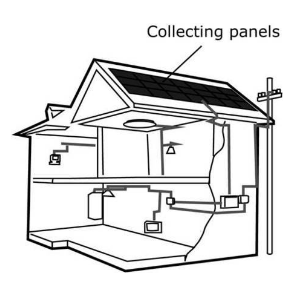
The house illustrated here uses panels on the roof to collect a natural resource and convert it into electricity that can be used.
Which alternative energy source does this house use?
Which alternative energy source does this house use?
a)
Water
b)
Wind
c)
Solar
d)
Geothermal
52.
An energy company wants to build a hydroelectric power plant. Which of these characteristics of an area is most important to the development of a hydroelectric power plant?
a)
The area has a cool, rainy climate.
b)
The area is located in a valley with very little wind and frequent heavy fog.
c)
The area has a river that flows rapidly from nearby mountains through a valley
d)
The area has no geysers or hot springs.
53.

This power plant produces electricity by getting heat from a hot spring. It is most likely using -
a)
fossil fuels
b)
biofuels
c)
solar energy
d)
geothermal energy
54.

Based on the data collected, which source of alternative energy is most efficient?
a)
Coal
b)
Wind
c)
Natural gas
d)
Solar
55.
What type of energy is Nuclear Energy?
a)
Non-Renewable
b)
Renewable
56.
What is Nuclear Energy?
a)
The use of nuclear reactions that release nuclear energy to to generate heat.
b)
Nuclear energy is obtained at nuclear power plants when they heat water to steam and is created when uranium atoms split this is called Fission.
c)
A non renewable energy
57.
What are 2 advantages of renewable energy?
a)
Not harming the planet and not relying on other countries
b)
We will have more energy and make it faster
c)
We can make more money and energy
d)
They are free and exciting!
58.
What characteristic do all renewable resources share?
a)
Produced by waste products
b)
Form underground from dead organisms.
c)
Replaced in a short period of time
d)
Allow energy to pass through them easily
59.
Fossil fuels are classified as nonrenewable because they.......
a)
require expensive equipment
b)
take millions of years to replace
c)
can be found all over
d)
provide all the energy we use
100 %

