

wayground logo

Free Printable Worksheets

Font size

S
M
L
XL
Worksheets

Earth's Atmosphere

Total questions: 137

Worksheet time: 2hrs 19mins

Name
Class
Date
1.
Where you will find the ozone layer.
a)
stratosphere
b)
thermosphere
c)
exosphere
d)
mesosphere
2.
Where weather occurs.
a)
stratosphere
b)
thermosphere
c)
troposphere
d)
mesosphere
3.
Where we live.
a)
stratosphere
b)
thermosphere
c)
troposphere
d)
mesosphere
4.
The hottest layer.
a)
troposphere
b)
thermosphere
c)
exosphere
d)
mesosphere
5.
Which order is correct from the earth to space?
a)
thermosphere
 troposphere
 exosphere
mesosphere
stratosphere
 ionosphere
b)
thermosphere
 troposphere
 stratosphere
 exosphere
mesosphere
 ionosphere
c)
exosphere
ionosphere
thermosphere
mesosphere
 stratosphere
troposphere
d)
troposphere
thermosphere
 troposphere
 stratosphere
 exosphere
mesosphere
6.
What two gases are found throughout all layers of the atmosphere?
a)
Nitrogen and carbon dioxide
b)
Nitrogen and oxygen
c)
Oxygen and carbon dioxide
d)
Trace gases and water vapor
7.
What does the earth's atmosphere do?
a)
help to regulate the temperature on Earth
b)
Help UV rays to reach the Earth's surface
c)
Creates meteors in the sky
d)
Keep ocean waters cold
8.
As you go higher in the troposphere, the temperature _______________.
a)
decreases
b)
increases
c)
stays the same
d)
gets very hot
9.
What is the function of the ozone layer?
a)
to allow UV rays to get to Earth
b)
to block UV rays from getting to Earth
c)
To keep oxygen in
d)
to allow meteors to get to Earth
10.
Where I find clouds.
a)
thermosphere
b)
stratosphere
c)
troposphere
d)
ionosphere
11.
This is the layer where most commercial jet airliners fly.
a)
Troposphere
b)
Stratosphere
c)
Mesosphere
d)
Thermosphere
12.
The higher you go, the air becomes _____ _____.
a)
More dense
b)
Less dense 
13.
This is the layer where meteors, or shooting stars, burn up.
a)
Troposphere
b)
Stratosphere
c)
Mesosphere
d)
Thermosphere
14.
What happens to the density (thickness)/air pressure of the air as you increase in altitude?
a)
density increases
b)
density decreases
c)
density stays the same
d)
density disappears
15.
The higher one is in the atmosphere the ________________ oxygen(air) there is available to breathe.
a)
More
b)
Less
16.
The coldest layer.
a)
troposphere
b)
thermosphere
c)
exosphere
d)
mesosphere
17.
The most common gas in the atmosphere (78%).
a)
Nitrogen
b)
Oxygen
c)
Carbon Dioxide
d)
Trace gases
18.
Which statement is true?
a)
The troposphere has the highest temperature because of the distance from the Sun
b)
The troposphere has the highest pressure because gravity keeps the air down.
c)
The exosphere has the highest temperature because of the distance from the Sun
d)
The exosphere has the highest pressure because gravity keeps the air down.
19.
As you go higher in the thermosphere, the temperature _______________.
a)
decreases
b)
increases
c)
stays the same
20.
What is the greenhouse effect?
a)
The warming of a planet due to trapped radiation.
b)
The cooling of Earth due to air pollution.
c)
The heating of a solid, such as a rock.
21.
What gas from the list below is a cause for global warming?
a)
Urethane
b)
Oxygen
c)
Carbon Dioxide
22.
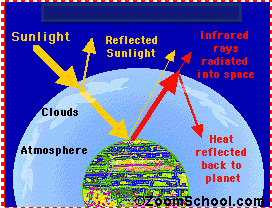
What does this diagram illustrate?
a)
Ozone Layer
b)
The Greenhouse Effect
c)
Ultraviolet Radiation
d)
Layers of the atmosphere
23.
Without the Greenhouse Effect the Earth would be
a)
warm 
b)
cold
c)
dead
24.
21% of the air is made up of this gas.
a)
Nitrogen
b)
Argon
c)
Oxygen
d)
Carbon Dioxide
25.
The layers of the atmosphere are classified according to changes in _________.
a)
altitude
b)
density
c)
composition
d)
temperature
26.
Where are the Aurora Borealis located?
a)
Troposphere
b)
Mesosphere
c)
Thermosphere
d)
Stratosphere
27.
What is O3?
a)
Oxygen
b)
Ozone
c)
Oranges
d)
Opposites
28.
What is the third main layer of Earth's atmosphere?
a)
Thermosphere
b)
Troposphere
c)
Stratosphere
d)
Mesosphere
29.
What is the lowest main layer of Earth's atmosphere?
a)
Thermosphere
b)
Troposphere
c)
Stratosphere
d)
Mesosphere
30.
What is the second lowest main layer of Earth's atmosphere?
a)
Thermosphere
b)
Troposphere
c)
Stratosphere
d)
Mesosphere
31.
What is the outer most main layer of Earth's atmosphere?
a)
Thermosphere
b)
Troposphere
c)
Stratosphere
d)
Mesosphere
32.
What is needed for animals and humans to survive?
a)
Oxygen
b)
Carbon Dioxide
c)
Carbon Monoxide
d)
Ms. Budd
33.
Which layer of the atmosphere contains the greatest amount of water vapor?
a)
Thermosphere
b)
Troposphere
c)
Mesosphere
d)
Stratosphere
34.
Where is the air pressure the greatest?
a)
1
b)
2
c)
3
d)
4
35.
What layer of the atmosphere is the lowest (letter D)?
a)
mesosphere
b)
stratosphere
c)
thermosphere
d)
troposphere
36.
What layer of the atmosphere is the highest (letter A)?
a)
thermosphere
b)
troposphere
c)
stratosphere
d)
mesosphere
37.
Which layer of the atmosphere matches letter C?
a)
trophosphere
b)
stratosphere
c)
mesosphere
d)
thermosphere
38.
Which layer of the atmosphere matches letter B?
a)
troposphere
b)
thermosphere
c)
stratosphere
d)
Mesosphere
39.

What term represents light bouncing off an object?

a)

reflection

b)

scattering

c)

radiation

d)

absorption

40.

What term represents the trapping of heat in the atmosphere?

a)

reflection

b)

radiation

c)

greenhouse effect

d)

absorption

41.

When the Earth is learning away from the sun in the Northern Hemisphere, what season is occurring?

a)

summer

b)

winter

c)

spring

d)

fall

42.

When the Earth is learning toward the sun in the Souther Hemisphere, what season is occurring?

a)

summer

b)

winter

c)

spring

d)

fall

43.
The ozone layer helps life on Earth because ozone
a)
modifies the normal El Niño weather pattern
b)
reflects insolation from the Sun
c)
reflects insolation from the Sun
d)
deflects winds from a straight line to a curved path
44.
Locations in the Northern Hemisphere are warmest in summer because sunlight in summer is
a)
least intense and of shortest duration
b)
least intense and of longest duration
c)
most intense and of shortest duration
d)
most intense and of longest duration
45.
The primary method of energy transfer by which Earth loses energy to outer space is
a)
radiation
b)
conduction
c)
convection
d)
transpiration
46.
The factor that contributes most of the seasonal temperature changes during one year is the changing
a)
speed at which the Earth travels in its orbit around the Sun
b)
angle at which the Sun’s rays strike the Earth’s surface
c)
distance between the Earth and the Sun
d)
energy given off by the Sun
47.
In New York State, the risk of sunburn is greatest between 11 a.m. and 3 p.m. on summer days because
a)
The air temperature is hot
b)
The angle of insolation is high
c)
Earth's surface reflects most of the sunlight
d)
The Sun is closest to the Earth
48.
What happens to the angle of insolation between 6 am and solar noon?
a)
it decreases
b)
it increases
c)
it remains the same
d)
it increases then decreases
49.
What factor has the greatest influence on the number of daylight hours a particular location receives?
a)
latitude
b)
longitude
c)
diameter of the Sun
d)
distance from the Sun
50.
How do clouds affect the temperature at Earth's surface?
a)
Clouds block sunlight during the day and prevent heat from escaping from night
b)
Clouds block sunlight during the day and allow heat to escape at night
c)
Clouds allow sunlight during the day and prevent heat from escaping from night
d)
Clouds allow sunlight during the day and allow  heat to escape at night
51.

What percentage of incoming solar radiation does Earth's surface absorb?

a)

100%

b)

50%

c)

10%

d)

0%

52.
What is the greenhouse effect?
a)
The warming of a planet due to trapped radiation.
b)
The cooling of Earth due to air pollution.
c)
The heating of a solid, such as a rock.
53.
 Which of the following activities contributes the most to carbon emissions globally?
a)
Deforestation
b)
Agriculture
c)
Burning fossil fuels
d)
Respiration
54.

Gases that trap heat in the atmosphere are called ______ gases.

a)

ozone

b)

thermal

c)

greenhouse

d)

warming

55.

Which of the following is NOT a greenhouse gas?

a)

Nitrogen Oxide

b)

Carbon Dioxide

c)

Methane

d)

Water Vapor

56.
The "Greenhouse Effect" is real and contributes to global warming.
a)
True 
b)
False
57.
where does radtation come from
a)
sun
b)
moon
c)
day
d)
night
58.
The kind of heat transfer that travels through space in electromagnetic waves is ______________________.
a)
insulation.
b)
Radiation
c)
Conduction
d)
Convection
59.
The type of heat transfer that happens through direct contact of molecules or particles with each other is ___________________.
a)
Convection
b)
Conduction
c)
Radiation
d)
insulation.
60.
___________________ is the type of heat transfer that occurs in fluids, such as warm air rising and cold air sinking; creating wind.
a)
Convection
b)
Conduction
c)
Radiation
d)
insulation.
61.
A large house being heated by heater warms a house when the air is circulating.
a)
Convection
b)
Conduction
c)
Radiation
d)
insulation.
62.
The air in the troposphere has a greater density than the air in any other layer of the atmosphere,
a)
True
b)
False
63.
Temperature in the stratosphere warms as altitude increases.
a)
True
b)
False
64.
Which gas in our atmosphere is most abundant?
a)
Argon
b)
Oxygen
c)
Nitrogen
d)
Carbon Dioxide
65.
Temperature decreases as altitude increases in the Thermosphere.
a)
True
b)
False
66.
What percentage of our atmosphere is made up of other gases such as argon, water vapor, and carbon dioxide?
a)
1%
b)
21%
c)
78%
d)
90%
67.
What is the percentage of oxygen in Earth's atmosphere?
a)
1%
b)
21%
c)
78%
d)
90%
68.
What is the percentage of nitrogen in Earth's atmosphere?
a)
1%
b)
21%
c)
78%
d)
90%
69.
Which layer of the atmosphere contains the greatest amount of water vapor?
a)
Thermosphere
b)
Troposphere
c)
Mesosphere
d)
Stratosphere
70.
What causes the temperature to increase in the stratosphere?
a)
Nitrogen
b)
Ozone
c)
Water Vapor
d)
carbon dioxide
71.
What decreases as you go up in the atmosphere?
a)
Altitude
b)
Atmosphere
c)
Meteors
d)
Air Pressure
72.
Where is the temperature the highest?
a)
1
b)
2
c)
3
d)
4
73.
Where is the altitude the greatest?
a)
1
b)
2
c)
3
d)
4
74.
Where is the air pressure the greatest?
a)
1
b)
2
c)
3
d)
4
75.
The layers of the atmosphere are classified according to changes in _________.
a)
altitude
b)
density
c)
composition
d)
temperature
76.
What are the 2 most abundant gases in Earth's atmosphere?
a)
carbon dioxide and oxygen
b)
carbon dioxide and nitrogen
c)
nitrogen and oxygen
d)
nitrogen and hydrogen 
77.
James plans to climb to the top of Mount Everest.  Which of the following statements about his climb will be the most accurate?
a)
Air pressure will rise and the temperature on a thermometer will increase.
b)
Air pressure will fall and the temperature on a thermometer will decrease.
c)
Air pressure will rise and the temperature on a thermometer will decrease.
d)
Air pressure and thermometer will not change.
78.
Which of the following is NOT a reason why the atmosphere is important?
a)
It is made of many layers.
b)
It provides gases living things need.
c)
It provides warm temperatures.
d)
It protects us from UV rays and meteors.
79.
What is the weather conditions in an area over a long period of time?
a)
climate
b)
temperature
c)
elevation
d)
precipitation
80.
Changes from minute-to-minute, hour-to-hour, day-to-day
a)
Climate
b)
Weather
81.
The ozone layer protects us from
a)
UV rays
b)
CFCs
c)
Increased atmospheric heat
d)
Decreased atmospheric heat
82.
Greenhouses gases
a)
Absorb and radiate heat
b)
Destroy the ozone layer
c)
Cause respiratory problems
d)
Create smog
83.
Which of the following are greenhouse gases?
a)
Carbon dioxide
b)
Methane
c)
Water vapor
d)
All answers are correct
84.
Greenhouse gases, in moderate amounts, keep the Earth's temperature stable
a)
True
b)
False
85.
Increase in which gas is primarily responsible for increased global warming?
a)
Carbon dioxide
b)
Water vapor
c)
Methane
d)
Nitric oxides
86.
Burning fossil fuels cause ________ that cause pollution.
a)
temperature decrease
b)
headaches
c)
emissions
d)
natural pollution
87.
Select the natural form of air pollution.
a)
CFC's
b)
Burning Fossil Fuels
c)
Forest Fires
d)
Paints and Solvents
88.
What is a primary pollutant? 
a)
pollutant that is put directly into air by human activities
b)
pollutants that react with other primary pollutants
89.
What is a secondary pollutant? 
a)
pollutant that is put directly into air by human activities
b)
pollutants that react with other primary pollutants
90.
What is the major cause for air pollution? 
a)
factories and cars
b)
cigarretes 
c)
deforestation
d)
oil spills
91.
What is air pollution?
a)
Any harmful substance that builds up in the air 
b)
pollen, dust, gases
c)
industrial pollution
d)
chemicals in the water
92.

The diagram below indicates regions of daylight and darkness on Earth on the first day of summer in the Northern Hemisphere. Four latitudes are labeled A, B, C, and D. What location receives the least intense insolation?

a)

A

b)

B

c)

C

d)

D

93.
Locations in the Northern Hemisphere are warmest in summer because sunlight in summer is
a)
least intense and of shortest duration
b)
least intense and of longest duration
c)
most intense and of shortest duration
d)
most intense and of longest duration
94.
The factor that contributes most of the seasonal temperature changes during one year is the changing
a)
speed at which the Earth travels in its orbit around the Sun
b)
angle at which the Sun’s rays strike the Earth’s surface
c)
distance between the Earth and the Sun
d)
energy given off by the Sun
95.
What factor has the greatest influence on the number of daylight hours a particular location receives?
a)
latitude
b)
longitude
c)
diameter of the Sun
d)
distance from the Sun
96.
Equal areas of which type of surface will reflect the most insolation?
a)
light gray rooftop Option 1*
b)
dark tropical forest
c)
snow-covered field
d)
black paved road
97.
The kind of heat transfer that travels through space in electromagnetic waves is ______________________.
a)
insulation.
b)
Radiation
c)
Conduction
d)
Convection
98.
The type of heat transfer that happens through direct contact of molecules or particles with each other is ___________________.
a)
Convection
b)
Conduction
c)
Radiation
d)
insulation.
99.
In heat transfer, heat always flows from the _______________ substance to the _______________ substance.
a)
Hotter to colder
b)
Colder to hotter
c)
Hotter to hotter
d)
Colder to colder
100.
___________________ is the type of heat transfer that occurs in fluids, such as warm air rising and cold air sinking; creating wind.
a)
Convection
b)
Conduction
c)
Radiation
d)
insulation.
101.
We live in the __________________layer, a level of the atmosphere.
a)
Troposphere
b)
Stratosphere
c)
Mesosphere
d)
Exosphere
102.
What absorbs ultraviolet rays in the atmosphere?
a)
troposphere
b)
stratosphere
c)
ozone layer
d)
greenhouse gases
103.

What is it called when a substance soaks up radiation?

a)

absorb

b)

reflect

c)

scatter

d)

conduct

104.

What is it called when energy bounces off an object

a)

reflect

b)

scatter

c)

convection

d)

conduction

105.

When radiation is dispersed it is

a)

scattered

b)

reflected

c)

absorbed

d)

conducted

106.

The most important way to heat the atmosphere is

a)

radiation

b)

reflection

c)

convection

d)

conduction

107.

When radiation hits an object, many things can happen, but the most important in the atmosphere is

a)

absorption

b)

reflection

c)

scattering

d)

conduction

108.

The greenhouse effect can be good and bad

a)

true

b)

false

109.

What are the effects of deforestation ?

a)

increased carbon dioxide

b)

increased green house gasses

c)

increased global temperatures

d)

all of the above

110.
Which of the following heats up the fastest?
a)
land
b)
ocean water
c)
fresh water (no salt)
111.
Far inland or close to water: where do you expect larger seasonal temperature differences (swings)?
a)
far inland
b)
close to water
112.
If it is cloudy during the day, then you would expect air temperatures to be ...
a)
wamer
b)
no change
c)
cooler
113.
As you decrease in altitude, the air temperature should ...
a)
increase
b)
stay the same
c)
decrease
114.
As you move closer to the equator, the air temperature generally will ...
a)
increase
b)
stay the same
c)
decrease
115.
Far inland or close to water: where do you expect smaller seasonal temperature differences (swings)?
a)
far inland
b)
close to water
116.
As you increase in altitude, the air temperature should ...
a)
increase
b)
stay the same
c)
decrease
117.

Los Angeles has smaller seasonal temperatures swings than Louisville. Which is the best fit?

a)

Louisville is closer to the equator

b)

Los Angeles is along the Pacific Ocean

c)

Los Angeles is at a higher altitude.

118.

The condition of the atmosphere at a certain point in time is known as ____________.

a)

Climate

b)

Weather

c)

Meteorology

119.
Cloudy nights can be warmer than clear nights because clouds trap heat____
a)
produced by the friction of air particles
b)
generated from tropical winds
c)
released from Earth's interior
d)
absorbed by Earth during daylight hours
120.
On a weather map, what are the lines that connect points of equal temperature called?
a)
isobars
b)
contour lines
c)
isotemps
d)
isotherms
121.
what are isotherms?
a)
lines connecting places of equal temperature
b)
lines drawn connecting places of equal pressure
c)
lines drawn to places of different temperatures
d)
lines drawn to places of different pressures
122.
the lines on a weather map connect equal areas of temperature
a)
contour lines
b)
isotherms
c)
isobars
d)
longitude
123.
The average weather of a place or region over a long period of time.
a)
climate
b)
leeward
c)
windward
d)
I don't know
124.

The winds in the US blow

a)

west to east

b)

east to west

c)

north to south

d)

south to north

125.

The western US gets more winds from the ocean therefore has more

a)

constant temperatures

b)

varying temperatures

126.

The eastern US gets more winds from the lan therefore has more

a)

constant temperatures

b)

varying temperatures

127.

The water

a)

has a low specific heat and doesn't change temperatures often

b)

has a high specific heat and doesn't change temperatures often

c)

has a low specific heat and changes temperatures often

d)

has a high specific heat and changes temperatures often

128.

Land heats to higher temperatures than water

a)

true

b)

false

129.

Land heats slower than water

a)

true

b)

false

130.

Mountains can block ocean winds, so on the leeward side of mountains, the temperature varies with

a)

the land

b)

the ocean

131.

Windward side of mountains get

a)

constant temperature breezes from the ocean

b)

constant temperature breezes from the land

c)

varying temperature breezes from the ocean

d)

varying temperature breezes from the land

132.
What heats faster, land or water?
a)
Land
b)
Water
133.
Albedo can best be described as...
a)
the temperature at the equator
b)
the amount of solar radiation absorbed
c)
the amount of solar radiation reflected
d)
the air pressure during El Nino
134.
Which would you expect to have the highest albedo?
a)
dirt
b)
sand
c)
ice
d)
water
135.

Which has a lower albedo, an asphalt parking lot or a snow-covered field?

a)

Asphalt parking lot

b)

Snow-covered field

c)

They have the same albedo

d)

More information is needed to answer this question

136.
Which type of surface would have the highest albedo effect?
a)
Forest
b)
Snow
c)
Water
d)
Rock
137.
_______is a measure of the reflective characteristics of the Earth's surface.
a)
Albedo Effect
b)
Greenhouse Effect
c)
Proxy
d)
CFC
