wayground logo

Free Printable Worksheets

Font size

S
M
L
XL
Worksheets

APES Earth Systems & Resources Review

Total questions: 96

Worksheet time: 2hrs 2mins

Name
Class
Date
1.
Which is NOT a freshwater ecosystem?
a)
stream
b)
lake
c)
ocean
d)
river
2.
Earth revolves around the sun
a)
Precession
b)
Rotation
c)
Revolution
3.
Spinning on an axis
a)
Rotation
b)
Nutation
c)
Solstice
4.
The angle the sun's rays strike the earth's surface
a)
Fusion
b)
Insolation
c)
Angle of Insolation
5.
The time and date of the year when day and night are equal length. 
a)
Fusion
b)
Solstice
c)
Equinox
6.
2 times a year when the sun reaches the highest or lowest point; shortest and longest day. 
a)
Beltane
b)
Solstice
c)
Equinox
7.
Exposure to the sun's rays
a)
Fusion
b)
Insolation
c)
Fission
8.
Stress along faults is measured by movement of the earth's crust in the vicinity.
a)
True
b)
False
9.
The thin layer of the Earth upon which tectonic plates move around is called the
a)
mantle
b)
asthenosphere
c)
lithosphere
d)
outer layer
10.
What is a fault?
a)
the point inside Earth at which an earthquake occurs
b)
the point on Earth's surface directly above the earthquake focus
c)
a fracture in Earth along which movement has occurred
d)
a fracture in Earth along which NO movement has occurred
11.
This Earth's layer houses solid iron and nickel 
a)
A
b)
B
c)
C
d)
D
12.
Which sphere contains rivers?
a)
biosphere
b)
geosphere
c)
hydrosphere
d)
atmosphere
13.
Which sphere contains volcanoes?
a)
biosphere
b)
geosphere
c)
hydrosphere
d)
atmosphere
14.
This layer includes the asthenosphere
a)
A
b)
B
c)
C
d)
D
15.
Earth’s outermost sphere is called the
a)
atmosphere
b)
biosphere
c)
geosphere
d)
hydrosphere
16.
Which sphere has no living things house on this system?
a)
atmosphere
b)
biosphere
c)
geosphere
d)
hydrosphere
17.
This sphere has ice glaciers
a)
atmosphere
b)
biosphere
c)
geosphere
d)
hydrosphere
18.
What is happening in Idaho, tectonically speaking?
a)
active ridges and continental extensions; minor transform faults generalized
b)
total spreading rate, cm/year
c)
major active fault or fault zone
d)
reverse fault
19.
A __________ is a mountain built from melted rock which rises from the Earth's interior to the surface, and can occur on land or in the sea
a)
volcanoes
b)
earthquakes
c)
channel
d)
eruptions
20.
The majority of the world’s active volcanoes on land are located along tectonic plate boundaries that surround the ______________________________________.
a)
Atlantic Ocean
b)
Indian Ocean
c)
Pacific Ocean
d)
Southern Ocean
21.
The measure of the energy released by an earthquake is called ___________________________________.
a)
magnitude
b)
dominant
c)
fault
d)
energy capacity
22.
The Earth’s surface is continually battered by wind and scoured by running water, which moves rocks around and changes their appearance
a)
True
b)
False
23.
____________________________________________ are blocks of lithosphere that consist of the crust and the rigid, outermost part of the mantle and glide across the underlying asthenosphere
a)
crust
b)
mantle
c)
tectonic plates
d)
faults
24.
Which of the following is NOT one of the three layers of soil?
a)
topsoil
b)
undersoil
c)
subsoil
d)
bedrock
25.
Which of the following is NOT one of the three types of soil?
a)
clay
b)
sand
c)
silt
d)
mud
26.
_______ is the type of soil used most often with plants. It is a mixture of clay, sand, and silt.
a)
loam
b)
humus
c)
mud
d)
dirt
27.
Humus is.....
a)
the dead parts of plants and animals in soil.
b)
A food we eat with pretzels.
c)
The tiny particles inside of soil
d)
The roots that come off of a plant and live in soil.
28.
Many plants cannot grow in clay soil. Why is this true?
a)
Clay soil does not have many nutrients.
b)
Roots cannot easily push through clay soil.
c)
Water doesn't drain well through clay.
d)
All of these choices.
29.
Many plants cannot grow in sandy soil. Why is this true?
a)
Sandy soil does not hold enough water.
b)
Oxygen cannot pass through sandy soil.
c)
Roots cannot easily push through clay soil.
d)
Sandy soil has too many nutrients.
30.
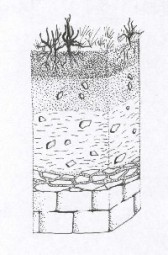
Which layer of soil are these roots growing in?
a)
subsoil
b)
topsoil
31.
What is a soil problem all farmers face?
a)
soil hardening
b)
soil erosion
c)
soil spoiling
d)
soil pollution
32.
Layers of soil are also known as:
a)
Soil Profiles
b)
Soil Horizons
c)
Soil sheets
d)
Soil cores
33.
What is the layer of soil that contains humus, leaf litter, and other organic matter?
a)
O - Organic
b)
A - Topsoil
c)
B - Subsoil
d)
R - Bedrock
34.
Which layer is the bottom of the soil profile?
a)
C - Partially Weathered Parent Material
b)
D - Separated rock
c)
R - Bedrock
d)
A - Topsoil
35.
Which layer of soil contains bedrock that has been cracked slightly?
a)
A - Topsoil
b)
B - Subsoil
c)
C- Partially Weathered Parent Material
d)
R - Bedrock
36.
Place the following layers in order from top to bottom: bedrock, topsoil, subsoil, organic, parent material.
a)
Organic, Topsoil, Subsoil, Parent Material, Bedrock
b)
Organic, Topsoil, Parent Material, Subsoil, Bedrock
c)
Topsoil, Organic, Subsoil, Parent Material, Bedrock
d)
Topsoil, Organic, Parent Material, Subsoil, Bedrock
37.
Wind blowing dirt and sand through the air is an example of...
a)
weathering 
b)
erosion
38.
The MAIN  thing Decomposers do for the the soil is the following:
a)
Store moisture
b)
Burrow deep in the soil
c)
Make space for air and water
d)
Break down and digest dead organisms
39.
This means the amount of salt dissolved in water.
a)
salinity
b)
salutation
c)
saturation
d)
saltiness
40.
What are areas where freshwater meets saltwater called?
a)
wetlands
b)
estuaries
c)
coastal byways
d)
intertidal zones
41.
If the Earth did not rotate on its axis, there would be no
a)
Greenhouse effect
b)
Coriolis effect
c)
Global warming
d)
Convection
42.
Where is ocean water the densest.
a)
The surface
b)
The middle
c)
The bottom
d)
Lake Michigan
43.
Warm ocean currents generally come from
a)
The North Pole
b)
The South Pole
c)
The Equator
d)
Both A and B
44.
Due to the Coriolis Effect, water in the Southern Hemisphere moves
a)
clockwise
b)
counter-clockwise
c)
both
d)
neither
45.
Cold ocean currents generally come from
a)
The North Pole 
b)
The South Pole
c)
The Equator
d)
Both A and B
46.
Two types of ocean currents are
a)
local and global
b)
sea and land
c)
surface and deep
d)
warm and cold
47.
A strong surface current that runs along the east coast of the United States and carries warm water to Europe.
a)
California Current
b)
Global Conveyor Belt
c)
Gulf Stream
d)
Surface Current
48.
Constantly moving system of deep-ocean circulation driven by temperature and salinity. It moves water around the globe.
a)
California Current
b)
Global Conveyor Belt
c)
Surface Currents
d)
Gulf Stream
49.
Currents are deflected to the _________ in the Northern Hemisphere.
a)
north
b)
right
c)
south
d)
left
50.
Where weather occurs.
a)
stratosphere
b)
thermosphere
c)
troposphere
d)
mesosphere
51.
Where you will find the ozone layer.
a)
stratosphere
b)
thermosphere
c)
exosphere
d)
mesosphere
52.
Which layer is the outermost layer?
a)
troposphere
b)
thermosphere
c)
exosphere
d)
mesosphere
53.
The coldest layer.
a)
troposphere
b)
thermosphere
c)
exosphere
d)
mesosphere
54.
The hottest layer.
a)
troposphere
b)
thermosphere
c)
exosphere
d)
mesosphere
55.
The most common gas in the atmosphere (78%).
a)
Nitrogen
b)
Oxygen
c)
Carbon Dioxide
d)
Trace gases
56.
As you go higher in the troposphere, the temperature _______________.
a)
decreases
b)
increases
c)
stays the same
d)
gets very hot
57.
What is the function of the ozone layer?
a)
to allow UV rays to get to Earth
b)
to block UV rays from getting to Earth
c)
To keep oxygen in
d)
to allow meteors to get to Earth
58.
Which layer has the highest pressure?
a)
thermosphere
b)
stratosphere
c)
troposphere
d)
ionosphere
59.
This gas makes up 21% of the atmosphere
a)
ozone
b)
oxygen
c)
nitrogen
d)
water vapor
60.
What happens to the air pressure (density) of air as you increase in altitude?
a)
density increases, this is due to the surface area of the atmosphere increasing as you increase altitude which allows for gas molecules to expand.
b)
density decreases, this is due to the surface area of the atmosphere increasing as you increase altitude which allows for gas molecules to expand.
c)
density stays the same
d)
density disappears
61.
What is the energy source for the water cycle?
a)
the sun
b)
the earth
c)
water
d)
the moon
62.
The atmospheric circulation cell nearest the equator, air rises near the equator and falls at about 30 degrees N & S are
a)
Polar Cells
b)
Ferrel Cells
c)
Hadley cells
63.
Atmospheric circulation cell between 30 and 60 degrees N and S, air rises at 60 degrees and falls at 30 degrees
a)
Polar Cells
b)
Ferrel Cells
c)
Hadley cells
64.
The surface winds within the Hadley Cells that blow from the east.
a)
Trade Winds
b)
Westerlies
c)
Polar Easterlies
d)
Jet Stream
65.
The surface winds within the Ferrel Cells that blow from the west.
a)
Trade Winds
b)
Westerlies
c)
Polar Easterlies
d)
Jet Stream
66.
The surface winds within the Polar Cells that blow from the east.
a)
Trade Winds
b)
Westerlies
c)
Polar Easterlies
d)
Jet Stream
67.
Polar oceans do not freeze solid nor does the Tropical ocean boil away, they maintain fairly constant average temperatures because
a)
The Sun always strikes these regions at the same angle
b)
Air masses remain stationary near the poles and equator
c)
The continual motion of the atmosphere and oceans spreads heat throughout Earth
d)
Earth Radiates extra back into space
68.
How does the intensity of incoming solar radiation change from the equator to the poles?
a)
increases
b)
decreases
c)
doubles
d)
stays the same
69.
What is the ITCZ?
a)
The belt where low pressure tropical air spreads apart at 5 degrees latitude
b)
the belt where low pressure tropical air creates tropical cyclones
c)
the belt where high pressure tropical air falls at 30 degrees
d)
The belt where low pressure tropical  comes together at rises, 
70.
What is not a characteristic of an El Nino?
a)
There is a flatter thermocline across the Pacific
b)
There is more rain on the West coasts of North and South america
c)
There are weaker Trade Winds
d)
Ther is better fishing off the coast of Peru because of increased upwelling
71.
A person standing in Hawaii is moving _______ that a person in Alaska because the circumference of the Earth in Hawaii is _____.
a)
slower, bigger
b)
slower, smaller
c)
faster, bigger
d)
slower, smaller
72.
Pumping a large amount of water from an aquifer may cause________
a)
the water table to rise
b)
recharge zone to shrink
c)
wells in the area run dry
d)
percolation of groundwater to stop
73.
How of Earth's water is fresh water?
a)
99%
b)
75%
c)
3%
d)
1%
74.
Where is most of the Earth's freshwater located?
a)
underground
b)
in lakes and rivers
c)
in the ocean
d)
frozen in glaciers
75.
Most of the fresh water in the world is used for 
a)
drinking
b)
farming
c)
industry
d)
washing cars
76.
Withdrawing too much water from an aquifer can cause all of the following except
a)
freshwater contaminated with saltwater
b)
land subsidence
c)
sinkholes
d)
drought
77.
One method of desalination uses high pressure to force saltwater through a membrane filter. This method is called
a)
diffusion
b)
distillation
c)
reverse osmosis
d)
active transport
78.

Use Figure provided. Household per capita daily use of water is greatest in

a)

Cambodia

b)

Australia

c)

Canada

d)

The United States

79.

Where do we typically see saltwater intrusions into freshwater aquifers?

a)

On the great plains

b)

In the mountainous regions

c)

In coastal areas

d)

Along rivers

80.

The disadvantage of desalination water is that...

a)

It is expensive and produces briny wastewater

b)

It can be used in areas with little freshwater

c)

It produces water that is not safe to drink.

d)

It is not a real thing.

81.

How has the diversion of water, as in the case of the Aral Sea, affected their original source of water?

a)

It left behind plains covered with salts and toxins.

b)

90% of the volume has been lost.

c)

Fisheries have collapsed, causing an economic disaster

d)

All of the above.

82.

What is the most effective type of irrigation?

a)

center pivot method

b)

flood irrigation

c)

drip irrigation

d)

using sprinklers

83.
Four of the following are disadvantages of dam and reservoir systems; one is not. Choose the one that is not.
a)
Dams and reservoirs disrupt migration of some fish.
b)
Dams and reservoirs displace people behind the dam
c)
Dams and reservoirs lead to devastating flooding if there is a failure.
d)
Dams and reservoirs increases downstream flooding.
84.
Which of the following is not a primary goal of a dam and reservoir?
a)
produce electricity
b)
clean the water supply
c)
supply water for irrigation
d)
reduce downstream flooding
85.

99% of the earth's water is unavailable or unsuitable for human use because:

I. of its salinity

II. it is polluted

III. it lies in inaccessible areas

a)

I only

b)

II only

c)

I and II

d)

I and III

86.

Wetlands are beneficial to a water conservation program because:

a)

they remove excess nutrients

b)

break down pollutants

c)

clean up agricultural runoff

d)

All of the Above

87.

A cone of depression may develop

a)

in any area where artesian wells are common

b)

in areas where the water table is rapidly drained for human use.

c)

in unconfined aquifers where water is used for irrigation.

d)

near a deep well from which a great deal of water is rapidly pumped.

88.

What is a disadvantage of an aqueduct?

I. Diversion from the natural river channel flow

II. Loss of water due to evaporation

III. Political problems due to location of water bodies

a)

I and II

b)

II and III

c)

I and III

d)

I, II and III

89.

You are selecting a new dishwasher. You do about 150 loads per year. The less efficient model uses 9 gallons per load. The more efficient model uses 6 gallons per load. How much money will be saved on water if you select the more efficient model and the price of water is $0.75 per 1,000 gallons?

a)

$0.34

b)

$3.30

c)

$330

d)

$3,000

90.
You are selecting a new dishwasher. You do about 150 loads per year. The less efficient model uses 9 gallons per load. The more efficient model uses 6 gallons per load. How many gallons of water will be saved over the course of one year?
a)
45 gallons
b)
250 gallons
c)
450 Gallons
d)
500 Gallons
91.
 Gray water may come from
a)
dishwashers
b)
Washing Cars
c)
Flushing toilets
d)
baths, showers, sinks, and washing machines
92.
Traditionally, floodplains were very important for development of human habitation because
a)
rivers contain a good supply of fish for food.
b)
when rivers overflow they deposit nutrient rich sediments for agriculture.
c)
large grazing animals inhabited those areas.
d)
rivers could be used for transportation.
93.
Levees do which of the following?
I. Prevent flooding
 II. Cause flooding downstream
 III. Prevent deposition of sediment on floodplains
a)
I only
b)
II only
c)
III only
d)
I, II, and III
94.

A dike is similar to a damn in these two ways

a)

a barrier that

to control the flow of water.

b)

a structure built to prevent ocean waters from flooding adjacent land

c)

power production facility

d)

the body of water created by damming a river or stream.

95.
A place where water is stored for some period of time is called a
a)
dam
b)
stream
c)
reservoir
d)
diversion
96.

Water that stands or flows across the Earth’s surface.

a)

Groundwater

b)

Surface water

c)

Runoff

d)

Divide