
 Worksheets
LMS Science Homework #11
Total questions: 25
Worksheet time: 22mins
Name
Class
Date
1.
What has to happen when a force is exerted on an object for work to be done?
a)
the object moves
b)
the object stays still
c)
the object is heavy
d)
none of these
2.
In which situation is NO work done?
a)
picking up a book bag
b)
dropping the bookbag
c)
carrying the bookbag
d)
none of these
3.
How do we calculate work?
a)
W = F * d
b)
w = f * D
c)
W = F * D
d)
w = f * d
4.
The SI unit of work is?
a)
Joules
b)
Watts
c)
Newtons
d)
meters
5.
How many elements are in C6H12O6?
a)
1
b)
2
c)
3
d)
4
6.
Element or compound?
H2O
H2O
a)
element
b)
compound
7.
What is the Law of Conservation of Mass?
a)
It states that no matter can be created or destroyed.
b)
It states that no energy can be created or destroyed.
c)
It states that matter can be created or destroyed.
d)
It states that no sound can be created or destroyed.
8.
At the end of chemical reactions, what is the total mass of the reactants compared to the total mass of the products?
a)
the product is doubled
b)
the product is half the mass of the reactants
c)
the mass is the same
d)
the mass changes depending on the reaction
9.
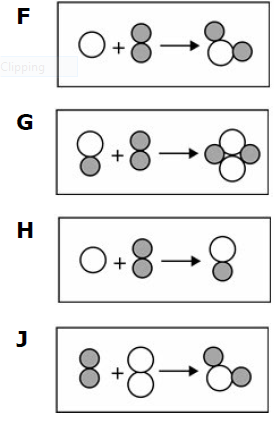
Which of the following models best demonstrates a balanced chemical equation?
a)
F
b)
G
c)
H
d)
J
10.
Why must chemical equations be balanced?
a)
So that the equation doesn't explode
b)
The reaction won't happen until it is balanced
c)
Based on the Law of Conservation of Matter, matter cannot be created or destroyed.
d)
Based on the Law of Conservation of Energy, energy cannot be created or destroyed.e
11.
Which are the reactants in the following reaction?
2Mg + O2 ---> 2MgO
a)
Mg and O2
b)
MgO
c)
Mg and MgO
d)
O2 and MgO
12.
Which of the following is NOT an indication of a chemical reaction?
a)
new gas formed
b)
temperature change
c)
new smell detected
d)
two liquids form a mixture
13.
Which problem is balanced?
a)
PbO2 + 2H2
b)
SO2 + H20 --> H2SO4
c)
2Na + 2H2O --> 2NaOH + H2
14.
What is a coefficient?
a)
The small number on the right of the chemical symbol.
b)
The large number to the left of a formula.
15.
Which of the following is a balanced chemical equation?
a)
2Mg + HCl --> MgCl2 + H2
b)
H2O2 --> H2O + O2
c)
SO2 + O2 + 2H2O --> 4H2SO4
d)
2Fe2O3 + 3C --> 4Fe + 3CO2
16.

This appears on the left side of a chemical formula, and represents how many molecules there are.
a)
an atom
b)
the subscript
c)
a molecule
d)
the coefficient
17.

How many valence electrons in this structure?
a)
6
b)
5
c)
4
d)
7
18.
What group would Ca like to join with
a)
5
b)
6
c)
7
d)
8
19.
Each column in the periodic table is called a
a)
period
b)
group
c)
cluster
d)
unit
20.
The atomic number tells you what?
a)
number of electrons
b)
number of protons
c)
number of neutrons
d)
both electrons and protons in an atom.
21.
Which element is not a metal?
a)
H
b)
Re
c)
Al
d)
B
22.

The atoms along the staircase are called
a)
metals
b)
nonmetals
c)
metalloids
d)
noble gases
23.
A horizontal row of elements in the periodic table.
a)
column
b)
group
c)
period
24.
A vertical column in the periodic table. Elements share similar properties.
a)
row
b)
group
c)
period
25.
A neutron has a charge of
a)
+2
b)
No charge
c)
-1
d)
+1
100 %

