
 Worksheets
States of Matter
Total questions: 40
Worksheet time: 26mins
Name
Class
Date
1.

Which form of matter has a definite shape and takes up space (has definite volume)?
a)
liquid
b)
solid
c)
gas
d)
clay
2.

The molecules in the picture are tightly held together with little movement. They have shape and energy. Therefore, the picture represents _________.
a)
solid
b)
liquid
c)
gas
d)
plasma
3.
Molecules move quickest in which state of matter
a)
solid
b)
liquid
c)
gas
d)
solid, liquid and gas
4.
When the temperature of matter decreases the particles ...
a)
speed up and move farther apart
b)
speed up and move closer together
c)
slow down and move farther apart
d)
slow down and move closer together
5.
When the temperature of matter increases the particles...
a)
speed up and move closer
b)
speed up and move farther apart
c)
slow down and move closer together
d)
slow down and move farther apart
6.
Water can be a solid, liquid, and a gas.
a)
True
b)
False
liquid
liquid
7.
Molecules are closest together in a
a)
Solid
b)
Liquid
c)
Gas
d)
plasma
8.

What does this picture represent?
a)
solid
b)
liquid
c)
gas
d)
plasma
9.

What does this picture represent?
a)
solid
b)
liquid
c)
gas
d)
plasma
10.

Which of the following statements is NOT true of all different types of matter?
a)
They are made of atoms and molecules
b)
The particles are always in motion
c)
The particles always move at the same speed
d)
They are made of particles that are too small to see
11.
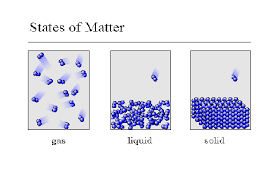
A gas
a)
has a definite shape but no definite volume
b)
has a definite volume but no definite shape
c)
has fast-moving particles
12.
Freezing
a)
Solid to gas
b)
Liquid to solid
c)
Gas to solid
d)
Liquid to gas
13.
Boiling
a)
liquid to gas
b)
gas to solid
c)
gas to liquid
d)
solid to liquid
14.
Define a liquid.
a)
Indefinite shape, indefinite volume
b)
Definite shape, definite volume
c)
Found in stars
d)
Definite volume, indefinite shape
15.
The state of matter that has no definite size or shape is
a)
Solid
b)
Liquid
c)
Gas
16.
Particles (molecules) in a ______________________ have more energy than the other states of matter.
a)
gas
b)
solid
c)
liquid
17.
Particles of a liquid
a)
are tightly packed together and stay in a fixed position.
b)
have no viscosity.
c)
decrease in volume with increasing temperature.
d)
are free to move around one another but still touch.
18.
Particles (molecules) in a ______________________ have more energy than the other states of matter.
a)
gas
b)
solid
c)
liquid
19.
What is condensation?
a)
gas to solid
b)
gas to liquid
c)
liquid to solid
d)
solid to liquid
20.
Which has a greater distance between particles?
a)
Solid
b)
Liquid
21.
A chemical change
a)
doesn't really change much.
b)
creates a new substance
c)
is a change in the state of matter
22.
A physical change is...
a)
a change that doesn't change the identity
b)
a change that makes something new.
c)
a chemical reaction
23.
What happens when my glass of water is sitting in the sun and disappears into a gas?
a)
evaporation
b)
burning
c)
melting
d)
freezing
24.
What term describes a liquid changing to a solid?
a)
Deposition
b)
Sublimation
c)
Evaporation
d)
Freezing
25.
Molecules are closest together in a
a)
Solid
b)
Liquid
c)
Gas
26.

Which state of matter has particles arranged like this?
a)
solid
b)
liquid
c)
gas
27.

Which state of matter has particles arranged like this?
a)
solid
b)
liquid
c)
gas
28.

Which state of matter has particles arranged like this?
a)
solid
b)
liquid
c)
gas
29.
Which state of matter has particles that are stuck in one spot but vibrate?
a)
solid
b)
liquid
c)
gas
30.
What happens to the particles when I add heat?
a)
The particles get bigger
b)
The particles get smaller
c)
The particles get slower
d)
The particles get faster
31.
Which of the following statements describes a gas?
a)
It has a fixed shape
b)
It takes the shape of it's container
32.
Which of the following statements describes a liquid?
a)
It has a fixed volume
b)
It becomes the volume of it's container
33.
Which of the following statements describes a solid?
a)
It has a fixed volume
b)
It becomes the volume of it's container
34.
Which of the following properties is a physical property?
a)
magnetism
b)
reactivity with oxygen
c)
flammability
d)
non-reactive
35.
Flammability is an example of what property?
a)
Chemical property
b)
Physical property
36.
What kind of properties can only be observed when a substance changes into a different substance?
a)
physical properties
b)
chemical properties
c)
liquid properties
d)
real properties
37.
Diamonds are capable of cutting glass
a)
Chemical Property
b)
Physical Property
38.
vinegar reacts with baking soda when mixed
a)
chemical
b)
physical
39.
Blue Color: Chemical or Physical Property
a)
Chemical Property
b)
Physical Property
40.
Reacts with Air: Chemical or Physical Property
a)
Chemical Property
b)
Physical Property
100 %

