wayground logo

Free Printable Worksheets

NEW

Font size

S
M
L
XL
Worksheets

Kinds of Chemical Bonds

Total questions: 44

Worksheet time: 40mins
Name
Class
Date
1.

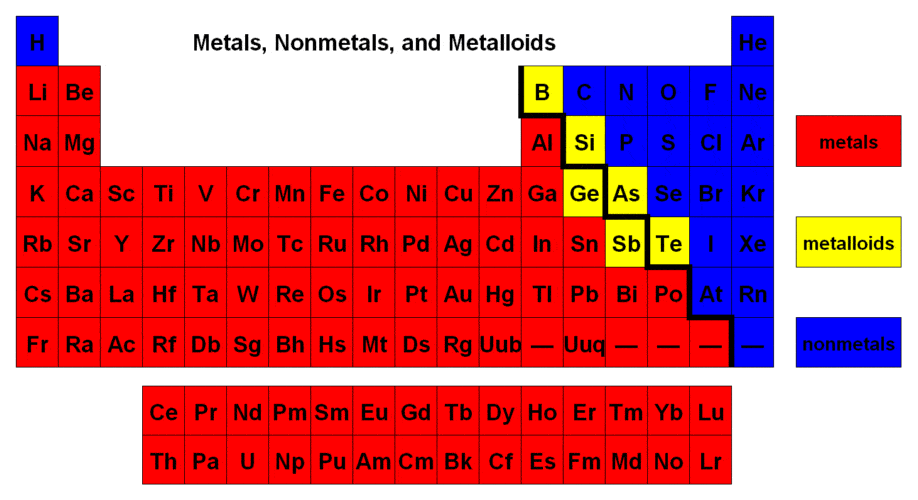
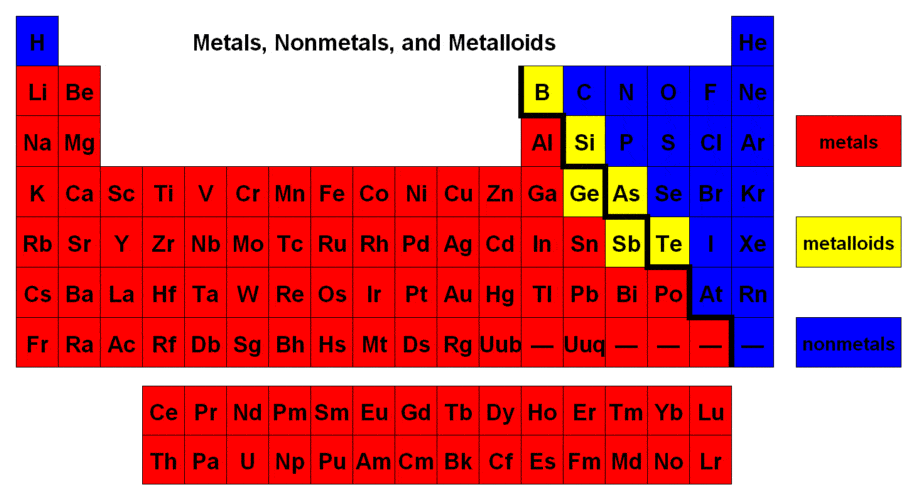
In the image, metals are shown in

a)

red

b)

blue

c)

yellow

d)

white

2.

In the image, nonmetals are shown in

a)

red

b)

blue

c)

yellow

d)

white

3.

Sulfur (S) is a

a)

metal

b)

nonmetal

4.

hydrogen (H) is a

a)

metal

b)

nonmetal

5.

Sodium (Na) is a

a)

metal

b)

nonmetal

6.

Copper (Cu) is a

a)

metal

b)

nonmetal

7.

Fluorine is a

a)

metal

b)

nonmetal

8.

Magnesium (Mg) is a

a)

metal

b)

nonmetal

9.

Potassium (K) is a

a)

metal

b)

nonmetal

10.

Oxygen (O) is a

a)

metal

b)

nonmetal

11.

Nitrogen (N) is a

a)

metal

b)

nonmetal

12.

Lead (Pb) is a

a)

metal

b)

nonmetal

13.
What elements generally make an ionic bond?
a)
metal and nonmetal
b)
2 or more nonmetals
c)
metal
d)
none of the above
14.
An ionic bond forms when 
a)
Valence electrons are shared
b)
a sea of mobile electrons surround the cations
c)
valence electrons are transferred between atoms
d)
none of the above
15.

Which of these compounds has ionic bonds (metal + nonmetal)?

a)

KBr

b)

CH4

c)

Fe

d)

NH3

16.

Which of these compounds has ionic bonding?

a)

H2O

b)

Ne

c)

Na2O

d)

NH3

17.

Which of these compounds has ionic bonding?

a)

Au

b)

NO2

c)

H2S

d)

LiOH

18.
In chemical compounds, covalent bonds form when
a)
valence electrons come loose forming a "mobile sea."
b)
electrons are transferred between two atoms, making positive and negative ions.
c)
pairs of electrons are shared between two nonmetal atoms.
d)
two nonmetal atoms are attracted to each other by opposite charges.
19.
What elements generally make a covalent bond?
a)
metal and nonmetal
b)
2 or more nonmetals
c)
metal
d)
none of the above
20.

Which of these compounds has covalent bonding (contains two nonmetals)?

a)

Au

b)

NO2

c)

CaF2

d)

LiOH

21.

Which of these compounds has covalent bonding?

a)

NaNO3

b)

AlCl3

c)

Zn

d)

CH4

22.

Which of these compounds has covalent bonding?

a)

SO2

b)

K2O

c)

PbCl2

d)

Cr

23.
What elements generally make a metallic bond?
a)
metal and nonmetal
b)
2 or more nonmetals
c)
metal
d)
none of the above
24.

Which of these substances has metallic bonding (only metals)?

a)

SO2

b)

K2O

c)

PbCl2

d)

Cr

25.

Which of these substances has metallic bonding ?

a)

SnCl2

b)

Al

c)

KBr

d)

NH3

26.

Which of these substances has metallic bonding ?

a)

PBr3

b)

Al2O3

c)

brass, a mixture of Cu and Zn

d)

CO

27.

Which of these substances has metallic bonding ?

a)

Fe

b)

MgCl2

c)

Ar

d)

CaSO4

28.
A positively or negatively charged particle.
a)
covalent bond
b)
compound
c)
ion
d)
chemical bond
29.
A chemical bond between oppositely charged ions.
a)
compound
b)
ion
c)
covalent bond
d)
ionic bond
30.
What types of atoms make an ionic bond?
a)
2 Nonmetals
b)
1 Nonmetal and 1 Metal
c)
1 or more metals
d)
2 Noble Gases
31.
Covalent compounds
a)
Share electrons
b)
transfer electrons
c)
contain a sea of electrons
d)
conduct electricity
32.
What types of atoms make a covalent bond?
a)
2 Nonmetals
b)
1 Nonmetal and 1 Metal
c)
1 or more Metals
d)
2 Noble Gases
33.
Is Hydrogen considered a metal or a non-metal?
a)
Metal
b)
Non-metal
34.
Contains a "sea of electrons" that are shared among atoms
a)
ionic
b)
Covalent
c)
Metallic
d)
All Types
35.
Has a low melting point
a)
ionic
b)
Covalent
c)
Metallic
d)
All Types
36.
Fill in the blank: Metallic compounds have ________ melting points.
a)
low
b)
nonexistent
c)
high
d)
medium
37.
What are the only parts of an atom that make chemical bonds?
a)
protons in the nucleus
b)
neutrons in the nucleus
c)
electrons in the nucleus
d)
valence electrons
38.

Covalent compounds

a)

Share electrons

b)

transfer electrons

c)

contain a sea of electrons

d)

conduct electricity

39.
Sn + Hg
a)
Ionic 
b)
Polar Covalent
c)
Metallic
d)
Nonpolar Covalent
40.
Predict the bond that will form between Mg and S.
a)
Ionic
b)
Covalent
c)
Metallic
41.
Predict the bond that will form between atoms in copper (Cu)
a)
Ionic
b)
Covalent
c)
Metallic
42.
Predict the bond that will form between O and Cl.
a)
Ionic
b)
Covalent
c)
Metallic
43.
Predict the bond that will form between Na and F.
a)
Ionic
b)
Covalent
c)
Metallic
44.

Which of these is a covalent compound?

a)

Ni

b)

Na2S

c)

CO2

d)

MgCl2