
NEW
Font size
 Worksheets
Oceans Review
Total questions: 37
Worksheet time: 2hrs 51mins
Salinity is the measure of...
oxygen in water
dissolved salts in water
What is the most abundant salt in the ocean?
Chromium iodide
Sodium Chloride
Deep Ocean currents are a result of
Global Wind Patterns
Density
Surface currents are a result of
Global Wind Patterns
Earth's Rotation
The Coriolis Effect is caused by
The tides of the ocean
Earth rotating on its axis
The Gulf stream carries _____________ water from the east coast of The United States to the West coast of Europe.
Cold
Warm
As you go deeper in the ocean, the water is colder and has less pressure.
True
False
Ocean currents have an affect on which two things
climate and weather
temperature and density
A technique that used sound waves to measure the depth of the ocean floor is
dredging
sonar
How much salt is in something is called_____________
Salinity
Transpiration

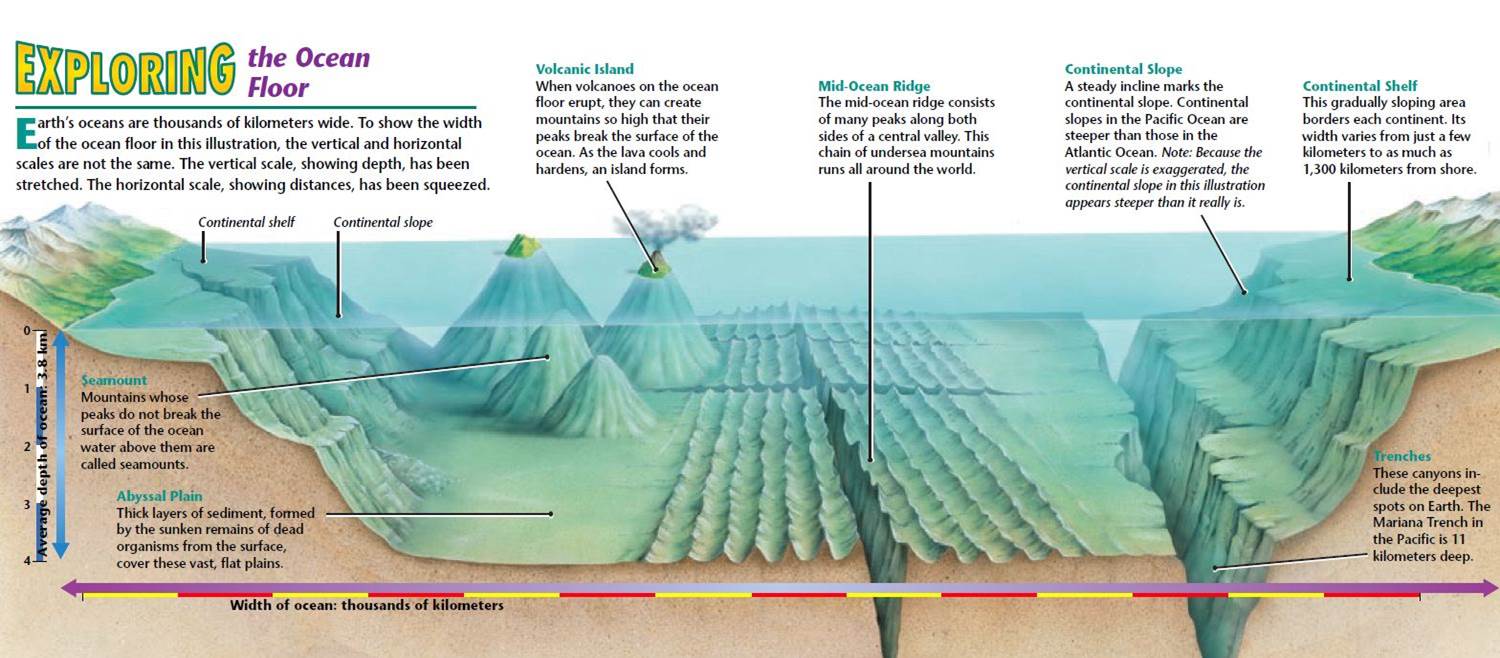
Label A
continental slope
continental shelf

What is label B
Trench
Seamount

Label C
abyssal plain
continental shelf

Label E
continental slope
volcanic island

Label F
continental slope
continental shelf

What is label G
Trench
Mid ocean ridge

When we go to beach, we go swimming on the ____________
continental slope
continental shelf
The continental slope is located at the end of the...
shoreline
continental shelf
The part of the ocean that extends from the low-tide line to the edge of the continental shelf is the
Neritic Zone
Open Ocean Zone
This is the zone between high-tide and low-tide (literally means between tides)
Neritic Zone
Intertidal Zone
This zone includes any area beyond the continental shelf where water is deepest.
Open-Ocean Zone
Neritic Zone
What two elements combine to make water?
2 Hydrogen and 1 Oxygen
1 Hydrogen and 2 Oxygen
The ocean is salty mainly due to volcanic eruptions and the weathering & erosion of rocks that contain salt-based minerals, like halite.
True
False

This image shows
sea floor spreading at the Mid Ocean Ridge
SONAR on the continental shelf

As the ocean gets deeper,
Pressure decreases
Temperature decreases

Bioluminescence means that a creature produces its own
Electricity
Light

What type of water is in the Ocean?
fresh water
salt water
Plants and animals that live on the ocean floor are...
benthos
nekton
The only part of the open ocean that receives enough sunlight to support the growth of algae is
Surface Zone
Hydrothermal vents
Organisms in the deep ocean that produce their own light are called
bioluminescent.
neritic
Free-swimming animals that can move throughout the water column are called
Benthos
Nekton
tiny algae and animals that float in water and are carried by waves and currents
Plankton
Nekton
Upwelling is the process where warm, nutrient rich water from deep in the ocean rises to the surface.
False
True
A result of upwelling is a/an _________ in nutrients in the water.
Decrease
Increase
Upwelling increases amounts of this at the surface
nutrients
Warm water
upwelling is driven by
plankton
wind
Upwelling causes the water off the western coasts of continents in the tropics to
Have warmer temperatures than other tropical waters
be productive fishing grounds

