

wayground logo

Free Printable Worksheets

Font size

S
M
L
XL
Worksheets

STAAR 2017 review 2

Total questions: 150

Worksheet time: 4hrs 48mins

Name
Class
Date
1.
A protest of small farmers in Pennsylvania against new taxes on whiskey. Washington sends troops. Shows strength of Federal Government.
a)
Precedent
b)
Shays Rebellion
c)
Whiskey Rebellion 
d)
Jay's Treaty
2.
an earlier event or action that is regarded as an example or guide for future people to follow
a)
Cabinet
b)
President
c)
example
d)
Precedent 
3.
What was G. Washington's policy with foreign nations?
a)
Alliance with Spain
b)
Alliance with Britian
c)
Alliance with France
d)
Stay Neutral
4.
What was taxed that caused farmers in Western Pennsylvania to rebel and refuse to pay the tax?
a)
Tea
b)
Whiskey
c)
Corn
d)
Sugar
5.
What did the Monroe Doctrine tell European nations?
a)
Stop colonizing in the Western Hemisphere!
b)
Stop colonizing in the Eastern Hemisphere!
c)
Get out of the USA!
d)
Stop trading with Great Britain!
6.
Alexander Hamilton wrote the Federalist Papers, a series of newspaper essays that helped convince a skeptical public to ratify the Constitution, with:
a)
James Madison and Thomas Jefferson
b)
James Madison and John Jay
c)
George Washington and John Jay
d)
James Madison and William Duer
7.
The principle of government that national and state governments must share powers
a)
Federalism
b)
Republicanism
c)
Checks & Balances
d)
Separation of powers
8.
Marbury v. Madison created:
a)
the Supreme Court's right to declare a law unconstitutional
b)
the right to vote
c)
the ability to regulate trade between countries 
d)
the right to pout until you get what you want
9.
What did Alexander Hamilton believe the U.S. needed?
a)
A national bank for economic stability
b)
A treaty with both France and Britain for political stability
c)
Tariffs on interstate goods for economic stability
d)
A stock market exchange system for social stability
10.

The idea that America has the "God give" right to expand its territory west to the Pacific Ocean was known as --

a)

Nullification Crisis

b)

Trail of Tears

c)

Free Enterprise

d)

Manifest Destiny

11.

Americans relocated many Native Americans for the purpose to obtain more --

a)

Land

b)

Money

c)

Taxes

d)

Tariffs

12.

The act, or law, was created in order to remove Native Americans from their homelands and force them West.

a)

Alien and Sedition Acts

b)

No More Natives Act

c)

Citizens Only Act

d)

Indian Removal Act

13.

"A state has the right to overrule an act passed by Congress." This ideology led to the --

a)

Nullification Crisis

b)

Free Enterprise

c)

Manifest Destiny

d)

Trail of Tears

14.
Andrew Jackson's election victory in 1828 depended on support from
a)
the rich and well-born.
b)
Native Americans.
c)
the common people.
d)
states'  rights supporters.
15.
Jackson's practice of rewarding political supporters with government jobs became known as
a)
the spoils system.
b)
Jacksonian democracy.
c)
mudslinging.
d)
a corrupt bargain.
16.
The Nullification Crisis was triggered y strong opposition to the
a)
Force Bill.
b)
Indian Removal Act.
c)
Tariff of Abominations.
d)
Bank of the United States.
17.
Why did people think Clay and Adams had made a deal?
a)
Because Clay became Adams Secretary of State
b)
Adams paid Clay to make him president
18.
In the Missouri Compromise, what state was allowed to enter as a slave state?
a)
Missouri
b)
Maine
c)
Kentucky
d)
Ohio
19.
Where was the Missouri Compromise line?
a)
36-30 degrees north in the Louisiana Purchase
b)
46-40 degrees north in the Louisiana Purchase
c)
56-50 degrees north in the Louisiana Purchase
d)
66-60 degrees north in the Louisiana Purchase
20.
What movement inspired people to become more religious and increased church attendance? 
a)
Abolitionism 
b)
Feminism 
c)
The Second Great Awakening
d)
Manifest Destiny
21.
During the election of 1824, candidate John Quincy Adams made a “corrupt bargain” with Henry Clay, by __________________________.
a)
Blackmailing Jackson into submission.
b)
Agreeing to support Clay’s candidacy eight years from then (after Adams serves for two terms).
c)
Stuffing the ballot box with fake votes, tipping the scales for Adams.
d)
Giving Clay the position of Secretary of State in exchange for Clay throwing his support behind Adams in the House of Representatives.
22.
Which of the following is true regarding Jackson’s spoils system?
a)
He spoiled the American people by reducing federal taxes and making the common man wealthier
b)
His top supporters during the campaign received government positions once Jackson won
c)
He spoiled the presidency of John Quincy Adams by beating him in the election
d)
None of these
23.
The Indian Removal act ordered the removal of Creek, Seminole, Cherokee, and other tribes to which present-day state?
a)
Oklahoma
b)
Nebraska
c)
Indiana
d)
New Mexico
24.
What was the name of the route by which Native Americans were forced to move from their homes to the established Indian Territory?
a)
Natchez Trace
b)
Trail of Tears
c)
Promised Land Parkway
d)
Highway 100
25.
The Trail of Tears refers to
a)
Jackson’s angry negotiations with the Five Civilized Tribes.
b)
the movement of Seminole Indians from the West to Florida.
c)
government workers who lost their jobs due to Jackson’s spoils system.
d)
the removal of Cherokee Indians from Georgia to Indian Territory.
26.
Which of these characteristics also describes these two states below?
a)
Founded as work colonies for debtors.
b)
Former slave states.
c)
Were havens for religious dissenters.
d)
Former Spanish colonies.
27.
What was one reason James K. Polk won the presidential election of 1844? 
a)
He was against removing American Indians from their native lands.  
b)
He favored the policy of popular sovereignty in the Kansas and Nebraska territories.  
c)
He was committed to fulfilling the goals of Manifest Destiny. 
d)
He opposed the extension of slavery west of the Mississippi River.  
28.
During the 1840s the factors in this diagram below contributed to widespread support for which of the following?
a)
The Kansas-Nebraska Act.
b)
Manifest Destiny
c)
The American System
d)
States’ Rights
29.
Which of these was a goal shared by many advocates of Manifest Destiny? 
a)
Abolishing slavery throughout the United States.
b)
Occupying all of North America.
c)
Withdrawing from foreign affairs.
d)
Returning to an agrarian economy.
30.
As a result of the Oregon Treaty, the United States achieved its goal of?
a)
expanding westward to the Pacific Ocean.
b)
acquiring land for a southwestern railroad.
c)
reserving western territory for American Indians.
d)
securing the southern border of the country.
31.
Which event on the timeline below contributed most directly to the outbreak of the U.S.-Mexican War?
a)
1
b)
2
c)
3
d)
4
32.
The Compromise of 1850 allowed certain territories to use popular sovereignty to determine whether the territory would be free or slave. This decision applied to much of the land gained from the?
a)
Revolutionary War
b)
War of 1812
c)
U.S.-Mexican War
d)
Civil War
33.
Which of these best completes the diagram below?
a)
California
b)
Nevada
c)
Texas
d)
Florida
34.
What states were part of the Mexican Cession?
a)
Massachusetts, Rhode Island, Pennsylvania
b)
Louisiana, Arkansas, Alabama, Mississippi
c)
Oregon, Washington, Idaho
d)
California, New Mexico, Utah, Nevada
35.
The war with Mexico BEGAN with
a)
California's rebellion
b)
a border dispute in Texas
c)
the Battle of Buena Vista
d)
a US invasion of Mexico City
36.
Which of the following presidents purchased Louisiana?
a)
Washington
b)
Adams
c)
Jefferson
d)
Jackson
37.
The purchase of Louisiana
a)
was a costly mistake
b)
was opposed by western farmers
c)
doubled the size of the United States
d)
led to war with Great Britain 
38.
How did the U.S. acquire Oregon? 
a)
treaty with the British
b)
war with England
c)
purchased from the British
d)
war with Mexico
39.
Why was the Gadsden Purchase added to the U.S. in 1853?
a)
it was needed for the building of a railroad
b)
it was a gift from Mexico
c)
it was part of the treaty with Mexico
d)
gold was discovered in that area
40.
In what year did the United States purchase the Louisiana Territory?
a)
1803
b)
1819
c)
1845
41.
How did the Northwest Ordinance of 1787 provide for the orderly expansion of the United States?
a)
It provided the president with the power to sign treaties with foreign powers to buy additional territory
b)
It provided a review process for laws in new territories and states.
c)
It provided procedures for establishing territories and creating states.
42.
Which of these is required of a U.S. territory in order for it to become a U.S. state?
a)
Election of a state governor
b)
A population of 60,000 people
c)
Appointment of the first postmaster
43.
Which of the following contributed to the westward expansion of the United States?
a)
European warships attacked the eastern seaboard, forcing citizens to move westward for safety.
b)
Most of the land east of the Mississippi River was not suitable for farming.
c)
Many Americans felt it was their right and duty to move westward.
d)
The standard of living on the Pacific Coast was very high, so many people wanted to move there.
44.
Which area on the map was acquired by the United States as a result of the Mexican War?
a)
Texas Annexation
b)
Gadsden Purchase 
c)
Mexican Cession
d)
Oregon Territory
45.
Name the piece of Land.
a)
Texas Annexation
b)
Mexican Cession 
c)
Louisiana Purchase 
d)
Florida Cession
46.
Name the piece of land.
a)
Mexican Cession
b)
Northwest Territory 
c)
Trans-Appalachian West 
d)
Oregon Country 
47.
Which of these would be the best title for the illustration above?
a)
Divine Nature
b)
Survival of the Fittest
c)
Universal Expansion
d)
Manifest Destiny
48.
Why were the Northwest Ordinances so important to the new nation?
a)
It led to the admission of new states to our country.
b)
It made Halloween a National Holiday! (don't pick this one!)
c)
It limited the number of voters in national election.
d)
It was so weak that it was replaced with the Constitution.
49.
These environmental modifications were made in order to construct? 
a)
permanent housing for immigrants in urban areas.
b)
canals that linked the Midwest to the Northeast.
c)
a transcontinental railroad.
d)
 harbor on the Mississippi River.
50.
This list below describes the nineteenth-century experiences of immigrants from?
a)
Italy
b)
China
c)
Germany
d)
Japan 
51.
What was one result of these regional differences below?  
a)
Cities in the South emerged as centers for textile mills.  
b)
Immigrants settled in the Midwest to establish small farms.  
c)
Slavery increased in the Northeast as industrialization expanded.  
d)
Plantation systems in the South were replaced by large businesses.  
52.
Which group was responsible for these contributions to American culture?
a)
Chinese Americans
b)
African Americans
c)
German Americans
d)
Italian Americans
53.
During the early 1800s many young women in New England were employed outside their homes as?
a)
crew members on cargo ships.
b)
cloth weavers in textile mills.
c)
H staff reporters for local newspapers.
d)
legal counselors in state courts.
54.
What was one major effect of the Erie Canal on the United States in the early nineteenth century?
a)
The rapid growth of cities in the Northeast.
b)
A rise in cotton exports to the United Kingdom.
c)
An increase in the cost of shipping goods to Europe.
d)
A decrease in trade between settlers and American Indians,
55.
The growth of railroads during the nineteenth century affected U.S. businesses by? 
a)
discouraging Congress from instituting tariffs.
b)
increasing the cost of raw materials.
c)
decreasing the wages of unskilled workers.
d)
opening new markets for goods.
56.
Which of these best completes the diagram below?
a)
The demand for slaves increases in the South.
b)
More textile factories are established in the South.
c)
The number of European immigrants arriving at southern port cities increases.
d)
More tobacco and food crops are cultivated on southern plantations.
57.
How did the plantation system influence the economic development of the United States?
a)
It prevented the development of industry in the Northeast.
b)
It turned the South into a major producer of the cotton used in northern mills.
c)
It restricted agricultural expansion in the western territories.
d)
It increased federal dependency on tariffs for revenue.
58.
Which factor accounts for this trend below?  
a)
The Second Great Awakening motivated people to join reform movements.
b)
Manifest Destiny inspired many people to become homesteaders.  
c)
Jacksonian Democracy allowed more people to vote in elections.  
d)
The Industrial Revolution encouraged people to pursue jobs in cities. 
59.
How did the development of the factory system encourage urbanization?
a)
Manufacturers produced goods to export overseas.
b)
Labor unions were formed to protect mill workers.
c)
Workers moved closer to manufacturing centers.
d)
Industrialists invested in cotton plantations.
60.
After the War of 1812, thousands of settlers and immigrants moved to the western frontiers of the United States in search of farming and business opportunities. In response, the government began building roads. This transportation network was intended to?
a)
promote the free-enterprise system.
b)
establish federal control over industry.
c)
discourage the organization of new territories.
d)
prevent border disputes between states.
61.
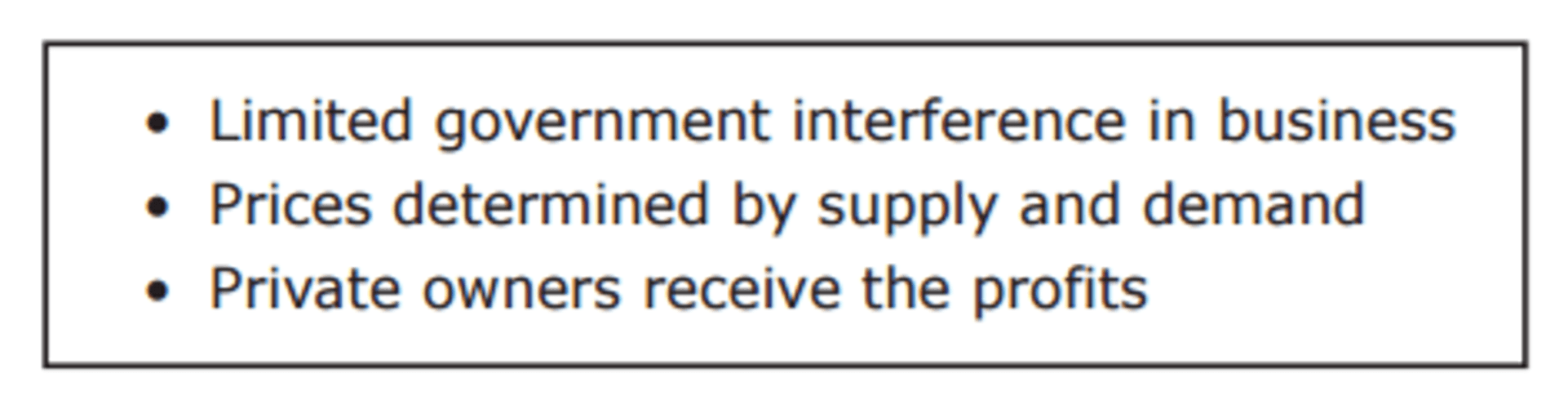
Which type of economy is best described by these characteristics below?
a)
Subsistence farming.
b)
Free enterprise.
c)
Mercantilism.
d)
Socialism.
62.
Between 1846 and 1855 the population of Ireland decreased by a third, including the approximately 1.5 million Irish immigrants who left for the United States. What was the primary reason for this migration?
a)
Massive unemployment resulting from British occupation. 
b)
Political unrest during an economic recession.
c)
Famine caused by a major crop failure.  
d)
Civil war between Catholics and Protestants.  
63.
How did this invention below contribute to the expansion of the plantation system?
a)
By reducing the number of slaves needed for growing cotton.
b)
By increasing the time needed to cultivate cotton.
c)
By increasing the profitability of slavery.
d)
By reducing the demand for raw cotton.
64.
The innovation shown in this photograph below most affected the U.S. economy by?
a)
decreasing the need for canals.
b)
allowing more efficient movement of goods.
c)
reducing the costs of settling in western territories.
d)
transporting workers from southern states to northern states.
65.
The Bessemer steel process affected westward expansion in the United States by enabling?
a)
clipper ships to be built in order to transport passengers from the East Coast to the West Coast.
b)
interstate canal systems to be built in order to transport agricultural goods from west to east.
c)
Conestoga wagons to be built in order to carry people and goods to the West.
d)
railroads to be built in order to carry people and goods to the West.
66.
Which of these occurred during early U.S. industrialization?  
a)
Manufacturers instituted a five-day workweek.  
b)
Labor laws required factories to provide a safe working environment.  
c)
Workers were required to attend schools to develop technical skills.  
d)
Production of goods transitioned from homes to factories.  
67.
Which statement best describes a result of industrialization in the United States during the mid-nineteenth century?
a)
People moved to cities in search of economic opportunity.
b)
Farmers began to cultivate land west of the Appalachian Mountains.
c)
Native peoples were forcibly relocated to western territories.
d)
Government officials began to promote the idea of Manifest Destiny.
68.
The era in which a change from household industries to factory production using powered machinery took place.
a)
American Revolution
b)
Industrial Revolution
c)
Technological Innovations
d)
Boom and Bust
69.
Factories took advantage of women, children and ______. 
a)
Native Americans 
b)
Slaves
c)
Chinese
d)
Immigrants 
70.
An invention by Eli Whitney that speeded the cleaning of cotton fibers and in effect, increased the need for slaves.
a)
Steamboat
b)
Mechanical Reaper
c)
Steel Plow
d)
Cotton Gin
71.
What was the first industry affected by the Industrial Revolution?
a)
Automobile
b)
Railroad
c)
Textile
d)
Telephone
72.
What allowed goods to be produced cheaper and faster for the increasing population?
a)
Cottage industry
b)
Animal power
c)
Hand made items
d)
Mass production
73.
What is the movement from rural to urban areas called?
a)
Moving
b)
colonization
c)
inflation
d)
urbanization
74.
Which reform movement fought to decrease the consumption of alcohol?
a)
Temperance Society 
b)
Seneca Falls Convention
c)
Abolition Movement
d)
Womens Suffrage 
75.
What took place in Seneca Falls?
a)
The first Women's Rights Convention
b)
The Emancipation Proclamation 
c)
The Second Great Awakening
d)
Signing of the Declaration of Independence
76.
Who were the 2 main leaders at the Women's Right Convention?
a)
Elizabeth Cady Staton and Lucretia Mott
b)
Lucretia Mott and Harriet Tubman
c)
Elizabeth Cady Staton and Harriet Beecher Stowe
d)
Harriet Beecher Stowe and Harriet Tubman
77.
Who was the leader of Transcendentalism? 
a)
Ralph Waldon Emerson 
b)
Elizabeth Cady Stanton 
c)
Lucretia Mott
d)
Frederick Douglas 
78.
Who was the conductor of the Underground Railroad?
a)
Harriet Tubman
b)
Ralph Waldo Emerson
c)
Elizabeth Cady Stanton
d)
Henry Clay
79.
Uncle Tom's Cabin, The North Star and The Liberator all concerned what?
a)
Opposing Slavery
b)
Opposing Abolition
c)
Supported Women's rights
d)
Supported Factory Reforms
80.
How was the Hudson river school a distinctly American painting?
a)
Artists painted landscapes to show man's connection with nature
b)
Artists avoided realism
c)
Artists showed industrialism ruined the environment
d)
Artists connected greek and roman myths to America
81.
What was an important location for the women's suffrage movement?
a)
Washington, DC
b)
Lubbock, TX
c)
Philadelphia
d)
Seneca Fall, NY
82.
Railroads and Canals were beneficial because
a)
products were moved from the West from the South.
b)
the West & South became more industrialized.
c)
People and products could move faster.
d)
It stopped migrants from moving to New York.
83.
Abolitionist Frederick Douglas
a)
became president of the Abolition Party.
b)
ran a secret escape route for slaves
c)
spoke about his life as a slave.
d)
wrote laws banning slavery.
84.
__________________ is a term used to describe the struggle to earn the right to vote.
a)
Supper
b)
Suffrage
c)
Electoral College
d)
Abolitionist Movement
85.
Define Reform
a)
to make change to something in order to improve it 
b)
first co-ed college
c)
the time period directly after a major war
d)
the right to vote
86.
The Second Great Awakening was a movement that promoted?
a)
spiritual revival and the need for social reform.
b)
the use of reason and scientific theory.
c)
states’ rights and governmental reform.
d)
mercantilism and the development of global trade.
87.
Which of the following was an argument made against slavery in the Thirteen Colonies? 
a)
Manufacturers argued that slavery discouraged the development of industry.  
b)
Farmers argued that using slave labor was expensive and inefficient.  
c)
Quakers argued that slavery violated Christian principles.
d)
Puritans argued that the slave trade encouraged materialism.  
88.
What was one major impact of this novel below?
a)
The profits from book sales funded early labor organizations.
b)
Congress was inspired to pass laws outlawing the abuse of slaves.
c)
The Supreme Court overturned fugitive slave laws.
d)
Support grew for the abolitionist movement.
89.
The abolitionist movement achieved its goal with the passage of which amendment?
a)
Twelfth Amendment
b)
Thirteenth Amendment
c)
Fourteenth Amendment
d)
Fifteenth Amendment
90.
The primary goal of the American Temperance Society was to?
a)
ban the spread of slavery to new territories.
b)
decrease the consumption of alcohol.
c)
gain the release of mentally ill people from prisons.
d)
create a self-sufficient utopian society.
91.
Which movement did Emerson lead?
a)
Temperance
b)
Abolitionism
c)
The Second Great Awakening
d)
Transcendentalism
92.

Sectional differences in the United States during the early 1800s were mostly rooted in differences about —

a)

religion

b)

economics

c)

the roles of women

d)

attitudes about war

93.

How did U.S. tariff policies contribute to sectionalism prior to the Civil War?

a)

Northern states benefited from the tariffs, while Southern states considered them an economic burden.

b)

Western states wanted tariffs to pay for improved infrastructure, while Northern states wanted to reduce the national debt.

c)

Northern states gained European investment in industry, while Southern plantations had to rely on trade with Latin America.

d)

Southern states benefited from tariffs on raw materials, while Northern and Western states disapproved of higher prices for imports.

94.

How did many Southern slaveholders view the issue of slavery?

a)

As a source of labor, slavery was an economic issue.

b)

Slavery was considered immoral and should be abolished.

c)

Slavery was considered a historical tradition that should be maintained to keep cultural ties with the past.

d)

As a source of controversy, slavery was considered a political problem the federal government should solve.

95.

During the heightened period of sectionalism of the early 1800s, John C. Calhoun became a spokesman for southern states by —

a)

working to repeal the Fugitive Slave Act

b)

compromising to stop the spread of slavery

c)

arguing in favor of a state’s right to nullify federal laws

d)

claiming that the Constitution did not apply to the states

96.

Which constitutional principal is the focus of the Nullification Crisis?

a)

Federalism

b)

Republicanism

c)

Individual Rights

d)

Popular Sovereignty

97.
Major result of Missouri Compromise.
a)
Increases the # of immigrants settlingin northern states.
b)
Provided financing for canal construction
c)
Rapidly expanded railroad construction in southern states.
d)
Temporarily relieved sectional tensions.
98.
Who made this statement about the Underground Railroad?
a)
Harriet Beecher Stowe
b)
Elizabeth Cady Stanton
c)
Harriet Tubman
d)
Phillis Wheatley.
99.
Which of these correctly describes an effect of the 1850 Compromise one escaped slaves & freedmen?
a)
Members of both groups were captured under the Fugitive Slave Law.
b)
Unlike freedmen, escaped slaves were welcome in the gold mines of California.
c)
Members of both groups could be sold in Washington D.C., slave markets.
d)
Unlike escaped slaves, freedmen could vote in the territories of the Mexican Cession.
100.
Every state north of Missouri's southern border had to be what kind of state?
a)
Free
b)
Slave
c)
Frontier
d)
Sovereign
101.
Who is the slave or former slave that lost his case, then won his case, then lost his case and then took his case all the way to the Federal Supreme Court and lost his case trying to gain his freedom?
a)
Stephen Douglas
b)
Plessy Ferguson
c)
Dred Scott
d)
Fredrick Douglas
102.
According to the Taney Supreme Court decision, slaves can never be what?
a)
Citizens
b)
Landowners
c)
Paid
d)
Bought
103.
In the Dred Scott decision, the Supreme Court...
a)
avoided controversy by ruling that Dred Scott had no right to sue in federal court.
b)
ruled that Congress could not prohibit slavery in the territories because slaves were private property.
c)
ruled that slaves could sue in federal court only if their masters allowed them to do so.
d)
ruled that a slave that had been transported to a free state or territory was a free citizen of the Untied States.
104.
The Compromise of 1850...
a)
allowed California to enter as a free state.
b)
ended the Fugitive Slave law.
c)
gave all of the land taken from Mexico to Texas.
d)
banned slaver in Washington D.C.
105.
An abolitionist supported which of the following causes?
a)
outlawing alcohol
b)
ending slavery
c)
limiting slavery to southern states
d)
ending women's suffrage
106.
Which region of the country had a lot of manufacturing?
a)
the north
b)
the south
c)
the west
d)
Alaska
107.
At the time of the Missouri Compromise, there were 11 free states and 11 slave states. Where would the balance between free and slave states become unbalanced if Missouri was accepted as a slave state?
a)
In the House of Representatives
b)
In the Senate
c)
In the Executive Branch
d)
In the Judicial Branch
108.
What Did The Kansas Nebraska Act Do Between The North And The South?
a)
Created peaceful tensions between them
b)
Raised the tensions between the sides and started a mini war 
109.
Which of the following literary works of Harriet Beecher Stowe supported the abolitionist movement before the Civil War?
a)
Up From Slavery
b)
Gone with the Wind
c)
Uncle Tom's Cabin
d)
The Jungle
110.
In the 1800's, which of the following required Northerners to help return runaway slaves?
a)
Dred Scott Decision
b)
Compromise of 1820
c)
Fugitive Slave Law
d)
Compromise of 1850
111.
How did the loss of its control of the Mississippi River contribute to the defeat of the Confederacy?
a)
The river had provided direct access to the Union’s base of military operations.  
b)
Losing control of the river removed the physical barrier between slave and free states.  
c)
The river had provided the Confederacy with a power source for factories and mills.  
d)
Losing control of the river divided the Confederacy in two and cut off its supplies.  
112.
One advantage the Confederacy had over the Union during the Civil War was that Confederate forces had?
a)
numerous factories for producing weapons and ammunition.
b)
a larger number of military troops in reserve.
c)
an extensive railroad system for moving troops and supplies.
d)
knowledge of the terrain where most battles were fought.
113.
Which region’s primary economic activity in 1861 was the cultivation of cotton?
a)
1
b)
2
c)
3
d)
4
114.
What was a major result of the Missouri Compromise?  
a)
It increased the number of immigrants settling in northern states.  
b)
It provided financing for canal construction.  
c)
It rapidly expanded railroad construction in southern states.  
d)
It temporarily relieved sectional tensions.  
115.
Which of the following was a result of the Kansas-Nebraska Act of 1854?
a)
Fighting broke out between pro-slavery and anti-slavery groups in Kansas.
b)
Kansas entered the Union as a slave state through popular sovereignty in 1856.
c)
Nebraskan settlers who supported abolition moved to Kansas.
d)
The boundary established by the Missouri Compromise of 1820 was extended farther south.
116.
Which accomplishment could be added to this diagram below?
a)
Commanded the U.S. military in the West during the Indian Wars.
b)
Led the Radical Republicans in Congress during Reconstruction.
c)
Was appointed general in chief of the Union army during the Civil War.
d)
Became Andrew Johnson’s vice president after Abraham Lincoln’s assassination.
117.
Which of the following completes this diagram below?
a)
President Lincoln’s First Inaugural Address.
b)
The Gettysburg Address.
c)
The Emancipation Proclamation.
d)
The Thirteenth Amendment.
118.
How was the event depicted in this image below significant to the Civil War?
a)
The Confederate defense of the besieged fort lengthened the war.
b)
The Union victory divided the Confederacy along the Mississippi River.
c)
The invasion of the Confederate capital resulted in the surrender of the Confederacy.
d)
The Confederate attack upon the Union fort initiated the war.
119.
After General Robert E. Lee’s surrender at Appomattox Court House, the main priority of the United States was to?
a)
elect a new president and vice president.
b)
complete construction of the Capitol.
c)
establish Union forts in the former Confederate states.
d)
implement a plan to bring Confederate states back into the Union.
120.
Which of the following reversed the Supreme Court ruling in Dred Scott v. Sandford?
a)
The Dawes Act
b)
The Fourteenth Amendment
c)
The Compromise of 1877
d)
The Kansas-Nebraska Act
121.
How did the loss of its control of the Mississippi River Contribute to the defeat of the Confederacy?
a)
The river provided direct access to the Union's base operation.s
b)
Losing control of the river removed the physcial barrier between slave and free states.
c)
The river provided the Confederacy with a power source for factories and mills.
d)
Losing control of the rivers divided the Confederacy in two and cut off its supplies.
122.
Which of the following is a Northern advantage leading into the Civil War?
a)
Rairoads
b)
Military Leadership
c)
Home Field Advantage
d)
Slaves
123.
After General Lee surrendered at Appomattox Courthouse, the main priority of the United States was to...
a)
elect a new president and vice president
b)
complete construction of the Capitol
c)
establish Union forts in the former Confederate states
d)
implement a plan to bring Confederate states back into the Union
124.
Bombardment of Fort Sumter
How was this event depicted in this image significant to the Civil War?
a)
the Confederate defense of the besieged fort lengthened the war
b)
the Union victory divided the Confederacy along the Mississippi River
c)
the invasion of the Confederate capital resulted in the surrender of the Confederacy
d)
the Confederate attack upon the Union fort initiated the war
125.
*Encouraged African Americans to fight for the Union
*Strengthened the Union militarily and politically
*Shifted the focus of the war to freedom for all
Which of the following is being described?
a)
President Lincoln's First Inaugural Address
b)
the Gettysburg Address
c)
the Emancipation Proclamation
d)
the Thirteenth Amendment
126.

The belief that states had rights and powers within the Union.

a)

Constitution

b)

States' Rights

c)

Federalism

d)

Confederacy

127.
Who is the president of the Confederate States after the secession?
a)
Abraham Lincoln
b)
Robert E. Lee
c)
Jefferson Davis
d)
Ulysses S. Grant
128.
The Civil War was fought between the years of ___________ and _____________.
a)
1831-1836
b)
1845-1851
c)
1836-1851
d)
1861-1865
129.
__________ ___________ was the first state to secede when an anti-slavery man named Abraham Lincoln was elected president.
a)
North Carolina
b)
South Carolina
c)
South Dakota
d)
North Dakota
130.
Which of the following terms is defined as "when citizens of a territory vote to allow or ban slavery."
a)
popular sovereignty
b)
tariff of abominations
c)
impressment
d)
right of habeus corpus
131.
What states are colored grey on the map?
a)
Union States
b)
Confederate States
c)
Border States
d)
Neutral States
132.
Who was the top general of the Confederate army?
a)
Robert E. Lee
b)
Ulysses S. Grant
c)
Lincoln
d)
Sam Houston
133.
What law allowed special government officials to arrest any person accused of being a runaway slave?
a)
Fugitive Slave Act 1850
b)
Emancipation Proclomation
c)
Underground Railroad
d)
Kansas Nebraska Act
134.
To break away from, or withdraw from something
a)
Abolish
b)
Secede
c)
Repeal
d)
Compromise
135.
Why did the U.S. Supreme Court rule against Dred Scott? 
a)
because he was the property of his owner and could be taken anywhere.
b)
 because Scott was a slave and he was not eligible to sue in court.
c)
because he did not live long enough in a free territory to be free.
d)
because he returned to a slave state and could not be freed.
136.
Which battle do most historians consider to be the turning point to ending the War for Southern Independence? 
a)
Gettysburg
b)
The Atlanta Campaign
c)
Chickamauga
d)
Kennesaw Mountain
137.
The BEST description of the Freedmen’s Bureau during Reconstruction was that it 
a)
registered newly freed slaves to vote.
b)
fought for political and civil rights for newly freed slaves.
c)
provided education, training and social services for the newly freed slaves.
d)
managed the distribution of farm land and animals to the newly freed slaves.
138.
The amendment to the U.S. Constitution that granted citizenship to all men born in the United States 
a)
13th
b)
14th
c)
15th 
d)
16th 
139.
What did the 13th Amendment to the U.S. Constitution do? 
a)
It changed who owned land.
b)
It gave blacks the right to vote.
c)
 It officially made former slaves United States citizens. 
d)
It officially ended slavery in the United States.
140.
What did the Fifteenth Amendment to the U.S. Constitution do? 
a)
It gave black males the right to vote.
b)
It abolished slavery.
c)
It gave blacks citizenship.
d)
It gave blacks the right to own property.
141.
How did the Black Codes impact the lives of African-Americans in the South? 
a)
The codes gave them access to education and other social services.
b)
The codes protected them from abuses by former masters.
c)
The codes prohibited unfair treatment of a person or group because of prejudice.
d)
The codes sought to restrict the rights of the freedmen.
142.
Which BEST describes the differences between sharecropping and tenant farming? 
a)
Sharecroppers received a percentage of the crops produced and could set aside cash money to purchase their own land, while tenant farmers had difficulty saving cash.
b)
Sharecroppers owned nothing but their own labor, while tenant farmers owned farm animals and equipment to use in working other people’s lands.
c)
Tenant farmers received a cash salary or wage for their farm work, while sharecroppers received only a portion of the crops they raised.
d)
Tenant farmers earned equity or an interest in the land they worked from year to year so that eventually they would own their own property.
143.
How did the Ku Klux Klan impact Georgia politics after the Civil War? 
a)
The group worked with the Freedmen’s Bureau to help poor white and former slaves.
b)
The group often used violent means to discourage freed blacks and white Republicans from voting and running for office.
c)
The group often used intimidation and physical violence to discourage Democrats from voting and running for office
d)
The group united Georgia politically and rallied support for the North’s plan for Reconstruction. 
144.
Before the Civil War, the north was different from the south. The north was _________ while the south was ___________.
a)
The North was more industrialized, agricultural.
b)
one religion, many religions
c)
poor, rich 
d)
supportive of slavery, opposed slavery
145.
Were the Compromises (Missouri, Compromise of 1820, 1850, etc.) successful?
a)
No, because it did not prevent the Civil War
b)
Yes, people were able to get along afterwards.
146.
Issues that divided the United States in the 1850's were ____.
a)
War with Mexico
b)
Industrial Revolution
c)
Slavery and States' Rights
d)
Railroads and Ships
147.
What was the Northern economy based upon?
a)
Industry and Manufacturing
b)
Agriculture and Forestry
c)
Farming and Ranching
d)
Police and Outlaws
148.
The Republican Party was formed in 1854 for what sole purpose?
a)
To continue slavery.
b)
To stop the spread of slavery.
c)
To abolish slavery.
d)
To make slaves free citizens.
149.
After the Civil War, the Confederate States had to go through required political, economic and social changes to rejoin the Union.  What were these changes called?
a)
Constitution
b)
Reconstruction
c)
Incrimination
d)
Secession
150.
The Emancipation Proclamation ended slavery in the _______.
a)
Entire United States
b)
Mexican Baja
c)
The Southern States that were in rebellion (Confederate States)
d)
Canada

