
 Worksheets
PARTS OF A MICROSCOPE
Total questions: 14
Worksheet time: 45mins
Hold the slide in place on the stage
Stage
Stage Clips
Aperature
Light Source
Holds objective lenses; Rotates to change objectives
Arm
Base
Revolving Nosepiece
Diaphragm
Moves the stage slightly to sharpen the image
Body Tube
Course Focus Knob
Aperature
Fine Focus Knob
Supports the microscope and located at the bottom
Base
Arm
Body Tube
Stage
Place where slide is placed on while being viewed
Base
Stage Clips
Diaphragm
Stage
You should always carry the microscope by the
arm and base
arm and body tube
arm only
the objectives
Never use this knob on high power.
Fine
Large
Course
Small
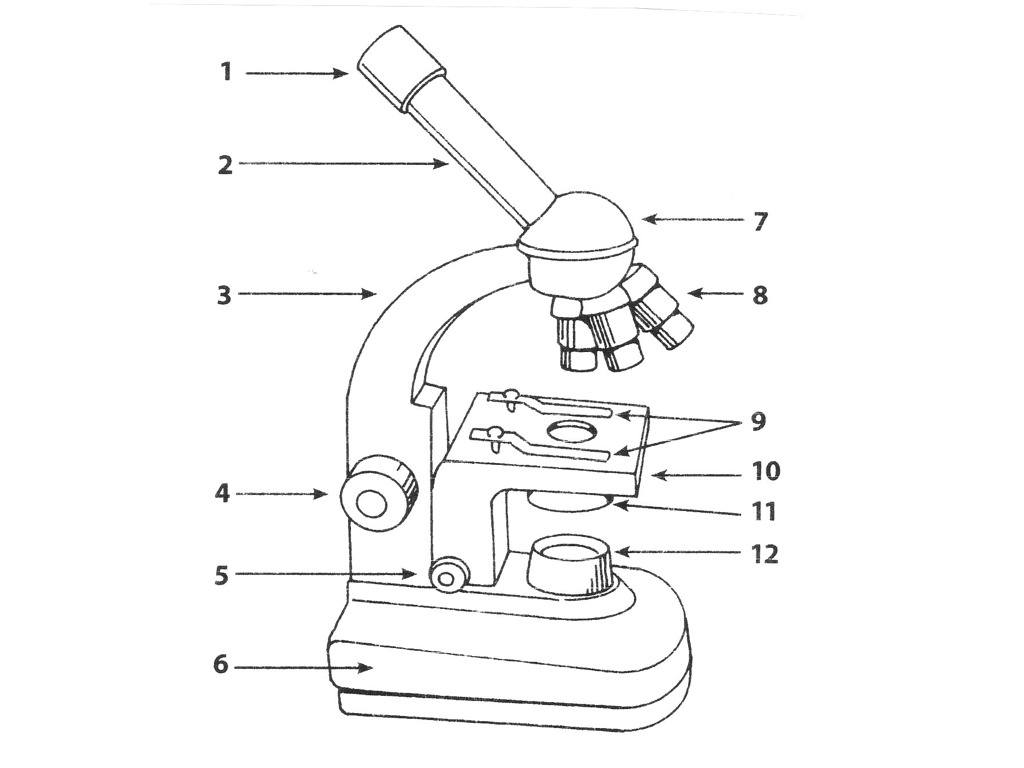
A microscope is an instrument that.
makes faraway objects look closer.
makes small objects appear larger.
decreases the size of small objects.
increases the size of small objects.

When you focus on a new specimen, always begin with
low power and coarse adjustment.
low power and fine adjustment
high power and coarse adjustment
high power and fine adjustment

Piece 7
Ocular Lens
Objective Lens
Base
Arm

piece 8
Base
Stage
Tube
Arm

piece 11
Course Adjustment
Fine Adjustment
Small Adjuster
Large Adjuster
The _______focuses the image under low power.
revolving nosepiece
fine adjustment knob
coarse adjustment knob
arm/neck
Who was the person who used his microscope to observe a thin slice of cork, and concluded that the cork was made up of cells?
Robert Hooke
Bill Nye
Matthias Schleiden
Rudolf Virchow

