Wayground logo

Free Printable Worksheets

Font size

S
M
L
XL
Worksheets

Fossils

Total questions: 32

Worksheet time: 33mins

Name
Class
Date
1.

Where are fossils usually formed?

a)

in rock

b)

in sedimentary rock

c)

in ice

d)

in metamorphic rock

2.

When an organism dies, what two things happen to the soft body parts?

a)

weather and erode

b)

firm up and tighten

c)

decay and eaten by animals

d)

harden and fossilize

3.

A solid copy of the shape of an organism is called?

a)

mold

b)

cast

c)

trace

d)

carbon

4.

A hollow area in sediment in the shape of an organism is called?

a)

cast

b)

mold

c)

trace

d)

carbon

5.

Some of the original wood remains when wood is petrified.

a)

true

b)

false

6.

All living things contain?

a)

bones

b)

hair

c)

skin

d)

carbon

7.

Evidence of the activities of ancient organisms is found in

a)

trace fossils

b)

carbon fossils

c)

petrified fossils

d)

mold fossils

8.

What is NOT learned about an organism in a trace fossil?

a)

its behavior

b)

its shape

c)

where it lived

d)

what it eats

9.

An organism can be preserved by

a)

freezing

b)

being ingested/eaten by another organism

c)

changing over time

d)

trapped in lava

10.

An organism can NOT be preserved by

a)

tar

b)

water

c)

amber

d)

freezing

11.

Scientists who study fossils are called

a)

archeologists

b)

geologists

c)

hydrogeologists

d)

paleontologists

12.

Organisms that have changed over time provide

a)

evidence of the history and past environments on earth

b)

evidence of habits of organisms

13.

An organism that no longer exists on Earth is called

a)

Decayed

b)

Evolved

c)

Extinct

d)

Preserved

14.
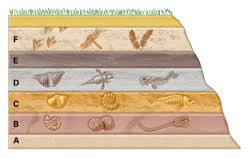
Which rock layer contains the newest fossils?
a)
F
b)
E
c)
B
d)
C
15.
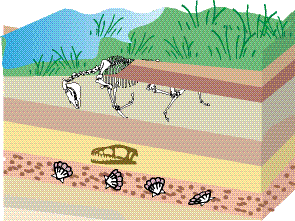
According to the law of superposition, the oldest fossils are found 
a)
At the top of the rock layers
b)
Near the bottom of the rock layers
c)
In the middle of the rock layers
d)
Somewhat near the surface
16.
The best index fossils have which two traits?
a)
widespread geographically, long lifespan
b)
widespread geographically, short lifespan
c)
specific place, long lifespan
d)
specific place, short lifespan
17.
Index fossils help determine relative age through correlating rock layers.
a)
True
b)
False
18.
One of the oldest organisms discovered is called a(n) _________.
a)
dinosaur
b)
micro-organism
c)
trilobite
d)
cast and mold fossil
19.
How old do Paleontologists believe the Earth is?
a)
2015 years old
b)
3.6 billion years old
c)
4.6 billion years old
d)
4.6 million years old
20.
Which of the following organisms formed last on Earth?
a)
Jellyfish
b)
Shark
c)
Lizards
d)
Horses
21.
To be considered an index fossil, it had to have lived for a relatively short period of time.
a)
True
b)
False
22.
Which fossil makes the best index fossil?
a)
Fossil 1
b)
Fossil 2
c)
Fossil 3
d)
None follow all of the rules
23.
Does the picture represent relative or absolute dating?
a)
relative
b)
absolute
24.

What is the best reason that fossil #4 is NOT a good index fossil?

a)

It is not widespread

b)

it is not short-lived (in numerous layers)

c)

It is in half of the outcrops

25.

Of these, which would make the best index fossil?

a)

trilobite

b)

bird

c)

dinosaur

d)

fish

e)

plant

26.
What type of fossil is this?
a)
Mold
b)
Cast
c)
Preserved remains
d)
Trace fossil
27.
Which of the following would NOT help an organism become fossilized?
a)
shell 
b)
skeleton 
c)
buried quickly with sediment 
d)
soft body parts 
28.
this type of fossil provides evidence of the activities of ancient organisms; examples include marks left by footprints or tails
a)
mold
b)
carbon film
c)
trace
d)
cast
29.
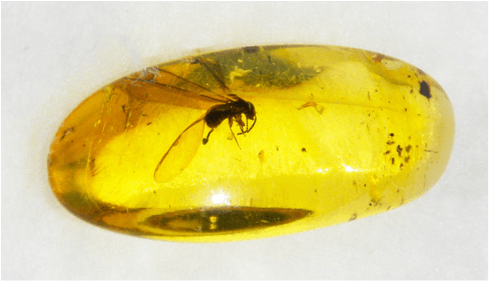
this material does an excellent job of preserving insect remains
a)
cast
b)
amber
c)
mold
d)
carbon film
30.
a scientist who studies fossils
a)
geologist
b)
biologist
c)
paleontologist
d)
chemist
31.

I wish I could be a fossil, then people would really dig me.

a)

Ha

b)

Hahaha

c)

Hahahahahahahahaha

32.

Did you hear about the fossil they just found in South America? It’s like a Brazilian years old.

a)

no, thank you

b)

I don't get it.

c)

Yes, please. More!