wayground logo

Free Printable Worksheets

NEW

Font size

S
M
L
XL
Worksheets

Erosion and Deposition

Total questions: 29

Worksheet time: 15mins

Name
Class
Date
1.

How does wind weather a rock?

a)

The wind slowly drills a hole in the side of a rock.

b)

The wind smashes big rocks against each other.

c)

The wind shakes the big rock and makes it weak.

d)

The wind blows tiny pieces of rock against a big piece of rock. The tiny pieces slowly break the big piece.

2.

How does wind erode rocks?

a)

The wind just leaves the pieces of rock where they are.

b)

When small pieces of rock or sand fall off of a big piece, the wind blows them away and deposits them somewhere else.

c)

Wind does not erode rocks.

d)

The wind turns the sand back into rock.

3.

__________ is created by the removal of silts and clay by the wind, leaving behind a pebbled rocky surface

a)

North Pavement

b)

Desert Pavement

c)

Sand Pavement

d)

South Pavement

4.
____________________ is the most significant form of erosion.
a)
Wind
b)
Water
c)
Waves
d)
Glaciers
5.
What are the agents of erosion?
a)
oxidation, acid rain, abrasion, root rust, root pry, abrasion
b)
deflation and depostion
c)
water, wind, ice, gravity
6.
_____________happens where agents of erosion drop or lay down sediment.
a)
Weathering only
b)
erosion only 
c)
Deposition
d)
compaction only
7.
What causes mass movement?
a)
water
b)
wind
c)
gravity
d)
weather
8.
Which is NOT a type of mass movement?
a)
landslide
b)
slump
c)
mudflow
d)
windstorm
9.
This is a picture of a ____________________
a)
slump
b)
creep
c)
windstorm
d)
mudflow
10.
The slowest type of mass movement is called a _____________________.
a)
slump
b)
creep
c)
landslide
d)
mudflow
11.

_____________ are formed when wave erodes and undercuts rock on the shoreline.

a)

Sea cave

b)

sea stack

c)

headlands

d)

sea cliff

12.

______________ are offshore columns of resistant rock that were once connected to the mainland.

a)

Sea Cliff

b)

Sea Arch

c)

Sea Stack

d)

Sea Cave

13.

A sea cave that cuts completely through the rock is called _____________________________.

a)

Sea Stack

b)

Sea Arches

c)

Headland

d)

Wave Cut Terrace

14.

The finger shaped projects on the side of a sea cliff are called ___________________.

a)

Headlands

b)

Sea Stacks

c)

Wave Cut Terrace

d)

Sea Arches

15.

________________ are streams that flow together to make a river.

a)

source

b)

tributaries

c)

mouth

d)

drainage basin

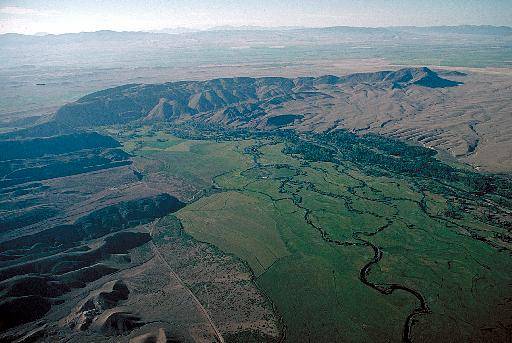
16.

What landform can you see in this picture?

a)

Waterfall

b)

V Shaped Valley

c)

Meander

d)

Ox-bow lake

17.
A tiny groove in soil made by flowing water.
a)
stream
b)
gully
c)
tributary
d)
rill
18.
A large channel in soil formed by erosion.
a)
gully
b)
rill
c)
stream
d)
tributary
19.
A channel through which water is continually flowing downhill.
a)
rill
b)
tributary
c)
stream
d)
gully
20.
The stream that flows into a larger stream.
a)
gully
b)
tributary
c)
stream
d)
rill
21.
Wide valley through which a river flows.
a)
delta
b)
V-shaped valley
c)
flood plain
d)
alluvial fan
22.
A loop like bend in the course of a river.
a)
meander
b)
oxbow lake
c)
alluvial fan
d)
delta
23.
A meander cut off from a river.
a)
alluvial fan
b)
delta
c)
flood plain
d)
oxbow lake
24.
A wide, sloping deposit of sediment formed where a stream leaves a mountain range.
a)
flood plain
b)
delta
c)
alluvial fan
d)
gully
25.
A landform made of sediment that is deposited where a river flows into an ocean or lake.
a)
delta
b)
alluvial fan
c)
flood plain
d)
oxbow lake
26.
Water that fills the cracks and spaces in underground soil and rock layers.
a)
stream
b)
tributary
c)
groundwater
d)
rain
27.
A calcite deposit that hangs from the roof of a cave.
a)
stalagmite
b)
stalactite
28.
A cone-shaped calcite deposit that builds up from the floor of a cave.
a)
stalagmite
b)
stalactite
29.
What is formed on dry land?
a)
an alluvial fan
b)
water pollution
c)
a terrace
d)
delta